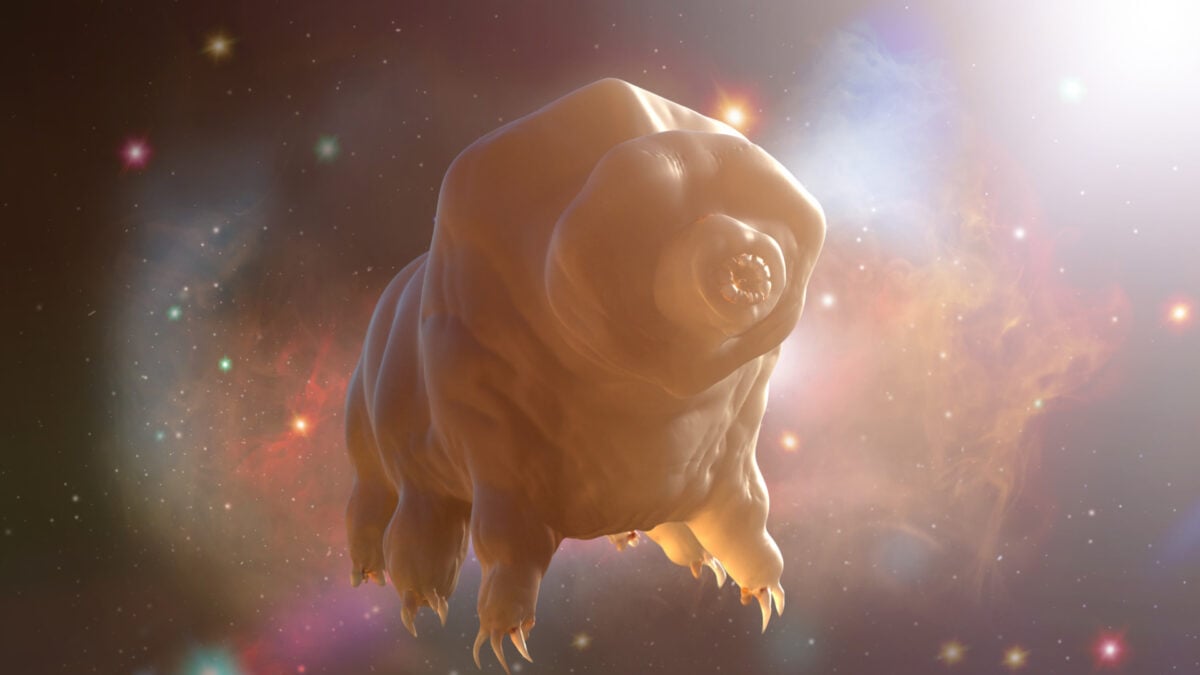
The Unyielding Limits: Scientists Uncover Tardigrades' Kryptonite on Simulated Martian Terrain
For centuries, the enigmatic tardigrade has defied the harshest conditions known to Earth. Now, a groundbreaking study reveals that even these 'water bears' have their breaking point—and it lies beyond our planet.
Earth's Indestructible Marvels: A Brief History of Tardigrade Resilience
Known affectionately as 'water bears' or 'moss piglets', tardigrades have long held a legendary status in the biological world. These microscopic invertebrates, typically less than a millimeter long, possess an unparalleled suite of survival mechanisms. They can withstand extreme temperatures ranging from near absolute zero to over 150°C, survive intense radiation doses thousands of times higher than lethal to humans, endure the vacuum of space, and even recover from complete desiccation by entering a state of suspended animation known as cryptobiosis. For scientists, tardigrades have been the ultimate extremophiles, challenging our very definitions of life and its boundaries.
Their remarkable tenacity has fueled imaginations, suggesting that if life could survive such catastrophic events on Earth, perhaps it could persist in the cosmos, potentially hitchhiking between planets or enduring interstellar journeys. This theoretical invincibility made them prime candidates for astrobiological study, prompting researchers to continuously push the limits of their known endurance.
Beyond Earth's Bounds: The Search for a Weakness
Given their terrestrial invincibility, the logical next step for scientists seeking the tardigrade's true limits was to look beyond our pale blue dot. Mars, with its famously inhospitable surface, presented a compelling challenge. While we know Mars once harbored liquid water and potentially life, its current environment is a brutal combination of thin atmosphere, intense solar and cosmic radiation, extreme cold, and a lack of readily available liquid water. Could the 'water bear' truly survive a trip to, and prolonged exposure on, the Martian surface?
A recent study, highlighted by Gizmodo, delves into this very question. Instead of launching tardigrades into space, which comes with immense logistical challenges and ethical considerations, scientists opted for meticulous laboratory simulations. These simulations were designed to mimic the exact conditions found on the Martian surface, combining multiple stressors that would individually be challenging but, in concert, potentially lethal even for the toughest organisms.
The Martian Crucible: Unveiling the Breaking Point
The experiments involved subjecting tardigrade samples to a meticulously calibrated regimen of Martian-like stressors. This included exposure to the planet's average surface temperature fluctuations, its incredibly low atmospheric pressure, the harsh radiation environment (both UV and cosmic analogues), and prolonged desiccation. While individual tardigrades can famously survive desiccation or extreme cold in isolation, the combination of these factors, sustained over periods mimicking Martian surface exposure, proved to be their undoing.
The crucial takeaway was not that tardigrades are fragile—far from it. Rather, it's the synergistic effect of multiple, simultaneous, and persistent extreme conditions that overwhelmed even their robust biological machinery. The thin Martian atmosphere offers minimal protection from radiation, leading to cellular damage. The pervasive dryness prevents rehydration, a critical step for emerging from cryptobiosis. And while they can survive cold, the constant bombardment combined with lack of recovery resources ultimately proved too much for sustained survival.
Implications for Astrobiology and the Search for Extraterrestrial Life
This discovery carries profound implications for astrobiology. If even tardigrades, the poster children for extreme survival, cannot endure the full brunt of the Martian surface for extended periods, what does this mean for the likelihood of discovering indigenous life there? It reinforces the idea that life, even in its most resilient forms, requires certain fundamental conditions or protective niches to thrive. The Martian subsurface, where radiation is attenuated and water ice might be more stable, still remains a prime target for potential life, but the surface itself appears to be a biological dead end for complex organisms like tardigrades.
Furthermore, it refines our understanding of panspermia, the hypothesis that life can spread between celestial bodies. While a tardigrade might survive a brief, shielded trip through space, sustained exposure on an unprotected, hostile surface like Mars appears untenable. This doesn't rule out microbial life, which has different survival strategies, but it sets a higher bar for multicellular organisms.
The Future of Extremophile Research and Beyond
The study is a testament to the scientific method, highlighting the importance of rigorous simulation in understanding complex biological phenomena in extraterrestrial contexts. Future research will undoubtedly build upon these findings, perhaps exploring different species of tardigrades, varying Martian surface conditions (e.g., specific latitudes, presence of brines), or even examining the survival rates of other extremophilic organisms. The quest to understand the absolute limits of life continues, pushing us closer to answering one of humanity's oldest questions: Are we alone?
While tardigrades may not be truly invincible everywhere, their remarkable adaptations still offer invaluable insights into the resilience of life and the intricate ways organisms adapt to their environments. Their 'kryptonite' on Mars doesn't diminish their wonder; it merely defines the boundary of their extraordinary endurance, a boundary that continues to inform our search for life beyond Earth.