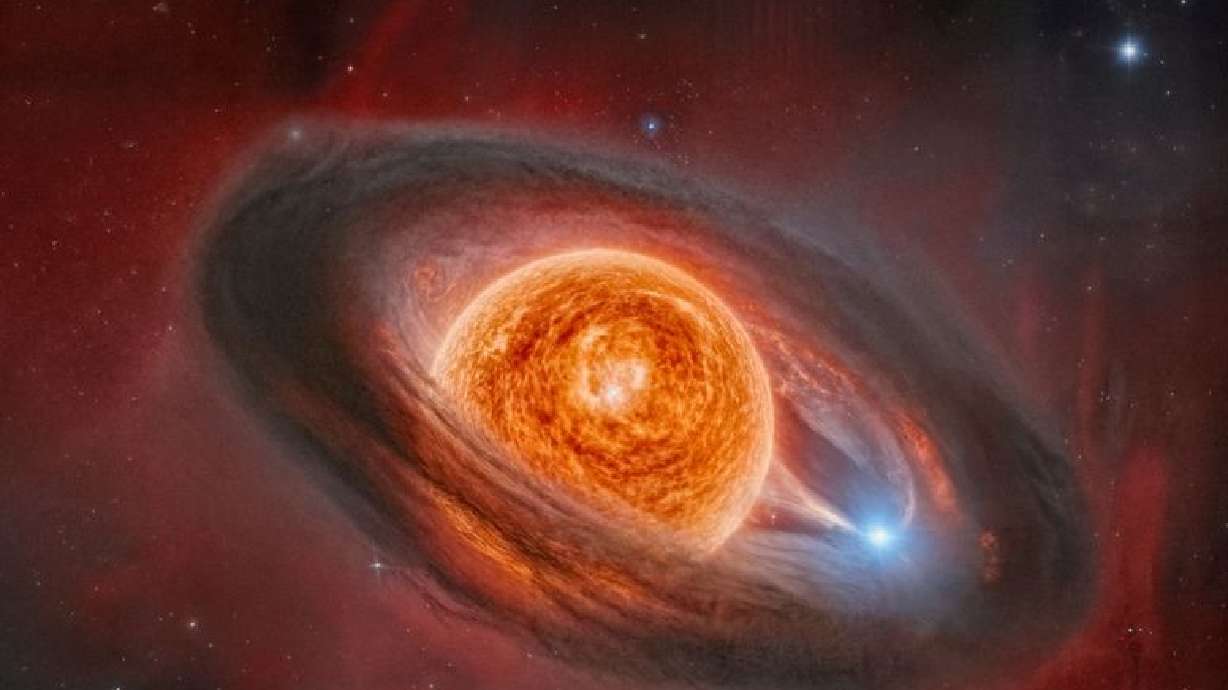
WOH G64: The Cosmic Rock Star Undergoing Dramatic Transformation
In the vast, inky expanse of the universe, certain celestial bodies command attention not just by their immense scale but by their tumultuous, unpredictable lives. Among these titans, one star stands out, likened to a legendary musician whose existence is a blazing, brief, and unforgettable performance: WOH G64. This cosmic behemoth, an ultra-luminous red supergiant located in the Large Magellanic Cloud (LMC), is currently captivating astronomers with dramatic changes that hint at a stellar life lived on the edge, echoing the electrifying intensity of a rock star like Jimi Hendrix.
The Life and Times of a Cosmic Rock Star
The largest stars in the universe are not merely big; they are spectacular engines of cosmic creation and destruction. They are born brilliant, blaze through their hydrogen fuel at an astonishing rate, and meet their end in cataclysmic supernovae, often leaving behind neutron stars or black holes. Their lives, compressed into mere millions of years compared to our Sun's billions, are truly a 'live fast, die young' narrative.
WOH G64 epitomizes this stellar rock star lifestyle. With an estimated radius of nearly 1,500 times that of our Sun, if placed at the center of our solar system, its photosphere would extend past Jupiter's orbit. Its luminosity is hundreds of thousands of times greater than the Sun's, casting a fierce, ultraviolet glow across interstellar distances. These hypergiants are rare, constituting a tiny fraction of the stellar population, yet their importance to astrophysics is immense. They are the primary factories for heavy elements, scattering them across galaxies to seed new generations of stars and planets.
Dramatic Shifts: A Star's Erratic Performance
Recent observations have revealed WOH G64 is undergoing 'dramatic changes.' While the precise nature of these changes—be they fluctuations in brightness, shifts in its spectral signature, or episodic bursts of mass loss—remains a subject of intense research, any significant alteration in a star of this magnitude is cause for considerable scientific excitement. For a star as old and massive as WOH G64, such instability is often a precursor to its eventual, spectacular demise. It's akin to a rock star's legendary, unpredictable stage antics becoming more pronounced in their final years.
Massive stars like WOH G64 are known for shedding vast amounts of material through powerful stellar winds, creating extensive nebulae of gas and dust around them. The LMC, a satellite galaxy of the Milky Way, offers a relatively close-up laboratory to study these processes. If the observed changes relate to an accelerated or more violent mass-loss phase, it could significantly impact our understanding of how these stars evolve and how they enrich their galactic environments. Such events could alter the star's overall structure, its surface temperature, and its outward appearance, providing invaluable data points for stellar models.
Implications for Stellar Evolution and the Universe
The study of WOH G64's dramatic transformation has profound implications for our understanding of stellar evolution. Current models, while robust, still contain uncertainties regarding the final stages of massive star lives, particularly for the most extreme examples. Observations of WOH G64 can help fine-tune these models, allowing scientists to better predict the conditions under which these stars explode as supernovae, what elements they produce, and what remnants they leave behind.
Moreover, understanding the mass loss mechanisms of red supergiants is crucial for comprehending the chemical enrichment of galaxies. The heavy elements forged in the cores of these stars and expelled into space are the building blocks for planets, and ultimately, life itself. By tracking the changes in WOH G64, astronomers gain insight into the cosmic cycle of matter, from stellar birth to death and rebirth.
A Glimpse into the Future
What lies ahead for WOH G64? The dramatic changes suggest it might be nearing the end of its main life sequence, perhaps on the cusp of transitioning into a Wolf-Rayet star before ultimately exploding as a Type II supernova. This would be a cosmic event of unimaginable scale, briefly outshining entire galaxies.
Astronomers will continue to monitor WOH G64 with an array of powerful telescopes, from ground-based observatories to the Hubble and James Webb Space Telescopes. Each new observation will add another verse to the epic ballad of this cosmic rock star, offering unprecedented data on the most extreme stellar phenomena. Its ongoing transformation is a live, unfolding experiment, providing a rare opportunity to witness the final, explosive chapters of a stellar legend.
In the grand cosmic concert, WOH G64 is performing its most intricate and potentially final act. Its dramatic changes are not just fascinating observations; they are critical clues in humanity's quest to understand the fundamental forces that shape our universe, reminding us that even the most colossal and ancient objects in space are constantly evolving, living, and dying in spectacular fashion.