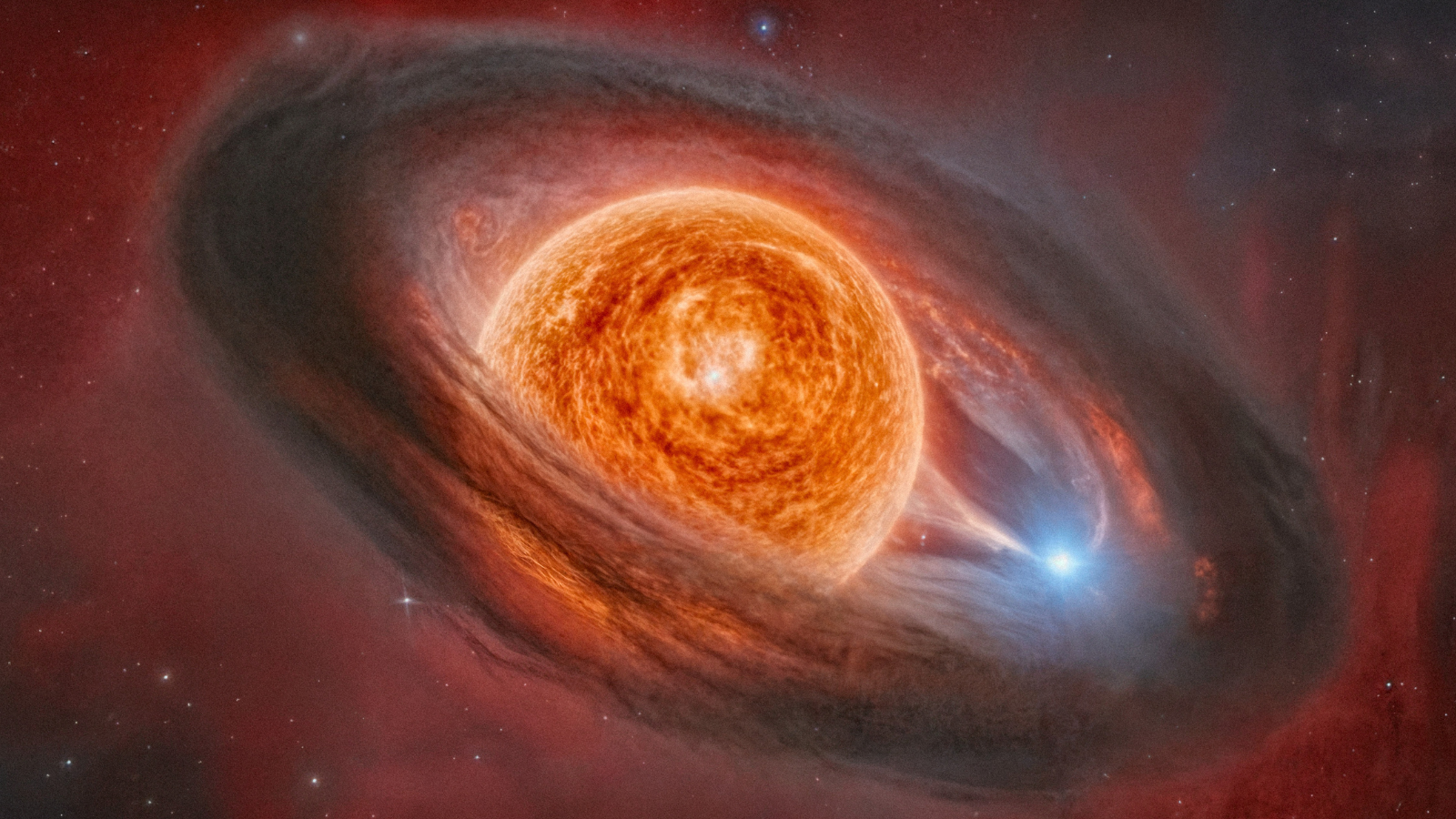
WOH G64: The Cosmic Behemoth Transforming Before Our Eyes – A Supernova Imminent?
In the vast cosmic theatre, where stars live and die in spectacular fashion, astronomers have recently turned their gaze to a celestial leviathan named WOH G64. This colossal star, already an impressive 1,540 times the diameter of our own Sun, has undergone a dramatic transformation, evolving into what scientists classify as a hypergiant. The question reverberating through the astronomical community isn't if it's big, but rather: Is WOH G64 on the precipice of a cataclysmic supernova, or will its majestic but volatile existence continue its uncertain dance?
Understanding the Hypergiant: A Stellar Anomaly
Hypergiants represent the absolute apex of stellar mass and luminosity, pushing the boundaries of what stars can be. Dwarfing even the more common red giants, these stars are characterized by extreme instability, shedding vast amounts of their mass through powerful stellar winds. Imagine our Sun as a grain of sand; WOH G64 would be a massive boulder by comparison. Its recent transition into a hypergiant phase signifies an even more turbulent state, where its immense gravitational forces are in a constant, desperate battle with the outward pressure generated by nuclear fusion within its core.
These stellar titans are exceptionally rare, with only a handful known across the entire observable universe. Their brief, yet incredibly bright, lives make them crucial objects of study for understanding the most extreme processes in stellar evolution and nucleosynthesis.
The Unfolding Drama of WOH G64
Located in the Large Magellanic Cloud, a satellite galaxy of the Milky Way, WOH G64 has long been an object of interest due to its immense size and unusual characteristics. The recent observation of its transformation into a hypergiant isn't just a classification update; it's a direct window into the dynamic and often violent end-stages of a supermassive star's life. This phase is marked by significant changes in its outer layers, often accompanied by increased luminosity variations and dramatic mass loss events.
Astronomers are meticulously monitoring these changes, analyzing spectral data for shifts in elemental composition and temperature, and looking for tell-tale signs of further instability. The data gathered provides invaluable insights into the complex physical mechanisms that govern these gargantuan celestial bodies.
The Supernova Conundrum: A Cosmic Ticking Clock?
The ultimate fate of most stars as massive as WOH G64 is a supernova – a cataclysmic explosion that can briefly outshine an entire galaxy. Hypergiants, due to their extreme mass and the rapid burning of their nuclear fuel, are considered prime candidates for these spectacular deaths. When a star like WOH G64 exhausts its core hydrogen and helium, subsequent heavier elements fuse, but this process becomes increasingly inefficient. Eventually, an iron core forms, which cannot fuse further. Without the outward pressure from fusion, gravity wins, leading to a catastrophic collapse and rebound.
However, the specific timing and even the certainty of a supernova for WOH G64 remain, as the source indicates, "uncertain." Stellar evolution models are complex, and the precise conditions that trigger a supernova can vary significantly based on a star's initial mass, rotation rate, and metallicity. This uncertainty is precisely what makes WOH G64 such a compelling object for ongoing research. It challenges our current understanding and provides a real-time laboratory for testing theoretical predictions.
Peering into the Depths: Observational Astronomy at its Finest
Observing WOH G64, located millions of light-years away, requires cutting-edge astronomical instruments and sophisticated analytical techniques. Telescopes like the Hubble Space Telescope and ground-based observatories equipped with adaptive optics play a crucial role in gathering the light and other electromagnetic radiation emanating from this distant star. By studying its light curve, spectrum, and even its surrounding stellar wind nebulae, scientists piece together its current state and predict its potential future.
Each new observation refines our models, pushing the boundaries of what we know about the most extreme stellar phenomena. The ongoing monitoring of WOH G64 is a testament to humanity's relentless pursuit of knowledge about the universe and our place within it.
Beyond the Explosion: Implications for Cosmic Understanding
Even if WOH G64 never explodes in our lifetime, or indeed, has already exploded and its light is still traveling to us, its study provides profound insights. Supernovas are not just spectacular light shows; they are the primary cosmic factories for heavier elements, scattering them across the galaxy to form new stars, planets, and even life itself. Understanding the precursors to these events, like the hypergiant phase of WOH G64, helps us better comprehend the chemical enrichment of the universe and the origins of everything around us.
The transformation of WOH G64 into a hypergiant serves as a potent reminder of the dynamic, ever-changing nature of the cosmos. It’s a compelling, live-action drama playing out on an unimaginable scale, inviting us to ponder the immense power and fleeting beauty of the stars that illuminate our universe.