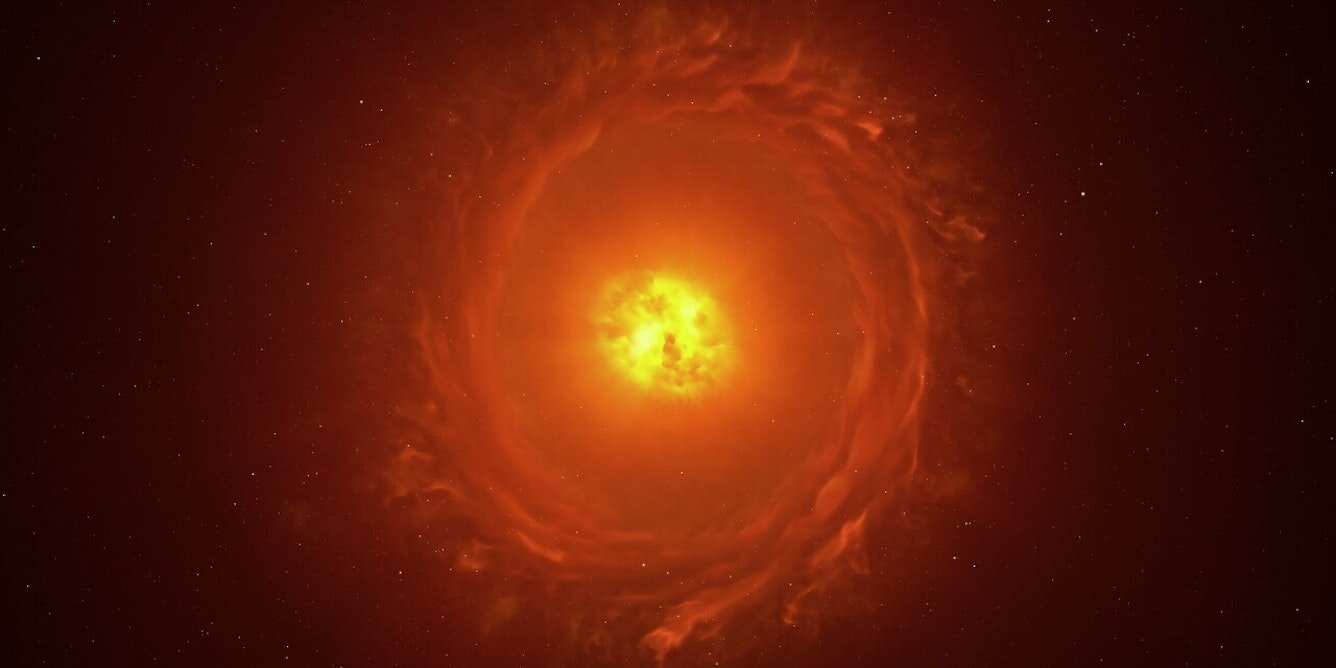
The cosmos, a canvas of endless wonders, periodically reminds us of its immense power and breathtaking drama. A recent study, published in Nature Astronomy and led by Gonzalo Muñoz-Sanchez at the National Observatory of Athens, has ignited the astronomical community with a truly colossal revelation: one of the universe's most massive known stars underwent an unprecedented transformation in 2014 and is now suspected to be on the precipice of a cataclysmic explosion. This isn't just another distant celestial event; it's a potential front-row seat to the ultimate cosmic fireworks – a supernova.
The Anatomy of a Cosmic Giant and its Grand Exit
To understand the gravity of this discovery, we must first appreciate the star itself. We're talking about a supergiant, a true titan dwarfing our Sun by an unimaginable margin. These stellar behemoths live fast and die young, burning through their nuclear fuel at an astonishing rate. While their lives are spectacular, their deaths are even more so. For stars of this magnitude, the end isn't a gentle fading; it's a violent, universe-altering explosion known as a supernova, capable of outshining entire galaxies for a brief period.
The 2014 transformation observed by Muñoz-Sanchez and his team isn't just a minor fluctuation; it's described as "dramatic," hinting at fundamental changes within the star's structure and output. While the exact details of these changes remain under intense scrutiny, such events in supergiant stars are often precursors to a core-collapse supernova. This could involve significant shifts in luminosity, the ejection of vast amounts of stellar material, or even a sudden cooling and expansion of the star's outer layers, signaling a deep internal instability. Astronomers are now actively monitoring for further indicators, such as increased neutrino emissions or a sudden brightening, which would confirm its impending doom.
A Glimpse Into Stellar Mortality: What to Expect
When a supergiant star exhausts its core hydrogen fuel, it begins a complex dance of gravitational collapse and thermonuclear fusion of heavier elements. Eventually, iron forms in the core, a substance that cannot be fused to release energy. At this critical point, the core succumbs to gravity, collapsing in a fraction of a second. This implosion then rebounds off the super-dense core, sending a powerful shockwave outward, ripping the star apart in a glorious supernova explosion.
The observation of a pre-supernova event is incredibly rare and provides an unparalleled opportunity to study the final moments of massive stars. Such an explosion enriches the cosmos with heavy elements – the building blocks of planets, and indeed, life itself – scattering them across vast distances. By catching a star in this vulnerable, transitional phase, scientists can gather invaluable data that refines our understanding of stellar evolution, nucleosynthesis, and the mechanisms driving these cosmic explosions. It's a cosmic laboratory, offering real-time insights into processes that shape the universe.
The Future Implications: Watching a Star Die
While the exact timeline for this star's potential explosion remains unknown – it could be tomorrow, or it could be thousands of years from now in cosmic terms – the discovery has profound implications. It underscores the dynamic nature of the universe and the continuous evolution of its constituents. For astronomers, this star has become a cosmic ticking time bomb, a focal point for powerful telescopes across the globe. The scientific community is poised, eager to capture every fleeting photon from what promises to be one of the most significant astronomical events of our time.
The impending demise of this stellar giant reminds us of the delicate balance between creation and destruction in the universe. Its eventual supernova will not only be a spectacular display but also a profound lesson, offering unprecedented data that will deepen our understanding of the cosmic cycle of life, death, and rebirth. NovaPress will continue to follow this unfolding cosmic drama, bringing you the latest updates from the front lines of astronomical discovery.