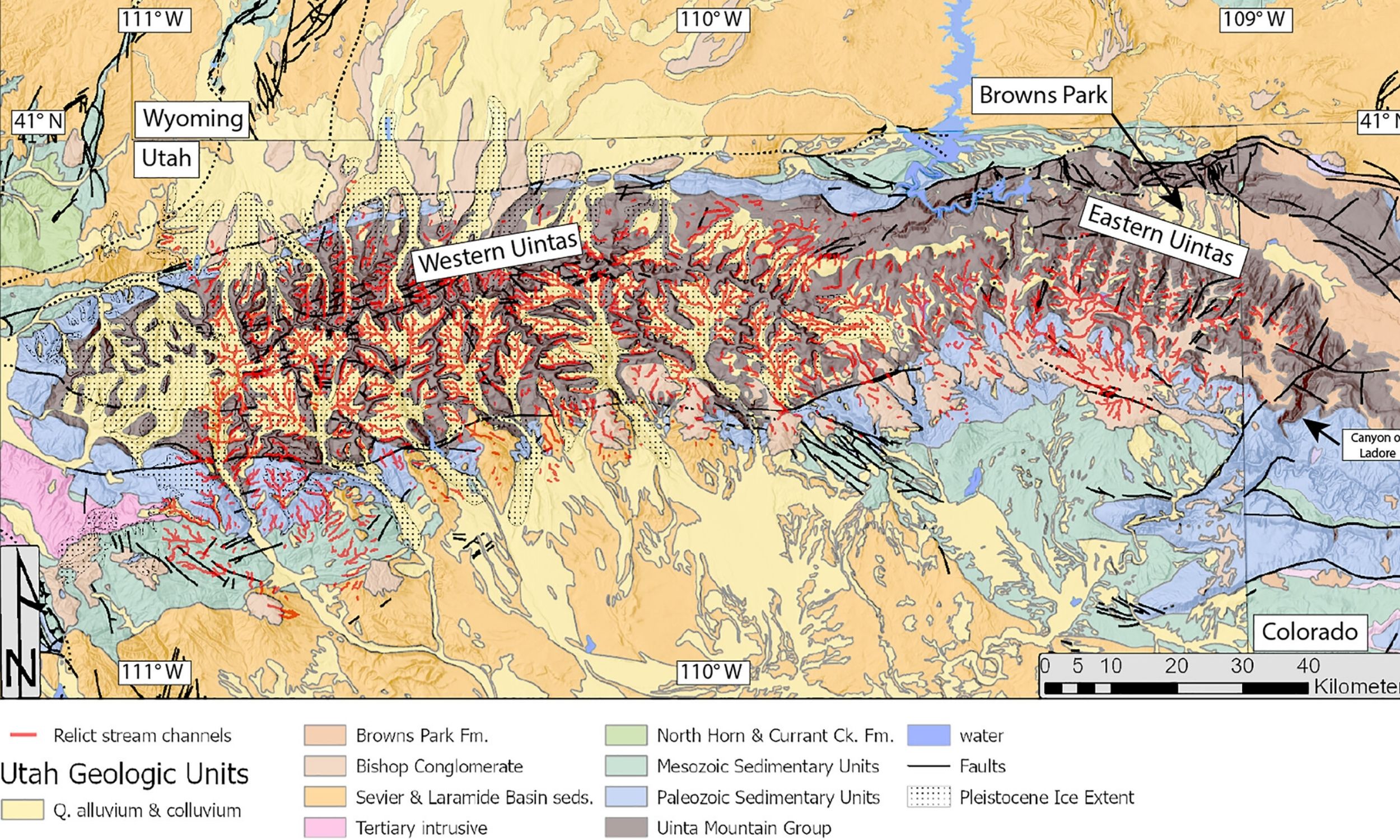
For nearly a century, one of the American West's most peculiar natural wonders has baffled scientists and captivated the imagination: the Green River. This colossal waterway, a major tributary of the Colorado River, performs a feat that seems to defy the very laws of physics, carving its way not around, but directly through towering mountain ranges for roughly 100 miles. It appears to flow uphill, a geological enigma that has long stood as a testament to Earth's profound and often hidden complexities. Now, geologists have finally pulled back the curtain on this long-standing mystery, revealing a breathtaking saga of subterranean shifts and unimaginable erosive power.
A Century-Old Puzzle Solved: When Rivers Seem to Defy Gravity
The notion of a river flowing uphill is, of course, an illusion. Water, invariably, seeks the path of least resistance and flows from higher to lower elevations. Yet, the Green River's journey through formidable mountain ranges, seemingly indifferent to the rising terrain, presented a paradox. Instead of diverting around the mountains, it sliced directly through them, creating some of the most spectacular canyons on Earth. This 'uphill' appearance hinted at powerful forces at play, forces that geologists struggled to precisely identify and explain.
The Illusion of "Uphill" Explained: Antecedent Rivers
The key to understanding the Green River's behavior lies in the concept of an antecedent river. An antecedent river is one that existed *before* the landform (like a mountain range) through which it now flows began to uplift. As the mountain slowly rose, the river, with its relentless erosive power, managed to cut down through the rock at roughly the same rate as the uplift, thereby maintaining its original course. It's not the water flowing uphill, but the land rising around a pre-existing, deeply incised channel.
The Hidden Hand: Tectonic Shifts Beneath the Surface
The recent breakthrough, published by a team of geologists, identifies a specific, dramatic event deep underground as the catalyst for the Green River's impossible path. Their research indicates that a monumental shift beneath the Earth's surface briefly and significantly lowered a section of a mountain range. This temporary subsidence created a gravitational pathway, an initial, low-elevation channel, allowing the Green River to establish its course across what would otherwise have been an insurmountable barrier.
Once the river had entrenched itself into this newly formed, lower-elevation pathway, subsequent geological forces began to uplift the surrounding terrain once more. But by then, the river had gained an immutable advantage. Its persistent flow, laden with abrasive sediments, began to carve downward into the rising bedrock, creating the deep, winding canyons we see today, through mountains that continued to ascend around it.
The American West: A Landscape in Constant, Dynamic Motion
The Western United States, particularly regions like the Colorado Plateau where the Green River flows, is a crucible of geological activity. Shaped by millions of years of plate tectonics, volcanic eruptions, and powerful erosive forces, this landscape is anything but static. The ongoing collision and subduction of tectonic plates, along with complex faulting and regional uplift, contribute to a dynamic environment where mountains rise and fall, and river paths are constantly challenged and redefined. The Green River's story is a vivid illustration of these relentless, slow-motion geological processes.
Broader Implications: Reshaping Our Understanding of River Evolution
This discovery is more than just an explanation for a geographical curiosity; it provides profound insights into the fundamental processes that shape our planet's surface. Understanding how such deep, hidden tectonic shifts can influence surface features like river networks offers new perspectives on:
- River Network Formation: It sheds light on how ancient river systems established their courses and how they can persist through dramatic geological upheaval.
- Landscape Evolution Models: The findings will help refine existing models of landscape development, integrating the role of rapid, localized subsidence events alongside gradual uplift.
- Geological Mapping: It highlights the importance of looking beyond surface features to understand the deeper, subsurface dynamics that drive landform creation.
The Earth's crust is far from uniform, and localized, rapid deformations can have long-lasting impacts on drainage patterns, challenging simplistic views of erosion always following pre-existing topographical lows. The Green River reminds us that the planet is a living, breathing entity, perpetually undergoing transformation.
Conclusion: A Testament to Earth's Enduring Mysteries
The Green River's gravity-defying journey is no longer an unsolvable riddle but a magnificent example of Earth's intricate geological dance. It serves as a powerful reminder of the hidden forces that sculpt our world, and the relentless pursuit of knowledge by geologists who continue to unravel these grand, ancient mysteries, one shifting mountain and one seemingly impossible river at a time. The next time you marvel at a majestic canyon, remember that beneath its visible beauty lies a story millions of years in the making, often involving extraordinary feats of nature that once seemed to defy belief.