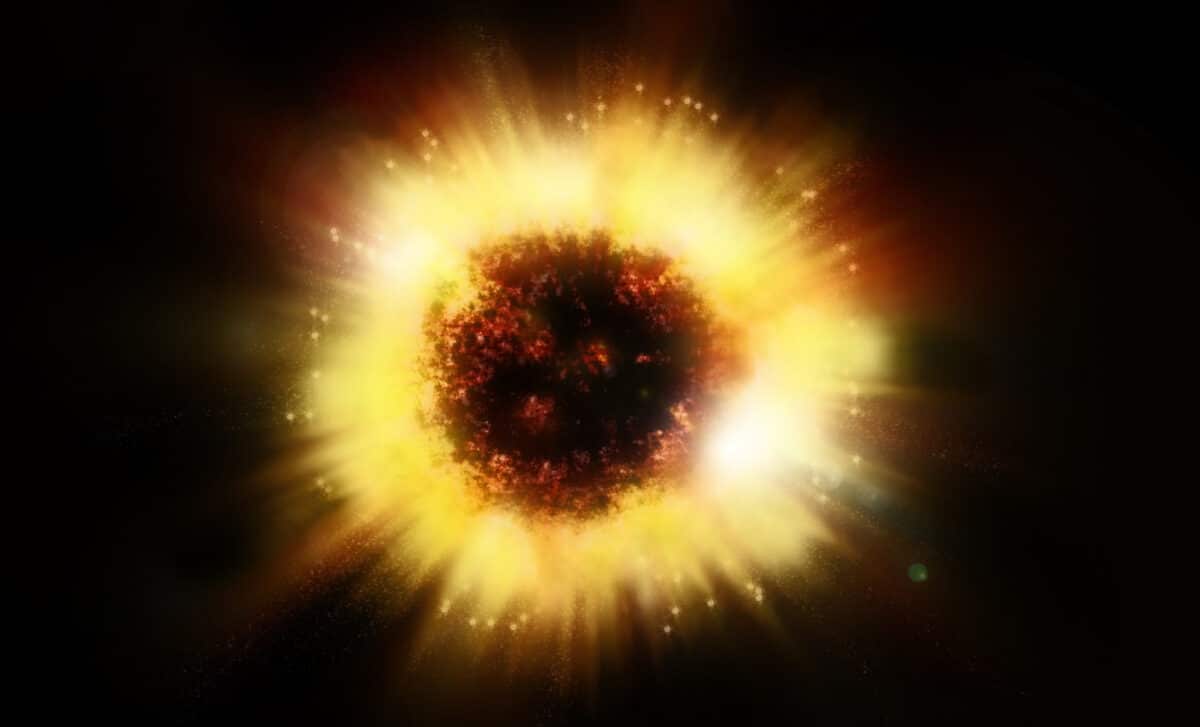
For decades, humanity has grappled with the ultimate fate of our universe, largely settling on a grim, yet distant, conclusion: the Big Freeze. This theory, driven by the mysterious force of dark energy, posited an ever-accelerating expansion, pushing galaxies apart until stars burned out, black holes evaporated, and the cosmos became a vast, cold, dark emptiness. It was an end of solitude and entropy, a slow fade into oblivion.
However, new calculations are challenging this long-held cosmic prophecy, painting a radically different, and perhaps even more dramatic, picture. Far from fading into eternal darkness, our universe might be headed for a cataclysmic collapse – a Big Crunch – and sooner than previously imagined: in a mere 20 billion years.
The Reign of the Big Freeze: A Cosmological Consensus
The Big Freeze, or "Heat Death," became the dominant theory in cosmology with the discovery of dark energy in the late 1990s. Observations of distant supernovae revealed that the expansion of the universe wasn't slowing down due to gravity, as once thought, but was actually accelerating. Dark energy, an enigmatic force constituting roughly 68% of the universe's total energy density, was deemed the culprit, acting as a kind of anti-gravity, pushing space itself apart.
Under this model, the universe would continue to expand, eventually stretching galaxies so far apart that they would be beyond each other's observable horizons. Stars would cease to form, existing stars would exhaust their fuel, and all matter would eventually decay into fundamental particles. The cosmic microwave background radiation would cool to absolute zero, leaving behind a cold, featureless void where nothing ever happens again. It was a bleak, but scientifically coherent, vision of the end.
A Ticking Clock: The Rise of the Big Crunch Theory
The new research, however, suggests that our understanding of dark energy, or its interaction with gravity, might be incomplete. While specific details of these calculations are complex, they fundamentally propose that the universe's expansion, currently accelerating, may not be permanent. Instead, the cosmic expansion could eventually halt and reverse, leading to an inexorable collapse.
The concept of a Big Crunch is not entirely new; it was an early competitor to the Big Freeze before the discovery of dark energy. In this scenario, gravity, rather than dark energy, would ultimately win the cosmic tug-of-war. If the total energy density of the universe were high enough, or if dark energy itself is not a constant but a transient phenomenon, the expansion would eventually give way to contraction.
What Happens in a Big Crunch?
Imagine the universe running in reverse. Galaxies, currently rushing away from each other, would begin to converge. Space itself would contract, bringing all matter closer and closer together. As the universe shrinks, its density and temperature would skyrocket. Stars and galaxies would collide, eventually forming a super-dense, super-hot singularity, much like the inverse of the Big Bang itself.
This dramatic reversal would occur in an incredibly accelerated fashion in its final stages. From our current vantage point, 20 billion years sounds like an eternity, but on a cosmic timescale, it's a relatively swift conclusion. This timeframe implies a dynamic universe where the current accelerating expansion is merely a phase, not a permanent state.
Implications for Cosmology and Our Cosmic Destiny
This shift from a Big Freeze to a potential Big Crunch scenario fundamentally reorients our understanding of the universe's future. It challenges the assumption of dark energy's eternal dominance and opens new avenues for theoretical physics, prompting scientists to revisit the fundamental constants and forces governing the cosmos. Researchers will undoubtedly delve deeper into the nature of dark energy, seeking to understand if it's truly a constant or if its properties can change over vast timescales.
While the prospect of the universe collapsing in 20 billion years might seem alarming, it's a timeline far beyond human civilization's current scope. However, for cosmologists, it offers a thrilling new frontier in the quest to map the universe's entire life cycle. It injects a sense of dynamic purpose back into the cosmic narrative, suggesting an ending that is far from quiet contemplation.
The Unfolding Mystery
Ultimately, the universe's final act remains a profound mystery, an active area of scientific inquiry. The new calculations regarding a Big Crunch serve as a powerful reminder that our understanding of the cosmos is continually evolving. As telescopes peer deeper into space and theoretical models grow more sophisticated, humanity continues its humble yet relentless pursuit of answering the biggest questions: how did it begin, and how will it all end?