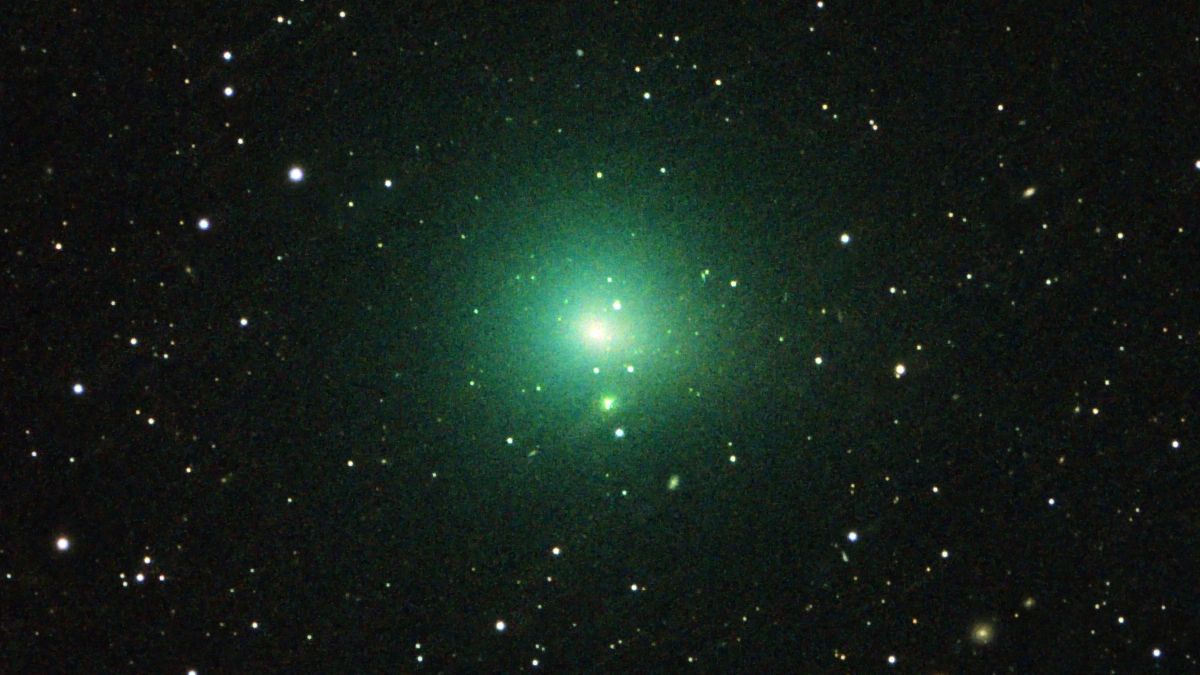
Cosmic Enigma: The Comet That Defied Physics and Reversed Its Spin
In the vast, predictable dance of celestial mechanics, certain events stand out as true anomalies, challenging our fundamental understanding of the cosmos. One such bewildering phenomenon occurred in early 2017, involving a relatively unassuming periodic comet known as 41P/Tuttle-Giacobini-Kresák. After its close approach to the Sun, this icy wanderer did something unprecedented: it completely reversed its rotational spin. This cosmic pirouette has left scientists astonished and sparked a profound re-evaluation of cometary behavior.
The Unseen Event: A Comet's Astonishing U-Turn
Comet 41P/Tuttle-Giacobini-Kresák is a short-period comet, completing an orbit around the Sun approximately every 5.4 years. Its return in 2017 was expected to be routine, a familiar visitor on its well-charted path. However, observations after its perihelion passage revealed something extraordinary. Analysis of its light curve and coma morphology indicated a dramatic and complete reversal of its spin direction. To put this in perspective, imagine a spinning top suddenly, and without external interference, spinning the opposite way. For a celestial body, this is nothing short of revolutionary.
Why is a Spin Reversal So Significant?
Comets are often described as 'dirty snowballs,' remnants from the early Solar System composed of ice, dust, and rock. Their rotation is typically stable, influenced by their initial formation and subsequent encounters. Changes in spin rate can occur due to outgassing—the sublimation of volatile materials forming jets that act like tiny thrusters. However, a *complete reversal* of spin direction implies an incredibly powerful and sustained torque, far beyond what is typically expected from symmetric outgassing.
The stability of a comet's spin is crucial for understanding its long-term evolution, its interaction with solar radiation, and even its potential as a source of material for planets. A sudden reversal challenges our models of cometary physics, suggesting that internal processes or solar interactions are far more dynamic and unpredictable than previously assumed.
Unraveling the Mystery: Hypotheses and Speculations
Scientists are actively developing theories to explain 41P's bizarre behavior. Several leading hypotheses include:
- Asymmetric Outgassing: While typically a slow process, an exceptionally strong, sustained, and asymmetrical jet of gas from a newly exposed patch of volatile ice could theoretically generate enough torque to reverse a comet's spin. This would require specific conditions, perhaps a 'fresh' patch of highly active material suddenly exposed to solar heating.
- Structural Reconfiguration: Comets are not solid, homogenous bodies. They are often porous and fractured. Intense solar heating could cause significant internal changes, perhaps triggering a 'landslide' or collapse of a large section of the nucleus, altering its moment of inertia and producing a sudden, powerful recoil effect.
- Subsurface Pockets of Gas: A rapid release of gas from a large, high-pressure pocket beneath the comet's surface could act like a rocket thruster, significantly altering its rotation. This would be a more explosive and short-lived event but could have profound rotational consequences.
- Tidal Forces and Solar Interaction: While 41P did not pass extremely close to the Sun, the cumulative effect of solar radiation pressure and subtle tidal stresses during perihelion could potentially interact with an already unstable spin state.
Future Implications for Cometary Science
The case of Comet 41P is a stark reminder that our Solar System still holds profound secrets. This spin reversal necessitates a deeper look into the internal dynamics of comets. Future research will likely focus on:
- Advanced Modeling: Developing more sophisticated computer models that can simulate complex outgassing patterns and internal structural changes in response to solar heating.
- Enhanced Observation: Closer, more frequent observations of other comets during their perihelion passages, using adaptive optics and space telescopes to detect subtle changes in rotation.
- Mission Design: Informing the design of future comet missions, such as sample returns or rendezvous missions, emphasizing the need to understand unpredictable changes in cometary dynamics.
The mystery of Comet 41P serves as a testament to the dynamic nature of our universe and the continuous quest for knowledge that drives scientific exploration. As we await 41P's next return, scientists will be watching with bated breath, hoping to catch another glimpse of this enigmatic wanderer and perhaps, finally, unravel the secret of its impossible spin.