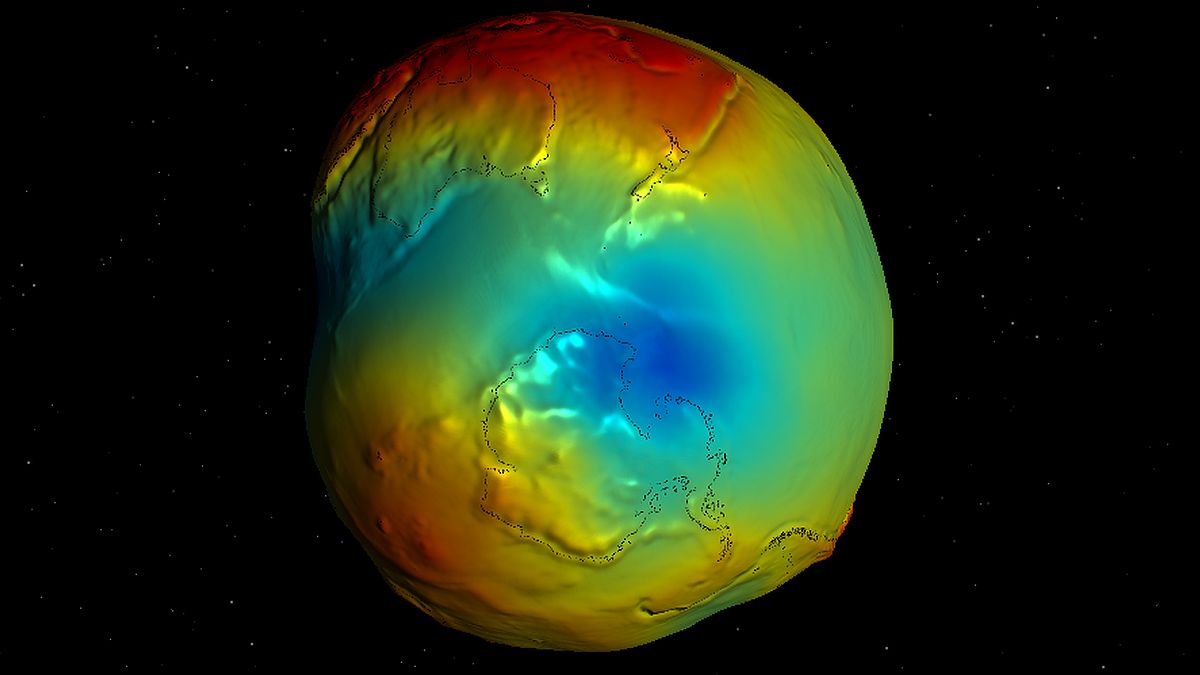
Forget everything you thought you knew about Earth's perfect spherical shape. While our planet might look like a blue marble from space, its gravitational field tells a very different story—one of intriguing bumps and divots, resembling something closer to a misshapen potato. This intricate gravitational landscape is a direct reflection of the uneven distribution of mass deep within our world, and scientists have just revealed a particularly profound mystery intensifying beneath one of its most remote continents: Antarctica.
Earth's Lumpy Gravitational Field: A Window to Its Core
The Earth's gravity isn't uniform across its surface. Factors like the planet's rotation, variations in crustal thickness, mantle convection, and the presence of dense materials (like mountains or massive ice sheets) or less dense regions (like ocean trenches or magma chambers) all contribute to tiny fluctuations in gravity. These 'gravity anomalies' are deviations from a theoretical, smooth gravitational field, providing geophysicists with invaluable clues about what lies beneath our feet.
For decades, satellite missions like GRACE (Gravity Recovery and Climate Experiment) and its successor GRACE-FO have precisely mapped these subtle differences. By measuring minute changes in the distance between two orbiting satellites, scientists can infer where gravity is stronger or weaker, effectively creating a "gravitational map" of the Earth. And it's on this map that Antarctica has been flashing a particularly strong signal.
The Strengthening Anomaly Beneath Antarctica
Deep within the frigid depths of Antarctica, one of the most significant gravitational anomalies on Earth has been identified, and critically, it's not static—it’s getting stronger. This immense concentration of gravitational pull suggests an ongoing geological process of considerable magnitude, far beneath the colossal ice sheets and bedrock. While the exact location is broad, encompassing parts of East Antarctica, its increasing intensity points to dynamic forces shaping our planet's future.
This isn't merely an academic curiosity; it's a geological puzzle piece of epic proportions. The sheer scale and intensification of this anomaly imply significant mass redistribution or active geological processes occurring in the Earth's mantle directly below the continent. Understanding this phenomenon is crucial for deciphering the complex interplay between Earth's internal dynamics, its surface features, and potentially, its climate systems.
Unpacking the Possible Causes
Scientists are exploring several hypotheses to explain the strengthening Antarctic gravity anomaly:
- Mantle Plumes: One leading theory suggests the presence of a superplume—a massive upwelling of hot, buoyant rock from the deep mantle. Such plumes can cause the overlying crust to uplift and thin, and their sheer mass can contribute to gravity anomalies. The strengthening could indicate an accelerating ascent of this material.
- Crustal Dynamics: The weight of Antarctica's vast ice sheets has historically depressed the continent's crust. As parts of these ice sheets melt due to climate change, the underlying land begins to rebound, a process known as glacial isostatic adjustment. While this typically causes a decrease in gravitational pull (as mass moves upwards and spreads), a specific deep-seated anomaly could be interacting with these processes in complex ways, or even be the primary driver if it's related to magmatic intrusion.
- Ancient Subduction Zones and Mantle Structure: The deep Earth retains scars of ancient tectonic activity. Subducted slabs of oceanic crust can remain cold and dense in the mantle for millions of years. Conversely, areas where these slabs have melted or been reabsorbed could lead to localized changes in density. The strengthening anomaly could be linked to changes in these deep structures, possibly an interaction with a hotter, less dense region.
- Magmatic Activity: Increased magmatic activity or the movement of molten rock beneath the continent could also contribute to changes in mass distribution and thus gravity. Antarctica is known to have active volcanoes, though most are under ice.
Implications for Earth Science and Beyond
The deepening mystery of Antarctica's gravity anomaly holds profound implications:
- Understanding Deep Earth Processes: This anomaly is a rare, direct probe into the dynamic processes occurring hundreds, even thousands, of kilometers beneath us. It helps refine our models of mantle convection, the engine that drives plate tectonics and ultimately shapes continents and ocean basins.
- Geological Hazard Assessment: While not directly predictive of earthquakes or volcanic eruptions, a better understanding of deep Earth dynamics improves our overall geological models, which can feed into long-term hazard assessments for other regions.
- Climate Change Connection: The interplay between ice sheet mass loss and crustal rebound is critical for climate models. If deep Earth processes are also significantly contributing to or being influenced by changes in surface mass, it adds another layer of complexity to predicting future sea-level rise and ice sheet stability.
- Satellite Navigation and Measurement: Precise knowledge of Earth's gravity field is fundamental for accurate satellite orbits, which in turn are essential for GPS, telecommunications, and climate monitoring. Anomalies require precise mapping to maintain accuracy.
NovaPress Outlook: The Dynamic Planet
The "potato-shaped" Earth and its strengthening Antarctic gravity anomaly serve as a powerful reminder that our planet is far from a static, perfectly formed sphere. It is a vibrant, constantly evolving entity with deep, powerful forces at play beneath its surface. The ongoing research into this anomaly is not just about mapping bumps and divots; it's about unlocking fundamental secrets of Earth's engine, its past, and its potential future.
As technology advances and new satellite missions provide even finer details, scientists at the forefront of geophysics will continue to peel back the layers of this fascinating mystery, bringing us closer to a complete understanding of the dynamic world we inhabit.