Unveiling the "Emerald Labyrinth": New Mexico's 49-Million-Year-Old Secret Could Redefine Life's Limits
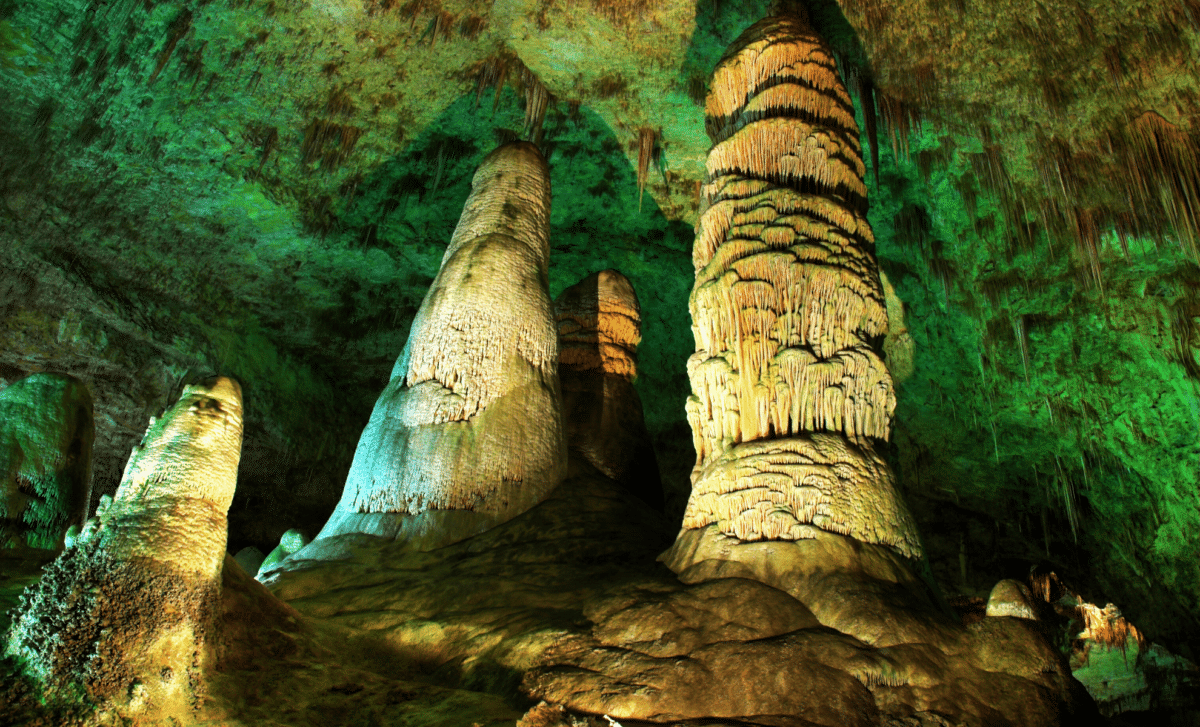
Deep within the sunless, silent chasms of New Mexico, a discovery of monumental proportions has been quietly unfolding. Untouched by human hands or even the breath of surface air for an astonishing 49 million years, a vibrant, inexplicable "bright green wall" has emerged from the primeval darkness. This isn't just another geological curiosity; it's a window into an ancient, isolated world, holding secrets that could fundamentally alter our understanding of life itself, both on Earth and potentially far beyond.
The Accidental Revelation: A Glimpse into Deep Time
The year was 2018 when a team of intrepid scientists, spearheaded by the visionary Dr. Hazel Bart, ventured into one of New Mexico's most remote and least-explored cave systems. What began as a routine geological survey quickly transformed into an expedition of profound biological and astrobiological significance. There, in a chamber so isolated that its atmosphere had remained virtually unperturbed since the Eocene epoch, they encountered it: a vast expanse of rock glowing with an otherworldly, vivid green hue.
Initial observations suggested an unusual mineral deposit, perhaps a rare copper formation. However, the uniformity and distinct vibrance of the color, coupled with preliminary spectroscopic analyses, hinted at something far more organic. The sheer age of the isolation—verified by sophisticated geochronological techniques—places this discovery squarely in the realm of ancient Earth biology, preserved in a time capsule almost beyond comprehension.
A Biosphere Beyond the Sun: What is the Green Wall?
While definitive conclusions are still pending the meticulous analysis of retrieved samples, the leading hypothesis captivating the scientific community is that the "bright green wall" is a living, breathing, albeit incredibly slow-metabolizing, microbial mat. This isn't photosynthesis as we know it; deep-earth extremophiles often thrive through chemosynthesis, deriving energy from inorganic chemical reactions rather than sunlight.
- Extremophile Haven: The cave environment is characterized by extreme pressure, total darkness, stable but low temperatures, and unique geochemistry. These conditions are ideal for specialized microorganisms, often called extremophiles, that have adapted to flourish where other life forms perish.
- Ancient Lineages: If indeed biological, the organisms composing this green wall could represent a lineage utterly isolated from surface life for tens of millions of years. This genetic isolation could reveal novel biochemical pathways, unique evolutionary strategies, and even entirely new domains of life.
- Geobiological Interaction: The green color itself might be a pigment, a chlorophyll-like molecule adapted for minimal light (though unlikely in total darkness) or, more plausibly, a byproduct of unique metabolic processes interacting with cave minerals. The specific composition will be key to unlocking its secrets.
Astrobiological Implications: Redefining the Search for Life
Perhaps the most profound implication of New Mexico's emerald discovery lies in its potential to revolutionize astrobiology. For decades, the search for extraterrestrial life has largely focused on planets with liquid water on their surface and conditions conducive to photosynthesis. However, discoveries like the deep-sea hydrothermal vents and, now, this potential deep-cave biosphere, are shifting paradigms.
The "bright green wall" is a powerful terrestrial analogue for potential life in subsurface oceans of icy moons like Europa (Jupiter) and Enceladus (Saturn), or even within the ancient crust of Mars. If life can persist, isolated and thriving, for 49 million years in the extreme depths of Earth, then the possibility of similar cryptic biospheres existing beneath the harsh surfaces of other worlds becomes not just plausible, but probable.
- Subsurface Habitats: This discovery reinforces the idea that subsurface environments, shielded from radiation and surface extremes, might be the most common refugia for life in the cosmos.
- Metabolic Diversity: Understanding the energy sources and metabolic strategies of these deep-cave organisms could inform the types of biosignatures we should seek in extraterrestrial environments.
- Planetary Protection: The extreme isolation and ancient nature of this environment also raise critical questions about planetary protection and contamination if such life forms were ever brought to the surface or if our probes inadvertently introduced terrestrial microbes to pristine alien environments.
The Road Ahead: Unlocking Ancient Secrets
The scientific journey to fully comprehend the "bright green wall" has only just begun. Researchers, including Dr. Bart's expanded team, are employing a suite of advanced techniques:
- Genomic Sequencing: To map the DNA of any microbial life present, identifying its lineage and unique genetic adaptations.
- Isotopic Analysis: To determine metabolic pathways and energy sources, distinguishing between biological and purely geochemical processes.
- In Situ Monitoring: Long-term deployments of sensors within the cave to track environmental parameters and any subtle biological activity without disturbing the delicate ecosystem.
The ethical considerations are also paramount. Scientists are working with extreme caution to avoid contaminating this pristine, ancient environment, ensuring that the act of discovery does not lead to the destruction of its unique biological heritage.
Conclusion: A Universe Teeming with Possibility
New Mexico's "bright green wall" is more than just a scientific curiosity; it's a profound statement about the tenacity and adaptability of life. It challenges our preconceptions, urging us to look beyond the familiar and to consider the myriad ways life might find a foothold in the most unlikely of places. As Dr. Bart's team continues to unravel its 49-million-year-old mystery, the emerald labyrinth promises to illuminate not just our planet's hidden depths, but also the vast, unexplored potential for life across the cosmos. The universe, it seems, is far more alive, and in far stranger ways, than we ever dared to imagine.