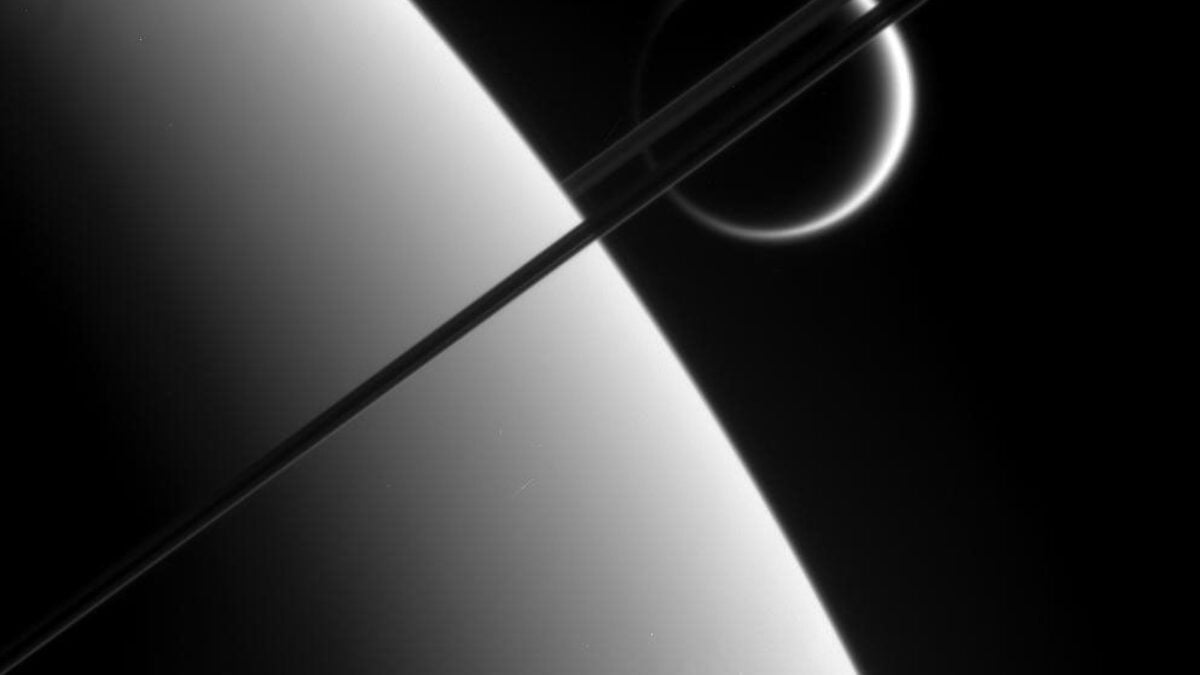
The Violent Genesis of Saturn's Rings: New Study Pinpoints a Cataclysmic Collision
Saturn, the jewel of our solar system, has long captivated humanity with its mesmerizing rings and a retinue of 274 moons. These rings, an emblem of cosmic beauty, have also been a profound astrophysical enigma. For decades, scientists have debated their origin and age. Now, compelling new research has reignited a dramatic theory, proposing that Saturn's iconic ring system is not as ancient as previously thought, but rather the spectacular aftermath of a violent, two-moon collision approximately 100 million years ago.
A Universe of Theories: Before the Impact
Prior to this new study, theories ranged from the rings being pristine remnants of the early solar system’s formation, billions of years old, to being the shredded remains of a comet or asteroid captured by Saturn's immense gravity. The sheer scale and relative thinness of the rings, composed predominantly of water ice particles, posed significant challenges to these hypotheses. Their "youth" — geologically speaking — has always been a contentious point, with some estimates placing their age at just a few tens of millions of years, a mere blink in cosmic time.
The Cataclysmic Proposal: Two Moons Collide
The latest research, drawing on sophisticated simulations and data from missions like Cassini, lends substantial weight to the idea of an ancient, cosmic demolition derby. The central premise is that roughly 100 million years ago, two of Saturn’s icy moons, perhaps similar in composition and size to present-day Tethys or Dione, found themselves on a collision course. This wouldn't have been a gentle graze, but a destructive, high-energy impact, shattering both bodies into countless fragments.
What makes this scenario particularly compelling is its ability to explain several observed characteristics of the rings. The theory posits that the debris from this collision, instead of re-accreting into new moons, was then subjected to Saturn's powerful tidal forces. These forces prevented the fragments from coalescing, instead spreading them out into the thin, broad disk we observe today. The predominantly icy composition of the rings aligns perfectly with the destruction of ice-rich moons, and the relatively young age of the rings—inferred from their pristine appearance and low dust content—fits the proposed timeline of 100 million years.
Unraveling the Dynamics: Orbital Instability and Formation
For such a collision to occur, a period of orbital instability would likely have preceded it. Gravitational interactions, possibly from other large moons or even a slightly different configuration of Saturn's system, could have perturbed the orbits of these two ancient moons, pushing them towards a fatal encounter. The simulations show that the energy released from such an impact would have been sufficient to disperse a vast amount of material into orbit around Saturn, with the smaller, faster-moving particles gradually settling into the distinct ring structure due to complex gravitational resonances and self-gravity.
The rings' distinctive gaps and divisions, carved out by the gravitational influence of Saturn's inner moons, would then have evolved from this initial chaotic debris field. This dynamic process highlights how planetary systems are not static but are continuously shaped by violent and transformative events.
Implications for Planetary Science and Beyond
This new research has profound implications beyond just Saturn. If Saturn's rings are indeed a recent, catastrophic byproduct of moon collisions, it suggests that such dramatic events might be more common in giant planet systems than previously thought. It could prompt a re-evaluation of the origins of other planetary ring systems, such as those around Uranus and Neptune, which are far less prominent but equally enigmatic.
Furthermore, understanding the mechanism of ring formation through moon collisions could offer insights into the early, more chaotic phases of our solar system's development, when impacts were far more frequent. It reminds us that the beauty we see in the cosmos often has its roots in incredible violence and destruction, followed by aeons of gravitational sculpting.
The Enduring Mystery
While this new study provides a compelling narrative for the origin of Saturn's rings, it also opens new avenues for inquiry. Future missions and advanced observational techniques will be crucial to gather more data, refine models, and potentially uncover direct evidence of this ancient cosmic collision. The rings of Saturn, once seen as timeless, now tell a story of dramatic recent history, inviting us to look deeper into the dynamic and often violent processes that sculpt our universe.