Beyond the Light: Unraveling the Cosmic Puzzles Only Dark Matter Can Explain
In the grand tapestry of the cosmos, what we perceive as 'real' – the stars, galaxies, planets, and nebulae – constitutes a mere fraction of existence. An astonishing 85% of the universe's mass remains shrouded in mystery, an invisible entity we've dubbed dark matter. This enigmatic substance doesn't interact with light in any discernible way; it neither absorbs, emits, nor reflects. Yet, its gravitational fingerprints are everywhere, dictating the very structure and dynamics of the universe. For cosmologists, dark matter isn't just a hypothesis; it's a profound necessity, the only coherent explanation for some of the most perplexing phenomena observed across billions of light-years.
The Universe's Invisible Anchor: What is Dark Matter?
Imagine a vast cosmic ocean where only 15% of the water is visible, yet currents and tides suggest an overwhelming presence of something unseen. This analogy captures the essence of dark matter. It's a type of matter that doesn't interact with the electromagnetic force, meaning it doesn't emit or reflect light and is therefore utterly invisible to telescopes. Its existence is inferred purely through its gravitational effects on visible matter and spacetime. Without it, our understanding of galactic formation, cosmic structure, and even the fate of the universe crumbles.
Gravitational Anomalies: The Unseen Force at Play
The compelling case for dark matter stems from a series of observations that defy explanation by ordinary (baryonic) matter alone. These cosmic paradoxes suggest an overwhelming amount of non-luminous mass exerting a gravitational pull:
1. Galaxy Rotation Curves: Spinning Too Fast
One of the earliest and most robust pieces of evidence emerged from observing how galaxies rotate. Stars at the outer edges of spiral galaxies orbit at speeds far too great to be held in by the gravitational pull of the visible matter within the galaxy's disk. Newtonian mechanics dictate that stars further from the galactic center should slow down, much like planets further from the Sun. Instead, they maintain consistently high velocities, suggesting a massive, invisible halo of dark matter surrounding and permeating the galaxy, providing the extra gravitational glue.
2. Gravitational Lensing: Bending Light from Nothing
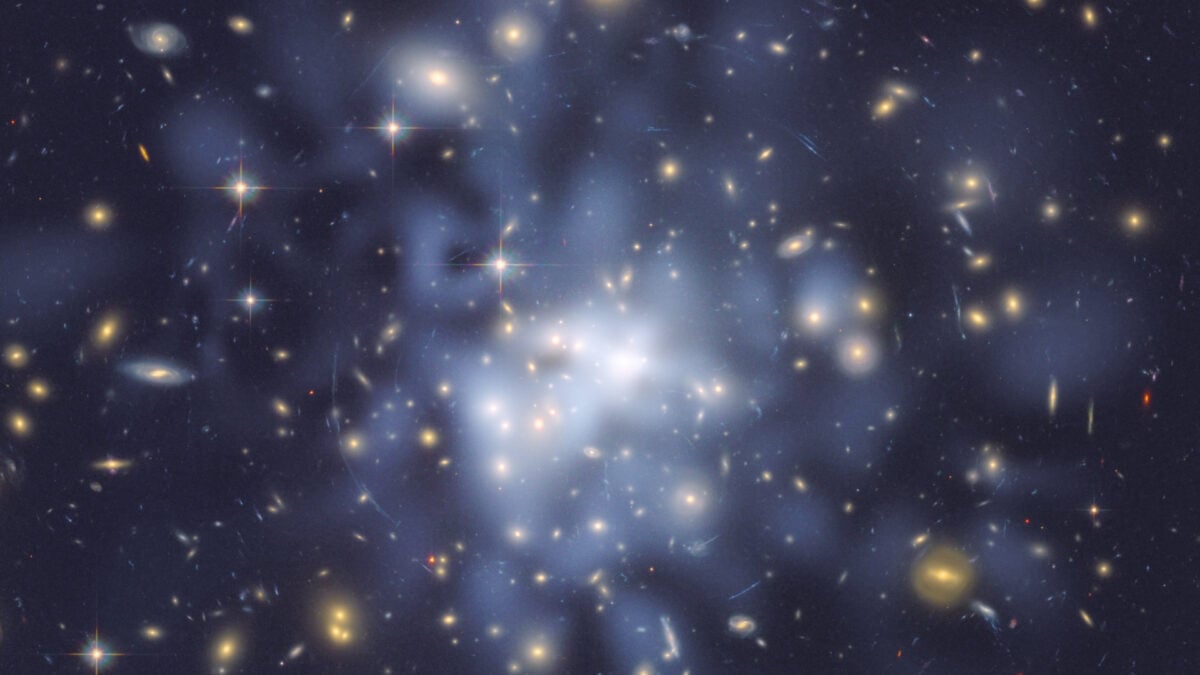
Einstein's theory of general relativity predicts that massive objects bend the path of light. This phenomenon, known as gravitational lensing, allows astronomers to observe distant galaxies whose light has been warped and magnified by massive foreground objects. Crucially, studies of gravitational lensing, particularly around galaxy clusters, reveal far more mass than can be accounted for by the visible galaxies and hot gas. This 'extra' mass, which bends light but doesn't emit it, is consistent with vast quantities of dark matter.
3. Cosmic Microwave Background (CMB): Seeds of Structure
The Cosmic Microwave Background is the afterglow of the Big Bang, a snapshot of the universe when it was just 380,000 years old. Tiny temperature fluctuations in the CMB provide crucial clues about the early universe's composition and initial conditions. The observed patterns and anisotropies in the CMB are remarkably well-explained by models that include a significant component of cold dark matter, which provided the gravitational scaffolding for the large-scale structures we see today – galaxies and galaxy clusters – to form and coalesce.
4. Large-Scale Structure Formation: The Cosmic Web
The universe isn't a uniform soup of galaxies; it's structured in a vast 'cosmic web' of filaments, clusters, and voids. Simulations of how such large-scale structures could have formed from the initial fluctuations in the early universe consistently require the presence of dark matter. Without its non-interacting gravitational pull, visible matter would not have had enough time or gravitational strength to clump together into the enormous structures observed today.
The Hunt for the Invisible: What's Next?
Despite the overwhelming observational evidence for its existence, dark matter has yet to be directly detected. Scientists around the globe are engaged in an intensive search, using a variety of cutting-edge experiments:
- Direct Detection Experiments: Deep underground laboratories house highly sensitive detectors designed to observe the rare interactions between dark matter particles and ordinary atomic nuclei.
- Indirect Detection Experiments: Telescopes in space and on Earth search for tell-tale signatures of dark matter annihilation or decay, which could produce gamma rays, neutrinos, or cosmic rays.
- Particle Accelerators: Experiments like the Large Hadron Collider attempt to produce dark matter particles in high-energy collisions, though this is challenging given current theoretical models.
The leading candidates for dark matter particles include WIMPs (Weakly Interacting Massive Particles) and axions, though many other theoretical possibilities are being explored. Each null result refines our understanding, pushing the boundaries of what dark matter could be.
Implications and the Future of Cosmology
The quest for dark matter is more than just a search for an elusive particle; it's a fundamental pursuit to understand the true nature and composition of our universe. A direct detection would revolutionize physics, opening new avenues for understanding fundamental forces and particles beyond the Standard Model. It would cement our current cosmological model, or perhaps, if it deviates, force a radical rethinking of gravity itself. Until then, dark matter remains the universe's most compelling enigma, an unseen architect shaping the cosmos, beckoning humanity to delve deeper into its profound mysteries.