The Hidden Ocean: Earth's Core Unveils a Staggering Store of Hydrogen
For generations, scientists have probed the mysteries beneath our feet, largely envisioning Earth's scorching core as a dense, metallic realm dominated by iron and nickel. Water, or its fundamental components, seemed an unlikely inhabitant of this extreme environment. Yet, a groundbreaking revelation is set to rewrite our understanding of planetary composition: Earth's core may harbor an astonishing 45 times the amount of hydrogen found in all the world's oceans combined. This discovery, highlighted by KSL News, isn't just a fascinating geological tidbit; it represents a profound shift in how we perceive the deep Earth, with far-reaching implications for everything from planetary formation to the very dynamics of our magnetic field.
Challenging Conventional Wisdom: A New View of the Core
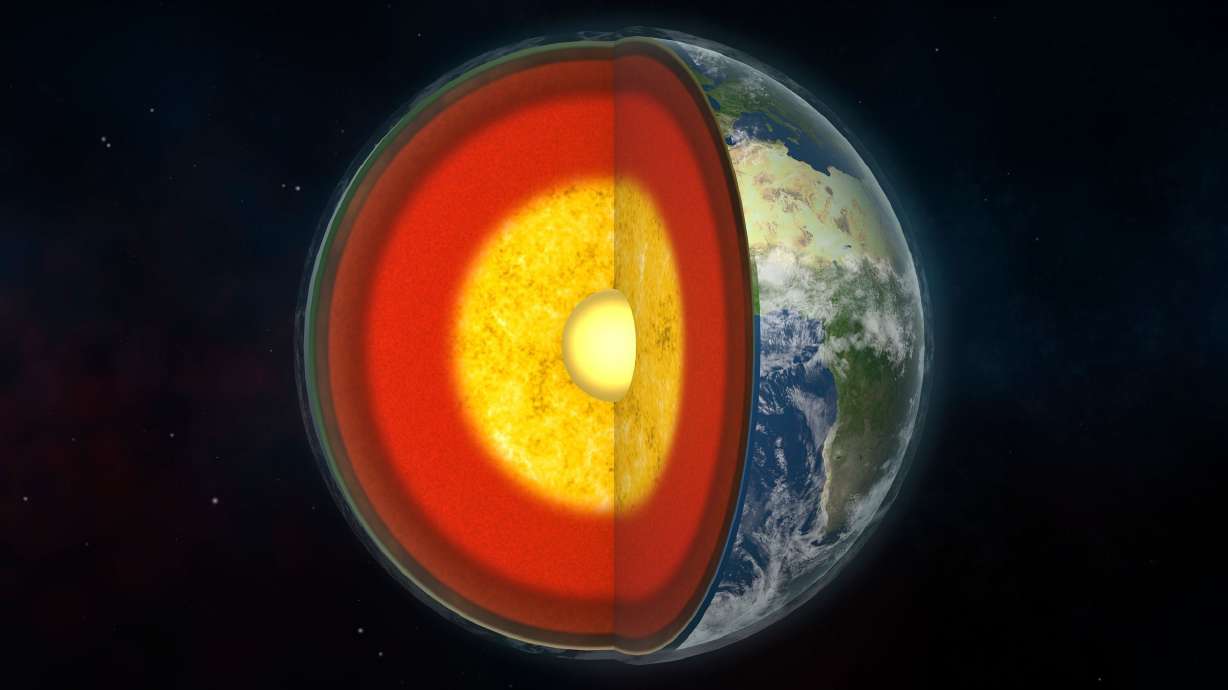
Traditionally, our model of Earth’s interior depicts a solid inner core and a liquid outer core, primarily composed of an iron-nickel alloy. While minor light elements like sulfur, oxygen, carbon, and silicon have long been suspected to be present, hydrogen was largely dismissed due to its volatile nature and the extreme pressures and temperatures of the core, which were thought to expel such light elements to the mantle and crust.
The sheer scale of this new estimate — equivalent to 45 Earth oceans' worth of hydrogen — forces a radical re-evaluation. To put this into perspective, consider that Earth's oceans cover approximately 70% of the planet's surface and contain a colossal amount of H2O. Now imagine multiplying the hydrogen content of that entire hydrosphere by forty-five and confining it within the innermost reaches of our planet. This isn't hydrogen in its familiar gaseous or liquid form, but rather deeply integrated within the metallic structure of the core, likely forming iron hydrides or existing as a metallic hydrogen solution under unimaginable pressures.
The Science Behind the Revelation
This audacious claim isn't based on direct sampling, which remains impossible given the extreme depth. Instead, it stems from a confluence of advanced computational modeling, high-pressure laboratory experiments mimicking core conditions, and sophisticated analyses of seismic wave propagation through the Earth. Scientists simulate the behavior of various elements under the tremendous pressures (millions of atmospheres) and temperatures (thousands of Kelvin) found in the core. These simulations suggest that hydrogen, far from being excluded, can stably dissolve into iron and form distinct compounds under such conditions.
Furthermore, subtle discrepancies between observed seismic wave velocities in the core and predictions based solely on an iron-nickel alloy have long hinted at the presence of lighter elements. Hydrogen, with its extremely low atomic mass, offers a compelling candidate to explain these geophysical anomalies, impacting density and acoustic properties in ways that align with the new models.
Profound Implications for Our Planet and Beyond
Reshaping Planetary Formation and Evolution
The presence of such vast quantities of hydrogen in the core challenges existing theories on how Earth formed and evolved. It suggests that hydrogen-rich materials might have been incorporated into our planet's building blocks during its accretion phase, or that significant amounts of hydrogen, perhaps from primordial water, were transported to the core early in Earth's history, rather than being degassed to the surface or remaining solely in the mantle.
Understanding Earth's Geodynamo
The liquid outer core's convective motion generates Earth's protective magnetic field. The composition of this fluid directly influences its density, viscosity, and electrical conductivity – all critical parameters for the geodynamo. A significant hydrogen content could alter these properties, refining our models of how the magnetic field is sustained and how it has varied throughout geological time. It might even offer new insights into episodes of magnetic field reversal.
Implications for Exoplanets and Habitability
If Earth's core can sequester such immense amounts of hydrogen, what does this mean for other rocky planets? This finding opens up the possibility that other planets, potentially even "super-Earths" or "water worlds," could have vastly different deep interiors than previously assumed, impacting their internal dynamics, thermal evolution, and even their potential for hosting life via their magnetic fields and crustal processes.
The Road Ahead: Unanswered Questions
While revolutionary, this discovery raises more questions than it answers. How did the hydrogen get there? What exact chemical forms does it take under core conditions? Does it participate in core convection? And what are its precise effects on the core's physical properties? Future research will undoubtedly focus on refining these models, conducting more intricate high-pressure experiments, and developing new geophysical techniques to indirectly probe the core's elusive chemistry.
The revelation of Earth's "hidden ocean" of hydrogen fundamentally reconfigures our understanding of planetary interiors. It underscores the dynamic and surprising nature of our own world and reminds us that even at the planet's very heart, profound mysteries await discovery, continuously challenging and expanding the frontiers of scientific knowledge.