Earth's Deep Secret: How 45 Oceans' Worth of Hydrogen Reshapes Our Planet's Story
For generations, scientists have debated the origins of Earth's vast oceans, fundamental to life as we know it. Was our water delivered by icy comets from the far reaches of the solar system, or did it emerge from within the planet itself? A groundbreaking new study suggests a revolutionary answer: the latter, to an astonishing degree. Researchers have found that Earth’s core may harbor an immense reservoir of hydrogen – an amount equivalent to a staggering 45 times the total hydrogen contained in all our surface oceans.
Unveiling the Core's Hidden Depths
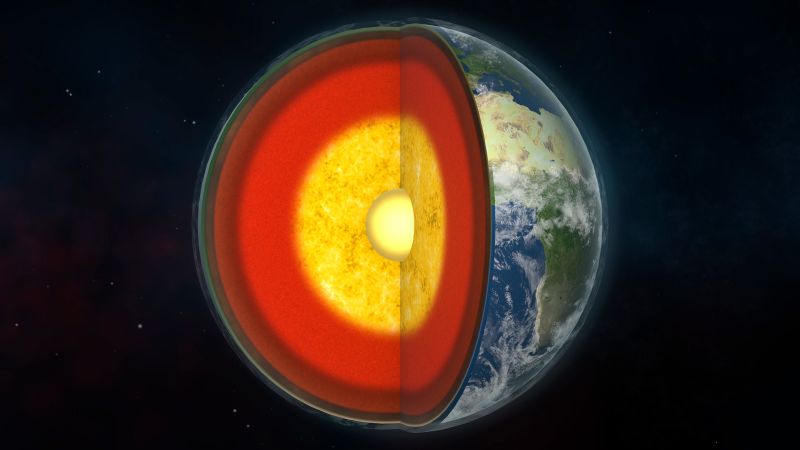
Our understanding of Earth’s interior has long depicted a layered structure: a thin crust, a silicate mantle, and a dense, iron-nickel core. While the core is known for its extreme temperatures and pressures, and its role in generating our protective magnetic field, its composition has largely been assumed to consist primarily of heavy metallic elements. The notion of light elements like hydrogen existing in such quantities at the planet's heart is, quite frankly, paradigm-shifting.
The research, likely relying on sophisticated seismic wave analysis, high-pressure experimental simulations, and advanced computational modeling, probed the properties of materials under conditions mimicking the core. By observing how seismic waves travel through the Earth, scientists can infer the density and composition of different layers. Anomalies in these observations, combined with laboratory tests showing how hydrogen can bind with iron under immense pressure, painted a picture of a core far more complex and hydrogen-rich than previously imagined.
To put this into perspective, imagine all the oceans covering 70% of our planet. Now, picture the hydrogen within them – the very building blocks of water. The study suggests multiplying that colossal amount by nine to grasp the scale of hydrogen potentially locked within the core. This isn't just a minor tweak to existing models; it's a fundamental re-evaluation of our planet's intrinsic chemistry.
Rewriting the Origin Story of Earth's Water
Perhaps the most profound implication of this discovery lies in its impact on the long-standing debate about the origin of Earth’s water. The prevailing theories have often leaned towards an extraterrestrial delivery mechanism, where comets and asteroids, rich in ice, bombarded the early Earth, gradually filling its basins. While these impacts undoubtedly contributed, the presence of such a vast internal hydrogen reservoir suggests that a significant, if not dominant, portion of Earth's water was present from the very beginning – incorporated during the planet's tumultuous formation.
This shifts the narrative: instead of water being an external delivery, it becomes an inherent component, sequestered deep within the nascent planet's core as it accreted from the protoplanetary disk. This primordial water would have been stored under immense pressure and temperature, slowly cycling and interacting with the mantle over billions of years, eventually making its way to the surface through volcanic activity and degassing.
Implications for Planetary Science and Beyond
The ramifications extend far beyond just water. This discovery compels a re-evaluation of fundamental processes in planetary science:
- Planetary Formation Models: How did light elements like hydrogen get incorporated into the core of a growing planet? This suggests a more complex chemistry during the accretion phase, potentially involving metallic melts interacting with hydrogen-rich nebular gas. It could also influence our understanding of the density and thermal evolution of early Earth.
- Geodynamics and the Geodynamo: Hydrogen, being a light element, would subtly alter the density and viscosity of the outer core. This could have significant implications for the convective currents that drive Earth’s magnetic field (the geodynamo). A less dense, more dynamic outer core might affect the strength, stability, and reversals of the magnetic field over geological timescales.
- Deep Earth Cycles: The presence of hydrogen in the core suggests a vast, previously unaccounted-for reservoir that could interact with the overlying mantle. This opens up new avenues for understanding deep-Earth cycles of volatile elements, potentially influencing mantle plumes, volcanism, and plate tectonics in ways we are only beginning to comprehend.
- Exoplanet Habitability: If Earth can naturally incorporate such vast amounts of water-forming elements during its formation, what does this mean for other rocky exoplanets? This discovery could broaden the scope of what we consider "habitable" or "water-rich" worlds, suggesting that water isn't just a surface phenomenon but an intrinsic planetary property.
The Road Ahead
While compelling, this research represents a significant step rather than the final word. Future studies will need to refine the estimates of hydrogen quantity, explore its exact chemical state within the core, and investigate the mechanisms by which it was incorporated and how it might interact with other core elements. Direct sampling of the core remains an impossibility, but advancements in seismic tomography, neutrino detectors, and ever more sophisticated high-pressure physics will continue to peel back the layers of Earth's ultimate mystery.
The finding that our planet's core may be a colossal hydrogen repository is a testament to the ongoing revelations about our home world. It reminds us that even after centuries of scientific inquiry, Earth continues to hold profound secrets, secrets that, when unveiled, can fundamentally alter our perception of where we come from and what makes our planet truly unique.