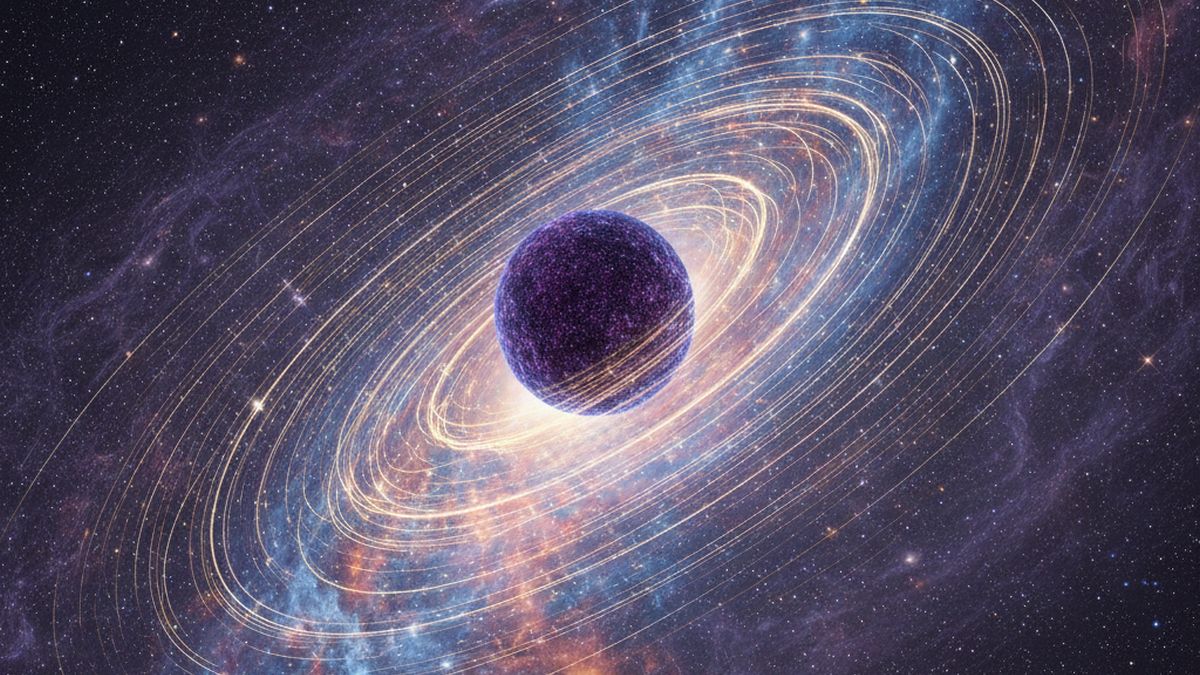
Beyond the Event Horizon: Is Something More Enigmatic Than a Black Hole Hiding at the Galactic Core?
For decades, our understanding of the Milky Way's heart has been dominated by one colossal entity: Sagittarius A* (Sgr A*), the supermassive black hole around which our entire galaxy gracefully spins. Its existence, inferred from the dizzying orbits of stars in its vicinity, has been a cornerstone of modern astrophysics. However, a groundbreaking new study is now daring to ask a provocative question: Is a supermassive black hole the only possible explanation for the immense gravitational pull observed at our galactic core? The implications could be profound, hinting at a reality far stranger and 'darker' than we've ever imagined.
The Unseen Architect: What We Know About Sagittarius A*
The evidence for Sgr A* has been compelling. Observations, particularly from the groundbreaking work of Andrea Ghez and Reinhard Genzel (Nobel laureates in physics), track stars like S2 as they hurtle through space, completing orbits around an invisible, incredibly compact object. These stellar ballets unequivocally demonstrate that approximately 4 million times the mass of our Sun is concentrated within a region no larger than Mercury's orbit. The prevailing wisdom is that only a supermassive black hole—a region where gravity is so intense that nothing, not even light, can escape—could account for such an extreme concentration of mass and its gravitational effects.
Black holes are fundamental predictions of Einstein's general relativity, representing the ultimate triumph of gravity over all other forces. They are the cosmic vacuum cleaners, born from the collapse of massive stars or through galactic mergers, growing over billions of years into gargantuan entities like Sgr A*. The concept has been widely accepted, shaping our models of galaxy formation and evolution.
A Paradigm Shift: Unpacking the 'Darker' Alternatives
Yet, the new research suggests that while the gravitational signature is undeniable, the identity of the mass might be more complex. What if the heart of the Milky Way harbors something even more exotic? The study delves into the realm of 'dark compact objects' – theoretical entities that could mimic a black hole's gravitational signature without necessarily being a traditional black hole with an event horizon. These alternatives could include:
- Boson Stars: Hypothetical celestial objects composed of bosonic particles (unlike the fermions that make up ordinary matter). They could be incredibly dense and gravitationally powerful, yet lack an event horizon and might not radiate in the same way as matter falling into a black hole.
- Gravastars (Gravitational Vacuum Condensate Stars): These are theoretical objects that propose a different endpoint for stellar collapse, where space-time itself undergoes a phase transition at the core, creating a repulsive vacuum energy that prevents the formation of a singularity and an event horizon.
- A Dense Concentration of Dark Matter: While dark matter is thought to be diffuse, it's not impossible that under certain conditions, a sufficiently massive and compact concentration of exotic dark matter particles could accumulate at the galactic center, creating a potent gravitational well without being a conventional black hole.
- Clusters of Stellar-Mass Black Holes: Although less 'dark' in the sense of being unknown, a highly dense cluster of thousands or millions of smaller black holes, packed incredibly tightly, could collectively produce the observed gravitational effects.
These alternatives, while speculative, offer intriguing avenues for exploration, challenging our assumptions about the ultimate fate of massive objects and the very nature of gravity itself. The term "far darker" implies an object that is not just invisible due to light not escaping, but fundamentally less understood or composed of entirely unknown physics.
Profound Implications: Rewriting the Cosmic Rulebook
If the heart of our galaxy truly harbors something other than a conventional supermassive black hole, the implications would reverberate through almost every field of astronomy and theoretical physics. It could necessitate a re-evaluation of:
- Galaxy Formation and Evolution: Our current models heavily rely on supermassive black holes acting as central regulators.
- General Relativity: While these alternative objects are often consistent with general relativity, their existence might hint at new solutions or even subtle deviations from Einstein's theory in extreme gravitational regimes.
- Fundamental Particle Physics: The existence of boson stars, for instance, would imply properties of bosonic particles that we are only beginning to explore.
Such a discovery would open up entirely new frontiers for research, forcing scientists to confront the universe with fresh eyes and a renewed sense of wonder.
Gazing Deeper: The Future of Galactic Center Research
Unraveling the true nature of the Milky Way's core will require a concerted effort from both theoretical and observational astronomy. Next-generation telescopes like the Event Horizon Telescope (EHT), which famously imaged the black hole in M87 and recently delivered new insights into Sgr A*, will be crucial. Future observations could potentially differentiate between the subtle gravitational lensing patterns, accretion disk behaviors, or even gravitational wave signatures that might be unique to these 'darker' alternatives compared to standard black holes.
Moreover, advancements in theoretical physics will be essential to further develop models for these exotic objects, predicting their observational fingerprints with greater precision. The ongoing quest to understand the ultimate nature of gravity and matter continues to challenge and inspire us.
The cosmos continues to surprise us, constantly pushing the boundaries of our knowledge. While the reign of the supermassive black hole at the heart of the Milky Way has been absolute for decades, the possibility that something far more enigmatic lurks there reminds us that the universe holds secrets beyond our current comprehension, waiting for humanity's persistent curiosity to uncover them.