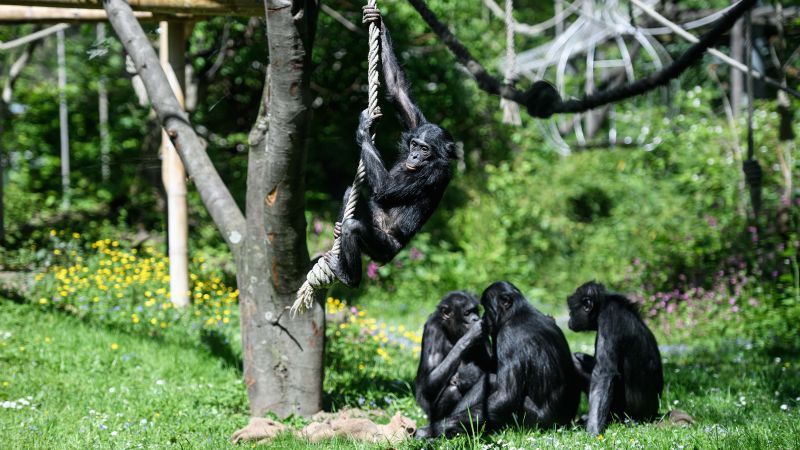
Beyond Imagination: How Bonobos' Pretend Play Reshapes Our Understanding of Animal Cognition
For centuries, the human capacity for imagination, particularly in the realm of pretend play, has been considered a hallmark of our unique cognitive prowess. We marvel at children creating elaborate imaginary worlds – hosting invisible tea parties, teaching stuffed animals, or operating make-believe grocery stores. This ability to mentally manipulate reality, to engage in symbolic thought and role-playing, was long held as a definitive boundary separating humans from the rest of the animal kingdom. However, groundbreaking new research is challenging this anthropocentric view, revealing that our closest primate relatives, the bonobos, are also capable of such sophisticated make-believe.
The Unveiling of Primate Pretenders
The study, which meticulously observed bonobo behavior, provides compelling evidence that these highly intelligent great apes engage in activities strikingly similar to human pretend play. While the specific scenarios might differ from a child's imaginary classroom, the underlying cognitive processes appear to be the same: the manipulation of objects and situations to represent something else, the enactment of roles, and the engagement with an imagined reality. This isn't just simple object manipulation; it involves a sophisticated understanding of symbols and a departure from literal interpretation.
The implications of these findings are profound. They force us to reconsider what we define as 'intelligence' and where the boundaries of complex cognitive abilities truly lie. If bonobos can engage in make-believe, it suggests a shared evolutionary lineage for cognitive traits previously thought to be exclusive to our species. It points towards a deeper, more intricate connection between human and primate minds than previously acknowledged.
Beyond Instinct: The Cognitive Depth of Play
Pretend play in human children is not merely a pastime; it's a vital developmental tool. It fosters creativity, problem-solving skills, social cognition, and the development of a 'theory of mind' – the ability to attribute mental states, beliefs, and desires to oneself and others. By simulating social interactions and complex scenarios, children learn empathy, negotiation, and future planning. If bonobos exhibit similar behaviors, it begs the question: are they deriving similar developmental benefits?
The presence of pretend play in bonobos suggests that this form of symbolic behavior might play a critical role in their social learning and cognitive development too. Bonobos are renowned for their complex social structures, high levels of empathy, and sophisticated communication. It's plausible that make-believe play serves as a crucible for honing these very traits, allowing young bonobos to practice social roles, understand the perspectives of others, and develop flexible problem-solving strategies in a safe, imaginative context.
Bonobos: A Mirror to Our Own Minds?
Bonobos (Pan paniscus) have long fascinated primatologists due to their unique social dynamics, which are often characterized by female dominance and conflict resolution through non-aggressive means, including sexual behavior. Their high capacity for empathy and ability to understand human communication have already set them apart. The discovery of pretend play adds another layer to their already remarkable cognitive profile, suggesting that they possess a richer inner world than we've often imagined for non-human animals.
This study further blurs the line between human and non-human intelligence, reinforcing the idea that cognitive abilities exist on a spectrum rather than being neatly compartmentalized. It challenges the very definition of what it means to be 'human' and prompts us to appreciate the intellectual and emotional depth of other species, especially our closest relatives.
Future Implications and Ethical Considerations
The revelation of pretend play in bonobos opens up exciting new avenues for research. Future studies could explore the specific forms of pretend play observed, their frequency, the social contexts in which they occur, and their long-term developmental impacts. Understanding the neural underpinnings of this behavior in bonobos could also shed light on the evolutionary origins of imagination and symbolic thought in humans.
Beyond academia, these findings carry significant ethical implications. If bonobos possess such sophisticated cognitive capacities, including the ability to engage in symbolic play, it strengthens the argument for their enhanced protection and welfare. Recognizing their complex inner lives can inform conservation efforts, captive care practices, and even our broader philosophical stance on animal rights and our place in the natural world. It urges us to foster greater respect for the intellectual and emotional capacities of all sentient beings.
Conclusion: A New Chapter in Understanding Cognition
The discovery that bonobos engage in pretend play marks a pivotal moment in our understanding of animal cognition. It dismantles a long-held belief about human uniqueness and invites us to embrace a more inclusive view of intelligence. As we continue to uncover the intricate mental landscapes of species like the bonobo, we are not just learning more about them; we are gaining invaluable insights into the fundamental nature of consciousness, imagination, and the very essence of what it means to think, to feel, and to play.