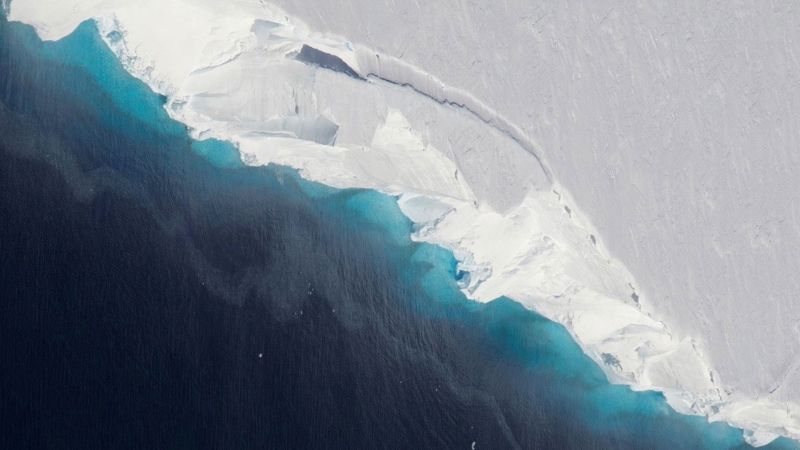
Antarctica's colossal Thwaites Glacier, chillingly dubbed the 'Doomsday Glacier' due to its immense potential to raise global sea levels, is facing a more aggressive threat than previously understood. A groundbreaking new study reveals that swirling underwater eddies, akin to oceanic storms, are relentlessly eroding the glacier's vital ice shelves from below, significantly accelerating its melt rate.
The Glacial Giant on the Brink
The Thwaites Glacier, situated in West Antarctica, is roughly the size of Florida and holds enough ice to raise global sea levels by several feet if it were to completely collapse. Its critical importance stems from its role as a natural buttress, holding back a larger expanse of the West Antarctic Ice Sheet. The stability of Thwaites is a linchpin for future sea level rise, making any accelerated melting a cause for grave international concern.
For decades, scientists have monitored the glacier's retreat, driven largely by warming ocean waters. However, the exact mechanisms and intensity of this interaction have remained a complex puzzle. This new research shines a stark light on a previously underestimated factor: dynamic oceanic currents acting directly on the ice.
Unveiling the Submerged Threat: Oceanic Eddies
The study pinpoints 'swirling underwater eddies' as a primary culprit in the aggressive melting. These aren't just gentle currents; they are powerful, rotating masses of water that function much like atmospheric storms, but in the deep ocean. These eddies are effectively drawing warmer, saltier water from the depths towards the base of the ice shelves, where the glacier meets the ocean.
Once this warmer water makes contact with the ice, it rapidly increases the rate of melting from beneath. This isn't a uniform, slow erosion; it's a focused, intensified assault that creates intricate channels and cavities within the ice, further weakening its structure and accelerating its flow into the ocean. The research highlights this phenomenon not just at Thwaites but at a second, unnamed Antarctic glacier, suggesting a more widespread issue.
Far-Reaching Implications for a Warming World
The implications of these findings are profound. If the 'Doomsday Glacier' continues to melt at an accelerated pace, the global ramifications will be severe:
- Accelerated Sea Level Rise: Current projections for global sea level rise may need to be revised upwards, impacting coastal cities and low-lying island nations far sooner than anticipated.
- Coastal Inundation: Increased flooding, storm surges, and saltwater intrusion will threaten critical infrastructure, agricultural land, and freshwater supplies in densely populated coastal areas worldwide.
- Ecosystem Disruption: Marine and terrestrial ecosystems will face unprecedented stress, leading to biodiversity loss and shifts in species distribution.
- Economic and Social Dislocation: Mass displacement, economic losses, and humanitarian crises could become more frequent as communities grapple with an unyielding environment.
This research underscores the intricate and often surprising ways in which our oceans and ice sheets interact. It’s a powerful reminder that the stability of even the most remote parts of our planet has direct, tangible consequences for every corner of the globe.
A Race Against Time
Understanding these complex processes is crucial for refining climate models and developing more accurate predictions for the future. The aggressive action of these underwater storms adds a new layer of urgency to global efforts to combat climate change. While scientists continue their vital work monitoring and modeling these dynamic interactions, the findings serve as a stark warning: the 'Doomsday Glacier' is not just a distant phenomenon; its fate is inextricably linked to our collective future, demanding immediate and sustained action to reduce greenhouse gas emissions.