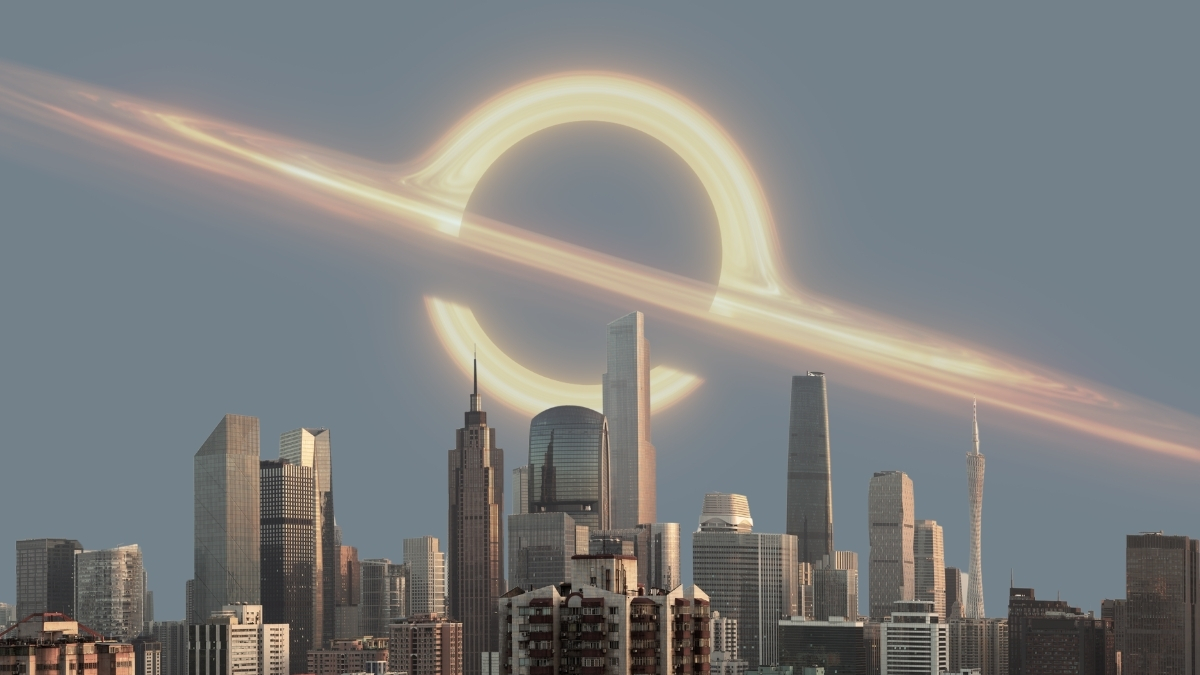
Beyond Oumuamua: The Stunning Reality of Runaway Black Holes
Last year, the scientific community and the public alike were captivated by a cosmic anomaly: a runaway asteroid, hurtling through our Solar System at an astonishing 68 kilometres per second. This interstellar visitor, likely from a star system far beyond our own, offered a tantalizing glimpse into the dynamic, chaotic nature of the cosmos. Yet, while such wanderers are fascinating, recent revelations point to an even more profound and mind-boggling phenomenon: the confirmed existence of "runaway black holes."
The implications are staggering. Imagine not a mere rock, but a collapsed star, an invisible gravitational monster, traversing the vast emptiness of space, potentially unimpeded for billions of years. These aren't just theoretical constructs anymore; evidence suggests they are a very real, albeit elusive, component of our galactic neighborhood.
What Exactly Are Runaway Black Holes?
At their core, runaway black holes are exactly what their name implies: black holes ejected from their birthplaces at immense velocities. Unlike stationary black holes that anchor galactic centers or orbit companion stars, these are cosmic mavericks, often escaping the gravitational confines of their host galaxies or star clusters.
Their formation mechanisms are varied and violent. One primary pathway involves the aftermath of a supernova explosion. If the star that collapses into a black hole experiences an asymmetrical explosion, the newly formed black hole can receive a powerful "kick," propelling it across the galaxy. Another, even more spectacular, scenario involves the merger of two supermassive black holes at the heart of colliding galaxies. As these colossal objects spiral inward and finally coalesce, gravitational radiation can be emitted preferentially in one direction, causing the resulting larger black hole to recoil like a cosmic cannonball, potentially escaping its new host galaxy entirely.
From Theory to Reality: The Evidence Unveiled
For decades, runaway black holes were largely theoretical, compelling predictions of general relativity and astrophysics but lacking direct observational proof. The challenge lies in their very nature: black holes are invisible by definition, detectable only through their gravitational influence on surrounding matter or the emission of high-energy radiation from accretion disks when they consume gas and dust.
However, recent advancements in observational astronomy and computational modeling have begun to peel back the veil. Astronomers have identified intriguing candidates – trails of ionized gas stretching for tens of thousands of light-years, seemingly emanating from nothing. These "wakes" are believed to be formed as a black hole tears through interstellar gas, heating it to extreme temperatures and leaving a luminous signature. In other cases, studies of galactic nuclei post-merger have revealed displaced supermassive black holes, still moving at high velocities away from the center of their new host, a direct consequence of the gravitational recoil mechanism. While definitive, irrefutable proof for every single runaway black hole remains elusive, the cumulative evidence from various phenomena strongly supports their widespread existence.
Cosmic Implications and Future Hunting Grounds
The reality of runaway black holes fundamentally alters our understanding of galactic evolution. These cosmic nomads could strip gas and dust from their paths, influence star formation, or even eject stars from their home galaxies. They are powerful, unseen sculptors of the universe, potentially contributing to the scattering of dark matter and shaping the distribution of stellar populations.
Detecting and studying these objects will be a major focus of future astrophysical research. Next-generation observatories like the James Webb Space Telescope (JWST) are already providing unprecedented views into distant galaxies, potentially revealing more of these active, high-velocity black holes through their unique infrared signatures. Ground-based telescopes equipped with adaptive optics, and future gravitational-wave observatories such as the Laser Interferometer Space Antenna (LISA), will offer new avenues, allowing us to 'hear' the gravitational reverberations of these colossal objects as they traverse the cosmos.
A Universe Full of Surprises
From a runaway asteroid to runaway black holes, our universe continues to surprise and challenge our perceptions. The confirmation of these ultra-fast, invisible behemoths traversing the cosmic expanse underscores the dynamic and often violent processes that govern the evolution of galaxies and the very fabric of spacetime. As we continue to refine our instruments and theories, who knows what other cosmic wanderers we might discover, hidden in plain sight? The journey to fully understand these celestial bullets has only just begun.