Unveiling the Interstellar Wanderer: What Comet 3I/ATLAS Tells Us About the Cosmos
In the vast cosmic ballet, celestial objects often follow predictable paths within their home star systems. But every so often, a true outlier emerges, a messenger from beyond our solar neighborhood. Such is the case with Comet 3I/ATLAS, an interstellar visitor currently captivating astronomers and igniting public intrigue as it makes its fleeting journey through our inner solar system.
A Glimpse of the Alien: Tracking 3I/ATLAS
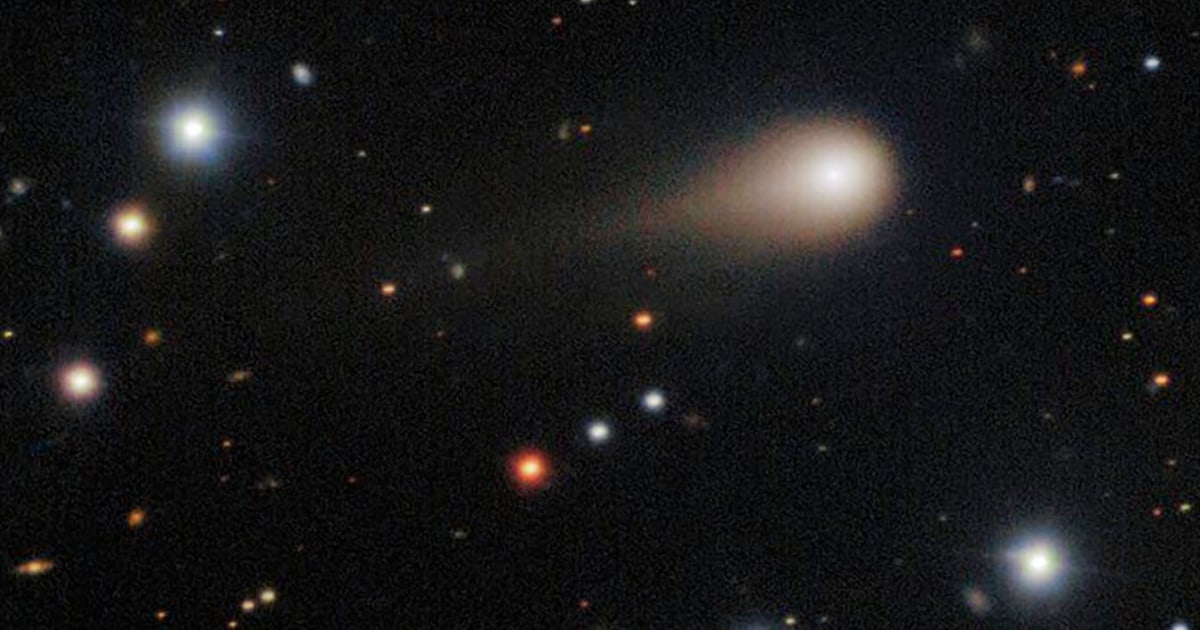
The fascination surrounding 3I/ATLAS isn't merely academic; it's a testament to the power of observation. Late last month, NASA's venerable Hubble Space Telescope played a crucial role, tracking the comet from an astounding distance of approximately 178 million miles away from Earth. Despite this immense separation, Hubble's sophisticated instruments were able to record the moving comet as a luminous, albeit distant, point of light. These growing collection of images, however faint, have pieced together a compelling narrative of an object unlike those born within our own stellar nursery.
Unlike periodic comets that orbit our Sun, 3I/ATLAS hails from another star system entirely. Its "3I" designation stands for "third interstellar object," placing it in an incredibly exclusive club alongside 'Oumuamua and 2I/Borisov. Each of these objects offers a unique, unfiltered look at the raw materials and processes occurring in distant cosmic environments, untouched by the billion-year evolutionary journey of our own solar system.
Deciphering Distant Origins: The Science Behind the Intrigue
The significance of studying 3I/ATLAS extends far beyond its visual appeal. For astrophysicists, this comet is a pristine sample, a cosmic time capsule providing direct clues about the composition of protoplanetary disks around other stars. By analyzing its light – its spectral signature – scientists hope to understand the types of ice, dust, and volatile compounds present in its birthplace. Are they similar to what we find in the Kuiper Belt or Oort Cloud? Or do they reveal entirely different chemical processes at play in its original system?
"Every interstellar visitor like 3I/ATLAS is a unique, unscheduled delivery from the galactic post office," explains Dr. Lena Petrov, a senior researcher at NovaPress Astro-Analytics. "They carry secrets from stellar nurseries potentially millions of light-years away, offering empirical data that complements our theoretical models of exoplanet formation and the distribution of elements across the galaxy."
The velocity and trajectory of 3I/ATLAS further reinforce its interstellar identity. It is moving too fast and on too open a path to be gravitationally bound to our Sun. This slingshot trajectory through our solar system, while ephemeral, provides a fleeting window for observation before it departs, likely never to return.
Future Implications: The Quest for Cosmic Understanding
The observations of 3I/ATLAS are not just about this single object; they are about preparing for the next. As our observational capabilities improve, driven by new telescopes and advanced data analytics, the detection rate of interstellar objects is likely to increase. Each discovery refines our understanding of how star systems form, how materials are exchanged between them, and even the potential for life-sustaining ingredients to traverse the vast emptiness of space.
Ultimately, Comet 3I/ATLAS serves as a potent reminder of the dynamic and interconnected nature of our galaxy. It's a tangible link to other stellar neighborhoods, a silent testimony to the incredible diversity of the cosmos. As we continue to study its ghostly glow, we're not just looking at a comet; we're peering into the deep, unknown origins of existence beyond our cosmic home. The intrigue surrounding this mysterious object will undoubtedly continue to grow, pushing the boundaries of human knowledge with every new photo and data point.