Beyond Particles: Is Gravity Itself the Answer to the Dark Matter Enigma?
For decades, the invisible hand of dark matter has shaped our understanding of the cosmos, explaining everything from the rotation of galaxies to the large-scale structure of the universe. This pervasive, unseen entity, essential to the standard cosmological model, has driven physicists to search for exotic new particles, from WIMPs to axions. Yet, despite immense effort and sophisticated detectors, direct evidence for these particles remains elusive. What if, instead of new particles, the solution to the dark matter mystery lies not in what is there, but in how something fundamental behaves?
The Dark Matter Predicament: A Brief History
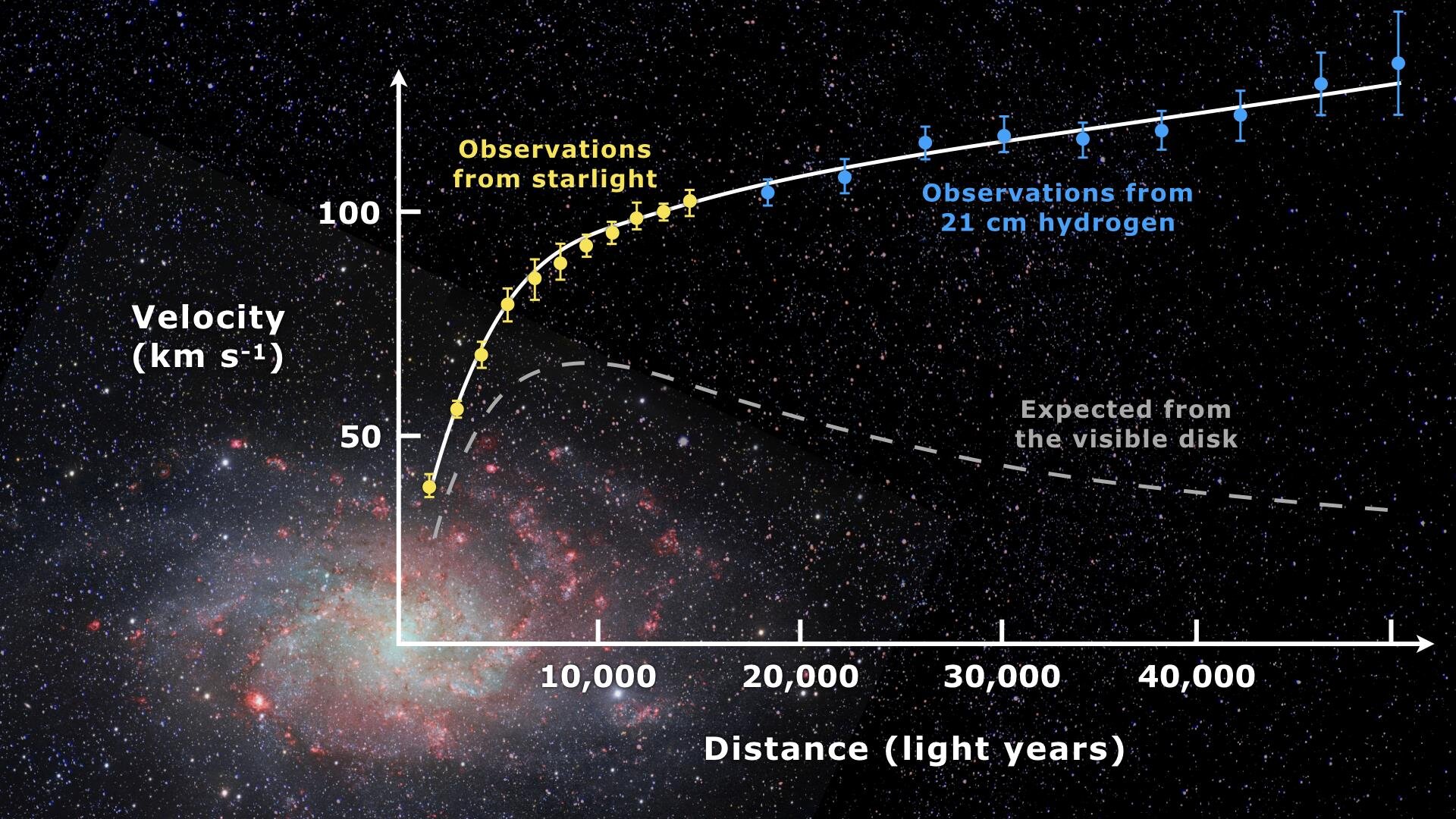
The concept of dark matter arose from observational anomalies that defy explanation by visible matter alone. Early observations in the 1930s by Fritz Zwicky noted that galaxy clusters possessed far more mass than could be accounted for by their luminous components, leading to the term "dunkle Materie." Decades later, Vera Rubin's meticulous studies of galaxy rotation curves in the 1970s provided compelling evidence: stars at the outskirts of galaxies orbit far too fast to be held in by the gravity of visible matter alone, suggesting a vast, unseen halo of mass encompassing them. Further evidence emerged from gravitational lensing, the cosmic microwave background (CMB), and the formation of large-scale structures – all pointing to a dominant, non-baryonic, non-luminous form of matter making up roughly 27% of the universe's total mass-energy density.
The prevailing paradigm has been to search for Weakly Interacting Massive Particles (WIMPs), hypothetical particles that interact gravitationally but only weakly with the electromagnetic and strong nuclear forces. Experiments deep underground and at particle accelerators like the LHC have tirelessly sought these elusive particles, but so far, the universe holds its secrets close.
A Radical Shift: Gravity's "Infrared Running"
Enter a compelling alternative, one that re-examines the very fabric of spacetime and the force that governs it: gravity. New research, as explored in a recent Phys.org publication, proposes that instead of postulating new particles, gravity itself might behave differently at certain scales. Specifically, the concept of "infrared running of gravity" suggests that the strength or nature of the gravitational force could vary depending on the distance and energy scale at which it's observed.
In quantum field theory, "running" refers to how coupling constants (like the electromagnetic coupling constant) change with the energy scale of the interaction. While gravity is notoriously difficult to incorporate into a quantum field theory framework, this research takes a field-theoretic route, hinting that gravity's fundamental parameters, such as Newton's gravitational constant G, might not be truly constant but "run" in the infrared (i.e., at long distances or low energies). This means that at the vast, cosmological scales where dark matter effects are most pronounced – within galaxies and galaxy clusters – gravity might manifest in a way that mimics the effects currently attributed to dark matter, without the need for any exotic new particles.
The Field-Theoretic Implications: Rewriting the Rules
This approach is not entirely unprecedented. Modified Newtonian Dynamics (MOND), for instance, proposed a phenomenological alteration to Newton's law of gravity at low accelerations, successfully explaining galaxy rotation curves without dark matter. However, MOND faces challenges explaining gravitational lensing and the CMB, and lacks a robust underlying theoretical framework. The "infrared running of gravity" offers a potentially more fundamental, field-theoretic basis for such modifications.
By envisioning gravity within a quantum field theory context where its parameters are not fixed but dynamic, this research opens a pathway to naturally explain observed gravitational anomalies. It suggests that what we perceive as the "extra" gravitational pull of dark matter might simply be the universe revealing a deeper, scale-dependent aspect of gravity itself. This isn't about simply adding a correction term; it's about a re-evaluation of gravity's behavior across vast cosmic distances, where quantum effects, typically thought to be relevant only at microscopic scales, could manifest indirectly.
Future Implications and Challenges Ahead
Such a profound shift in perspective carries significant implications. If validated, it would fundamentally alter our understanding of gravity, quantum mechanics, and cosmology. It could pave the way for a unified theory of quantum gravity, potentially resolving the long-standing incompatibility between general relativity and quantum mechanics by providing a consistent field-theoretic description.
However, this hypothesis faces rigorous challenges. It must provide a consistent explanation for all dark matter observational evidence – galaxy rotation, gravitational lensing, the CMB anisotropies, and the formation of large-scale structures – at a level of precision comparable to the standard cosmological model. Deriving testable predictions that distinctly differentiate it from particle dark matter models will be crucial. This might involve looking for subtle deviations in gravitational interactions in specific cosmic environments or through advanced astrophysical observations that probe gravity's behavior at unprecedented scales.
The journey to unraveling the dark matter mystery is far from over. Whether it ultimately leads to the discovery of new particles or a redefinition of gravity itself, research like the "infrared running of gravity" ensures that the pursuit of knowledge remains as exciting and profound as the universe it seeks to explain. It serves as a powerful reminder that sometimes, the most revolutionary answers come not from adding new ingredients, but from re-examining the fundamental rules of the game.