Rust Coreutils' Relentless Pursuit of GNU Compatibility: Silencing the Skeptics at FOSDEM 2026
The world of open-source software is often a crucible of innovation, ambition, and, at times, skepticism. Few projects have faced as much scrutiny and doubt as the Rust Coreutils (uutils) initiative, which aims to rewrite the foundational command-line utilities—traditionally provided by GNU—in the modern, memory-safe language, Rust. However, at FOSDEM 2026 this past weekend, lead developer Sylvestre Ledru delivered a presentation that not only showcased monumental progress but emphatically silenced the project's critics, proving that 100% GNU compatibility is not just a dream, but an impending reality.
Context: The Cornerstone of Computing - Coreutils
To truly appreciate the magnitude of the uutils project, one must understand the role of core utilities. Commands like ls, cp, mv, cat, and grep are the bedrock upon which Unix-like operating systems function. They are used countless times a day by developers, system administrators, and even regular users, often without a second thought. For decades, the GNU Core Utilities have been the de facto standard, a robust and feature-rich collection honed over many years. Replacing such a deeply integrated and battle-tested suite is an undertaking of epic proportions, requiring meticulous attention to detail and an unwavering commitment to functionality parity.
Why Rust? A Modern Paradigm for System Utilities
The decision to rewrite core utilities in Rust is rooted in the language's core strengths: memory safety without garbage collection, concurrency, and performance that rivals C/C++. Traditional C-based utilities, while powerful, are prone to a class of bugs (buffer overflows, use-after-free errors) that Rust's ownership and borrowing system largely eliminates at compile time. This promise of enhanced security, reliability, and modern tooling has been a significant driver for the uutils project, offering a compelling vision for the next generation of system-level software.
The Compatibility Conundrum: A Mountain to Climb
Achieving 100% GNU compatibility is a formidable challenge. The GNU utilities have accumulated a vast array of options, behaviors, and edge-case functionalities over decades. Merely reimplementing the core functionality isn't enough; true compatibility means behaving identically in every conceivable scenario, including subtle differences in error messages, exit codes, and interaction with various file systems or environments. Critics often pointed to this immense scope, suggesting that the uutils project would inevitably fall short or become an endless, unmanageable endeavor.
Sylvestre Ledru's Vision and the FOSDEM Revelation
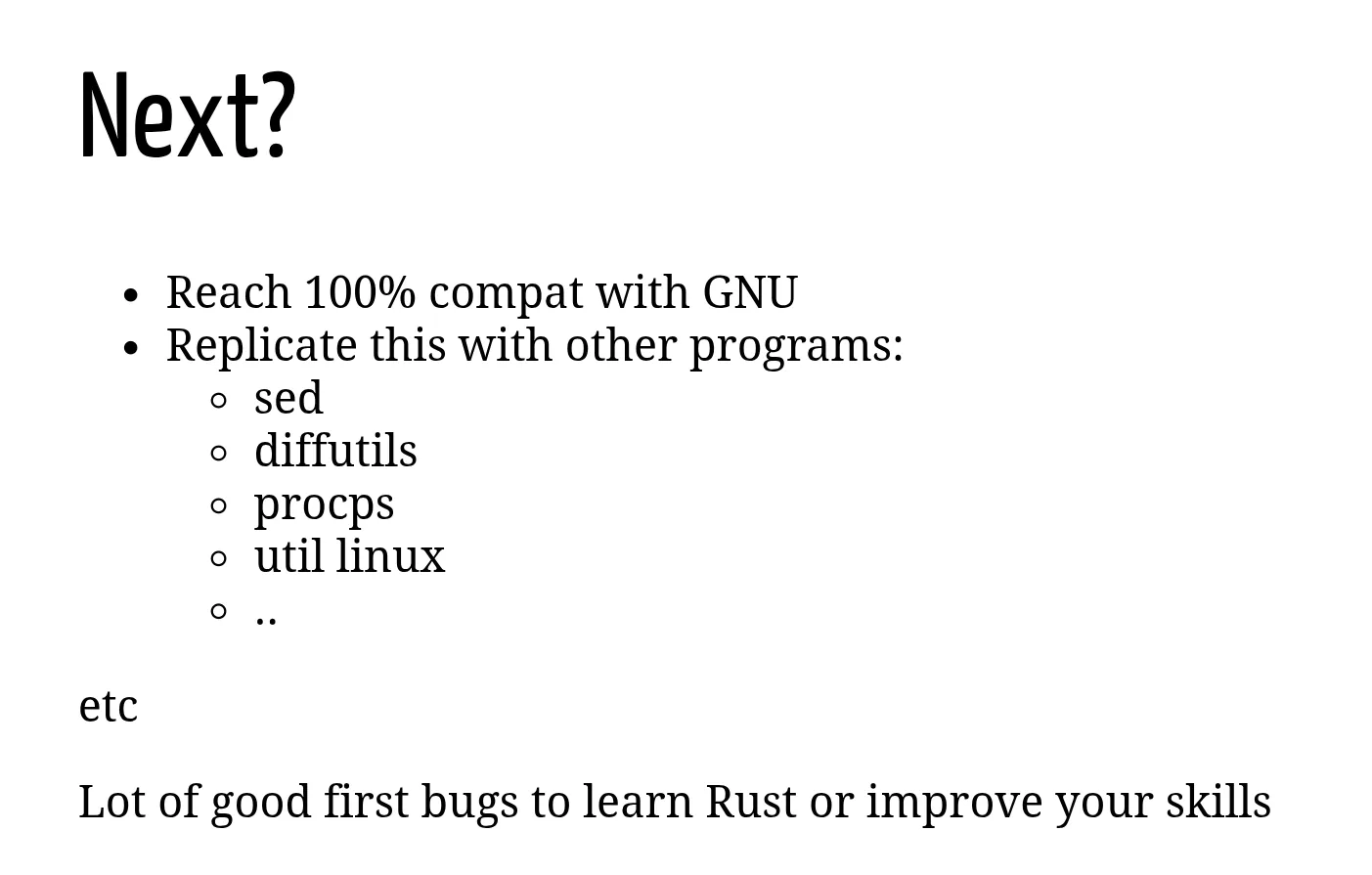
Sylvestre Ledru, the steadfast lead developer of the uutils project, has consistently steered this ambitious ship. His presentation at FOSDEM 2026 wasn't just a technical update; it was a testament to the dedication of the entire uutils community. While specific technical details of his talk are awaited, the description from Phoronix clearly indicates a significant stride towards complete GNU compatibility, effectively countering the long-standing doubts. This progress isn't just about lines of code; it's about a disciplined, community-driven effort to meticulously replicate and often improve upon established tools. It signals a turning point where the question is no longer if uutils will reach full compatibility, but when.
Future Implications: A New Era for System Software
- Enhanced Security and Stability: A Rust-based core utilities suite means fewer memory-related vulnerabilities, leading to more secure and stable operating environments.
- Performance Potential: While current focus is on compatibility, the inherent performance advantages of Rust could translate into faster execution for fundamental system tasks.
- Wider Adoption of Rust: A fully compatible Rust Coreutils could serve as a powerful demonstrator for Rust's capabilities in critical infrastructure, encouraging its adoption in other system-level projects.
- A Robust Open-Source Alternative: uutils offers a modern, independent reimplementation, fostering diversity and resilience within the open-source ecosystem.
- Silencing the Doubters: For those who dismissed the project as overly ambitious or impractical, the FOSDEM presentation serves as definitive proof of concept, legitimizing the uutils effort on a global stage.
Conclusion
The journey of Rust Coreutils has been a marathon, not a sprint, marked by persistent effort and a clear vision. Sylvestre Ledru's FOSDEM 2026 presentation represents a significant milestone, a powerful declaration that the uutils project is not only viable but thriving. By continuing their methodical march towards 100% GNU compatibility, the Rust Coreutils team is not just rewriting tools; they are rewriting expectations, demonstrating the power of modern language design, and securing a future for system utilities that is safer, faster, and unequivocally open source. The skeptics have been served their notice: the future of core utilities is indeed looking very rusty.