The Galactic Mystery of Missing Tatooines: How General Relativity Explains the Scarcity of Binary Star Planets
By NovaPress Staff Writers |
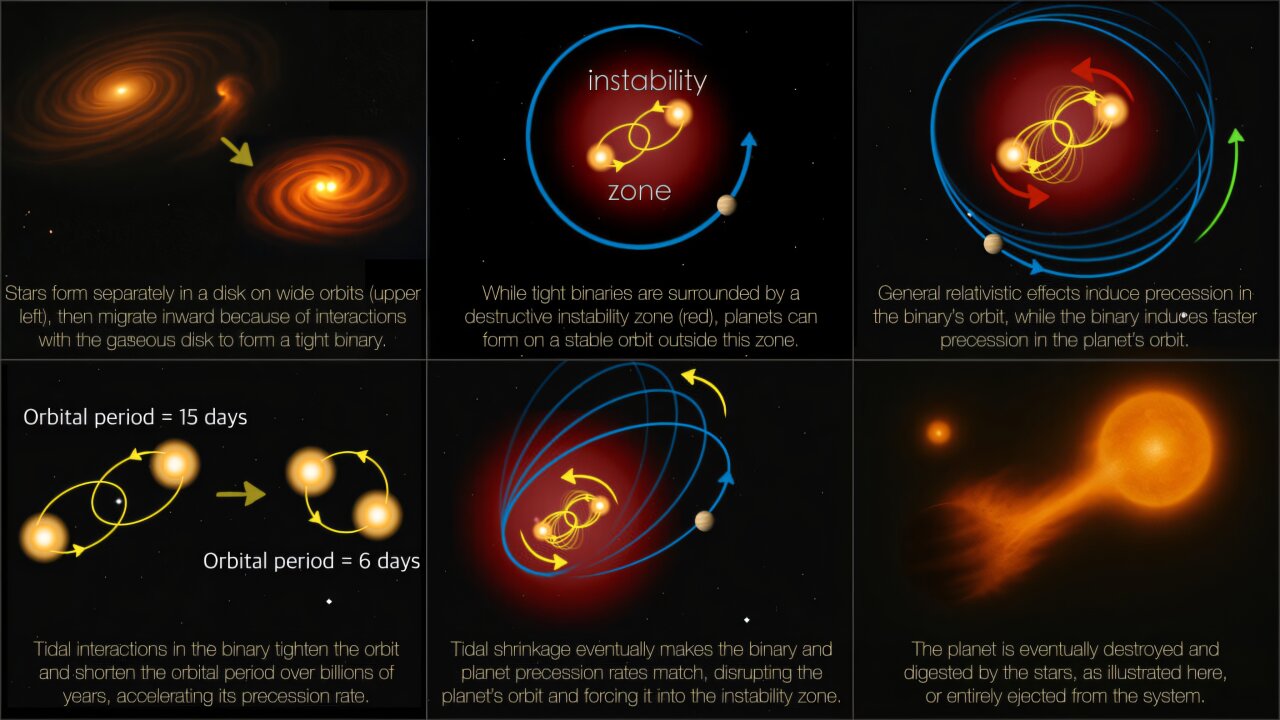
For decades, the image of Luke Skywalker gazing at a twin sunset on Tatooine has captured the imagination of science fiction enthusiasts. Such a spectacle, however, remains a profound rarity in astronomical observations. While astronomers have cataloged thousands of exoplanets orbiting solitary stars, the discovery of worlds around binary star systems — often dubbed "Tatooine planets" — remains strikingly scarce. This observational anomaly has long perplexed scientists, especially given that binary star systems are as common as their single-star counterparts. Now, physicists believe they have an explanation, one deeply rooted in the fabric of spacetime itself: General Relativity.
The Dearth of Dual-Sun Worlds: An Astronomical Anomaly
The hunt for exoplanets has been one of the most fruitful frontiers in modern astronomy. Missions like Kepler and TESS have revolutionized our understanding of planetary diversity, revealing gas giants, super-Earths, and even potentially habitable worlds orbiting stars light-years away. Yet, a peculiar pattern emerged: the vast majority of these discoveries clustered around single stars. Despite the fact that roughly half of all stars in our galaxy exist in binary or multi-star configurations, the proportion of planets found within these complex gravitational dance floors is dramatically lower than predicted. This isn't merely an observational bias; careful analysis has confirmed a genuine deficit.
Beyond Simple Gravity: The General Relativistic Hurdle
Initially, many theories focused on the increased gravitational perturbations in binary systems, suggesting that the chaotic dance of two stars would either prevent planets from forming in stable orbits or eject them from the system over time. While these classical Newtonian mechanics certainly play a significant role, the new understanding points to a more subtle yet profound influence: the distortions of spacetime predicted by Albert Einstein's General Theory of Relativity.
In a binary star system, the combined mass of the two stars creates a far more intricate and dynamic warp in spacetime than a single star alone. This complex gravitational environment can lead to several effects that are detrimental to planet formation and stability. One key factor is the way General Relativity affects orbital dynamics, particularly at close distances or in regions where gravitational fields are intense and rapidly changing. The theory predicts phenomena like frame-dragging and the precession of orbits, which become more pronounced in the strong, fluctuating gravitational fields of two co-orbiting stars. These relativistic effects can induce greater instabilities, making it exceedingly difficult for protoplanetary disks to coalesce into stable planets, or for nascent planets to maintain their trajectories over billions of years.
Furthermore, the relativistic interactions could lead to more frequent and energetic close encounters between planetary embryos, scattering them out of the system or causing them to collide violently. While Newtonian gravity accounts for the primary forces, General Relativity refines these calculations, revealing a deeper layer of complexity that pushes the boundaries of stable planetary formation in multi-star environments beyond what was previously considered. It's not just the sum of two gravitational wells; it's the interaction of two significant spacetime distortions.
Implications for Planetary Formation and Astrobiology
This new understanding has profound implications. For planet formation theorists, it refines models of how planets coalesce from protoplanetary disks, emphasizing the delicate balance required for stable accretion. It suggests that even if raw materials are abundant, the gravitational complexities introduced by General Relativity in binary systems present a formidable hurdle.
From an astrobiological perspective, the scarcity of Tatooine-like planets might narrow the search for extraterrestrial life. While a binary star system doesn't inherently preclude life (as seen in fiction), the reduced number of stable planetary orbits implies fewer potential havens for complex biology. However, it also directs our efforts: focusing on the orbital dynamics permitted by General Relativity might help identify the rare 'sweet spots' where stable planets could still exist around two suns.
The Future of Exoplanet Hunting: A Relativistic Lens
The explanation offered by General Relativity provides a powerful new lens through which to view exoplanet research. Future missions and observational strategies may increasingly incorporate relativistic considerations when targeting binary star systems. It encourages physicists and astronomers to collaborate even more closely, pushing the boundaries of both observational astronomy and theoretical physics. As our instruments become more sensitive, and our understanding of fundamental physics deepens, we continue to unravel the universe's most intricate secrets, one Tatooine at a time.
While the twin sunsets of Tatooine may remain a fantasy for the most part, the scientific journey to understand why offers a captivating glimpse into the profound workings of our cosmos, reminding us that reality often outpaces even the most vivid imagination.