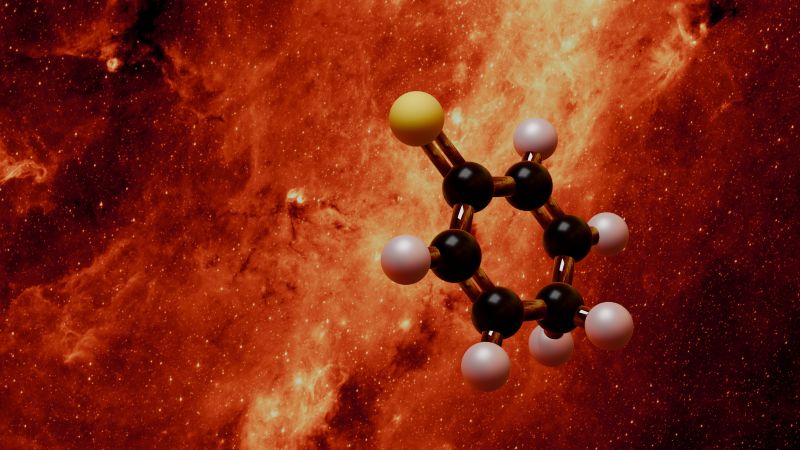
The vast, silent expanse of interstellar space, once thought to be a barren void, continues to surprise scientists with revelations that challenge our understanding of life's very beginnings. In a groundbreaking discovery, researchers have identified the largest organic molecule containing sulfur ever found in the cosmic wilderness, a 13-atom marvel that is being hailed as a critical 'missing link' in the quest to unravel the origins of life's chemistry.
Unlocking the Universe's Chemical Kitchen
For decades, astrobiologists have pondered the cosmic origins of the fundamental building blocks of life. While amino acids and other simple organic molecules have been detected in space before, the discovery of this complex sulfur-bearing molecule pushes the boundaries of what was thought possible in the harsh interstellar medium. Sulfur, often overlooked in favor of carbon, hydrogen, oxygen, and nitrogen, is a vital component of proteins and enzymes, playing an indispensable role in biological processes on Earth. Its presence in such a complex organic structure in space profoundly reshapes our understanding of prebiotic chemistry.
A "Missing Link" Found in the Cosmic Dust
The molecule, an intricate chain of 13 atoms, represents a significant leap in complexity for organic compounds observed far from stellar nurseries. The researchers liken its discovery to finding a crucial piece of a cosmic jigsaw puzzle. Its sheer size and the inclusion of sulfur suggest a more sophisticated chemical environment in space than previously imagined. This isn't just a simple molecule; it's a testament to the universe's inherent ability to synthesize complex organic structures, far removed from the protective embrace of a planet.
Why Sulfur Matters
Sulfur is a ubiquitous element crucial for life. It forms disulfide bonds, critical for protein structure, and is a key component of coenzymes like Coenzyme A, vital for metabolism. The detection of a large, sulfur-containing organic molecule in interstellar space indicates that the raw materials for these intricate biological functions may be seeded throughout the cosmos, rather than being unique to Earth's early environment.
From Stardust to Sentience: The Seeds of Life
This discovery bolsters the theory that the fundamental ingredients for life are not solely produced on planetary surfaces but are actively synthesized in the cold, dark recesses of space. These complex organic molecules, forged in interstellar clouds, can then be incorporated into nascent planetary systems through comets, asteroids, and dust, delivering the necessary chemical toolkit to young planets. The presence of such a sophisticated sulfur compound could mean that the early Earth received an even richer cocktail of prebiotic molecules than previously thought, significantly accelerating the path towards abiogenesis.
It also opens intriguing possibilities for life beyond Earth. If such complex molecules can form in diverse interstellar environments, then the chances of similar chemical processes unfolding around other stars, leading to the emergence of life on exoplanets, appear increasingly plausible. This isn't just about Earth's origins; it's about life's universal potential.
Pioneering the Future of Astrochemical Exploration
The identification of this 'missing link' is not an endpoint but a launchpad for future research. Scientists will now focus on identifying other complex organic molecules in interstellar space, particularly those containing elements like phosphorus, another cornerstone of life. New observational techniques and more powerful telescopes, both ground-based and space-based, will be crucial in this endeavor. Understanding the exact formation mechanisms of these complex molecules in the extreme conditions of space will provide unprecedented insights into the universe's chemical factories.
This discovery compels us to reimagine the cosmos not as an empty void, but as a vibrant chemical laboratory, constantly brewing the ingredients that may one day spark life across countless worlds. The search for extraterrestrial life, once a fringe pursuit, is increasingly becoming a core scientific endeavor, driven by profound revelations like this one.
The discovery of this 13-atom sulfur-containing organic molecule in interstellar space stands as a monumental achievement in astrobiology. It reinforces the idea that the universe is teeming with the chemical precursors to life, hinting at a common, cosmic origin for biology itself. As we continue to probe the depths of space, each new molecule found whispers tales of universal chemistry, bringing us closer to understanding our place in a universe potentially brimming with life.