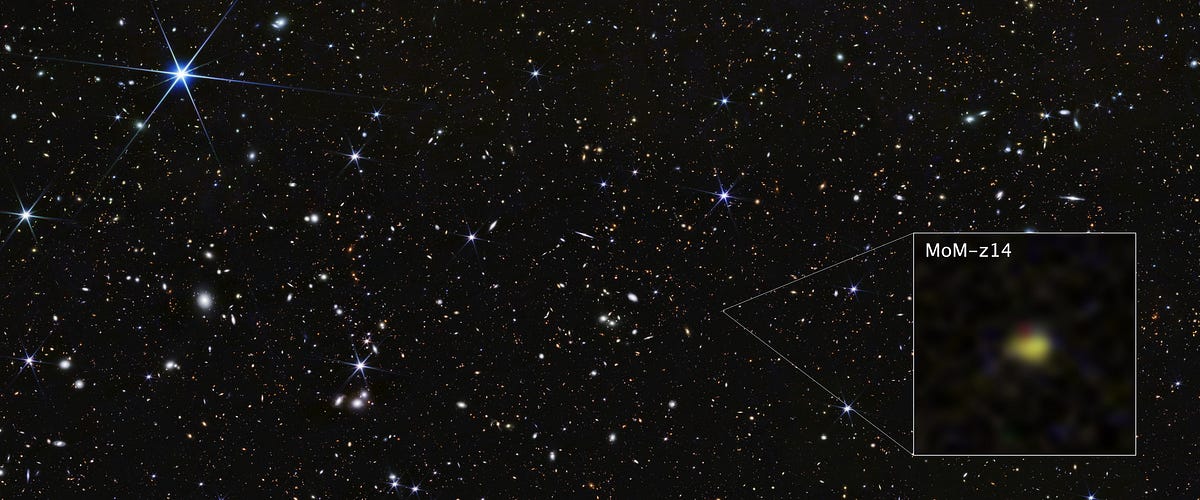
Echoes from the Dawn of Time: James Webb Unveils the Farthest Galaxy, MoM-z14
Humanity's quest to understand its origins has taken a monumental leap forward. Thanks to the unparalleled capabilities of NASA's James Webb Space Telescope (JWST), astronomers have officially detected MoM-z14, a galaxy so distant that its light began its journey to us a mere 280 million years after the Big Bang. This groundbreaking discovery, confirmed spectroscopically, pushes the boundaries of our cosmic understanding, offering an unprecedented glimpse into the universe's infancy.
A Beacon from the Cosmic Dawn
The detection of MoM-z14 at a redshift of 14.4 marks it as the farthest galaxy ever observed. Redshift, a phenomenon where light from distant objects appears 'stretched' towards the red end of the spectrum due to the universe's expansion, is a direct indicator of distance and, by extension, age. A redshift of 14.4 means we are observing this galaxy as it was when the universe was only about 2% of its current age – a time period previously shrouded in theoretical models.
The universe's early years, often dubbed the 'Cosmic Dark Ages,' were a period before the first stars and galaxies had fully formed and illuminated the cosmos. Observing a vibrant galaxy like MoM-z14 so early in cosmic history challenges existing models of galaxy formation and the reionization epoch, the period when the universe's neutral hydrogen gas was ionized by the first sources of light.
The James Webb's Eye: Unveiling the Invisible
This extraordinary discovery was made possible by JWST's highly sensitive instruments: the Near-Infrared Camera (NIRCam) and the Near-Infrared Spectrograph (NIRSpec). Due to the extreme redshift, the ultraviolet and visible light emitted by MoM-z14 billions of years ago has been stretched into the infrared spectrum by the time it reaches JWST. NIRCam's ability to capture this faint infrared light allowed for initial detection, while NIRSpec provided the crucial spectroscopic confirmation. Spectroscopic analysis, the gold standard in astronomy, breaks down light into its constituent wavelengths, revealing the chemical composition, temperature, and precise redshift of celestial objects.
JWST was specifically designed for this purpose – to peer back through time to the earliest galaxies. Its massive gold-coated mirror and cryogenically cooled instruments allow it to detect the faint, stretched infrared light from the universe's most ancient structures, something its predecessor, the Hubble Space Telescope, could not achieve with the same depth and clarity.
Implications for Early Universe Cosmology
The existence of a developed galaxy like MoM-z14 so soon after the Big Bang presents fascinating questions:
- Speed of Formation: How quickly could such a substantial collection of stars and gas coalesce and form within just 280 million years? This suggests either faster initial star formation rates or the presence of more massive 'seed' galaxies than previously theorized.
- Reionization Insights: What role did MoM-z14 and similar early galaxies play in the reionization of the universe? Were they powerful enough, and numerous enough, to ionize the vast swathes of neutral hydrogen gas that filled the early cosmos?
- Population III Stars: Does MoM-z14 harbor clues about the elusive Population III stars – the very first stars composed solely of hydrogen and helium, predicted to be massive and short-lived?
This discovery provides concrete observational data to test and refine cosmological models, particularly those describing the formation of large-scale structures and the evolution of the first generations of galaxies.
The Future of Cosmic Exploration
MoM-z14 is likely just the tip of the cosmic iceberg. With JWST continuing its operations, astronomers anticipate discovering even more distant and ancient galaxies. Each new detection will add another piece to the grand puzzle of cosmic evolution, helping us understand how the universe transitioned from a homogeneous soup of particles to the complex tapestry of stars, galaxies, and structures we observe today.
The ability to observe these nascent galaxies opens new avenues for research, allowing scientists to study their chemical compositions, star formation rates, and eventual fate. It's a thrilling era for astrophysics, where observation is catching up with, and in some cases, challenging long-held theoretical predictions.
Conclusion: A Universe Unfolding
The detection of MoM-z14 is more than just a record-breaking discovery; it's a testament to human ingenuity and our insatiable curiosity. It underscores the profound power of instruments like the James Webb Space Telescope to extend our senses beyond the confines of our solar system, reaching back to the very first moments of creation. As we continue to gaze into the infrared echoes of the early universe, we are not just observing history; we are rewriting it, one ancient galaxy at a time.