An Alien Visitor: Interstellar Comet 3I/ATLAS Offers Unprecedented Glimpse Beyond Our Solar System
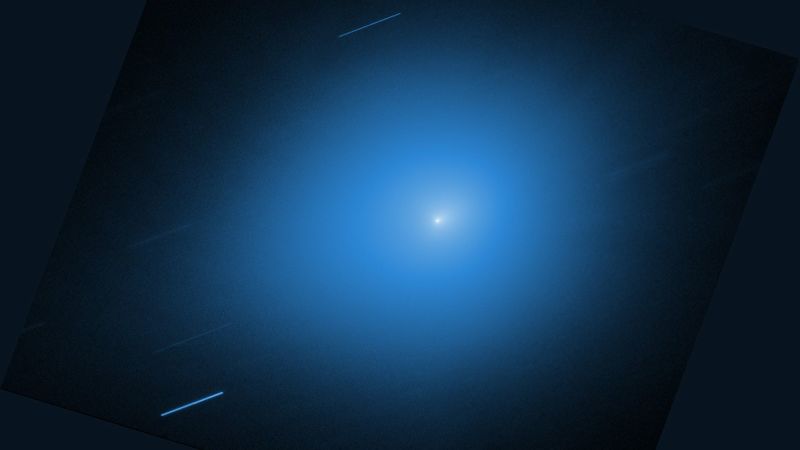
The cosmos has once again graced our solar neighborhood with a rare, fleeting visitor: Interstellar Comet 3I/ATLAS. As this enigmatic object makes its closest approach to Earth later this month, humanity's most advanced observational tools, including the venerable Hubble Space Telescope and the cutting-edge Jupiter Icy Moons Explorer (JUICE), have provided fresh, invaluable glimpses. These new images are not merely stunning visual captures; they represent a pivotal opportunity to peer directly into the material composition of another star system, offering insights that could redefine our understanding of cosmic genesis.
A Messenger from Beyond: The Rarity of Interstellar Comets
Interstellar objects are celestial wanderers that originate from outside our own solar system, flung into the vastness of space by gravitational slingshots from their home stars. Their visits are exceedingly rare. Before the discovery of 1I/ʻOumuamua in 2017, the very existence of such free-roaming bodies was largely theoretical. Comet 3I/ATLAS, the second confirmed interstellar comet and only the third such object ever detected, therefore represents an extraordinary scientific bounty. Unlike objects gravitationally bound to our Sun, 3I/ATLAS follows a hyperbolic trajectory, meaning it is merely passing through our cosmic backyard before continuing its journey back into the depths of interstellar space.
Its designation, '3I,' signifies its status as the third confirmed interstellar object. The 'ATLAS' part refers to the Asteroid Terrestrial-impact Last Alert System survey that first identified it. What makes comets like 3I/ATLAS particularly fascinating is their potential to carry pristine material from their birth environments. While asteroids are rocky remnants, comets are icy bodies, often described as 'dirty snowballs,' preserving volatile compounds that can offer clues about the conditions and chemical makeup of the protoplanetary disk from which they formed, billions of years ago, around another star.
The Eyes of Humanity: Hubble and JUICE in Concert
The recent capture of images by the Hubble Space Telescope and the Jupiter Icy Moons Explorer (JUICE) marks a significant milestone in our study of 3I/ATLAS. Hubble, with its unparalleled resolution and stability above Earth's atmosphere, provides detailed views of the comet's nucleus, coma (the fuzzy envelope of gas and dust surrounding the nucleus), and tail structures. Scientists will meticulously analyze these images for clues about the comet's activity, such as outgassing rates, the shape and rotation of its nucleus, and the composition of its ejected material through spectrographic analysis.
The contribution from JUICE is particularly novel. While its primary mission is to explore Jupiter and its icy moons, its journey through the solar system has offered a unique vantage point. As JUICE is already on an interplanetary trajectory, it can observe 3I/ATLAS from a different angle than Earth-based or near-Earth orbit telescopes, potentially revealing details about the comet's dust trails or gas jets that might be obscured from our perspective. This multi-perspective approach significantly enhances the data collected, providing a more comprehensive 3D understanding of this interstellar traveler.
Unlocking Cosmic Secrets: What Can 3I/ATLAS Teach Us?
The scientific implications of studying 3I/ATLAS are profound. By analyzing its composition, astronomers hope to:
- Probe Exoplanetary Chemistry: Discover the chemical building blocks present in other star systems. Are the raw materials for planetary formation similar across the galaxy, or do they vary wildly?
- Understand Stellar Nurseries: Gain insights into the conditions within the protoplanetary disks of other stars, including temperatures, pressures, and the prevalence of various elements and compounds.
- Refine Migration Models: Help validate or refine models of how planets and smaller bodies migrate within young stellar systems, leading to the ejection of objects like 3I/ATLAS.
- Compare Solar Systems: Provide a direct comparison point to the primordial material of our own solar system, offering context to our origins.
Every piece of data gathered from 3I/ATLAS is a rare sample from beyond our familiar cosmic neighborhood, a literal fragment of another star's legacy passing within our reach. It's an opportunity to perform 'contactless' interstellar material analysis.
The Brief Window of Opportunity and Beyond
As 3I/ATLAS hurtles towards its closest approach, the observational window is both critical and fleeting. Astronomers around the world are mobilizing ground-based telescopes to complement the space-based observations, aiming to gather as much data as possible before the comet recedes into the interstellar void, never to return. This collaborative effort underscores the global scientific community's dedication to unraveling the mysteries of the universe.
The study of 3I/ATLAS will continue long after its closest pass. The data collected by Hubble, JUICE, and other observatories will be processed, analyzed, and debated for years to come, contributing significantly to the burgeoning field of interstellar object research. Each discovery, no matter how small, adds another brushstroke to our ever-evolving portrait of the cosmos.
A Glimpse of the Interstellar Frontier
The presence of Interstellar Comet 3I/ATLAS in our solar system is a powerful reminder of the dynamic and interconnected nature of the galaxy. It serves as a natural probe, delivering samples and information from far-flung stellar systems directly to our observational doorstep. As we pore over the new images and data, NovaPress is excited to follow the unfolding story of this alien visitor, illuminating the profound insights it offers into the origins of stars, planets, and perhaps even life itself, far beyond the confines of our Sun.