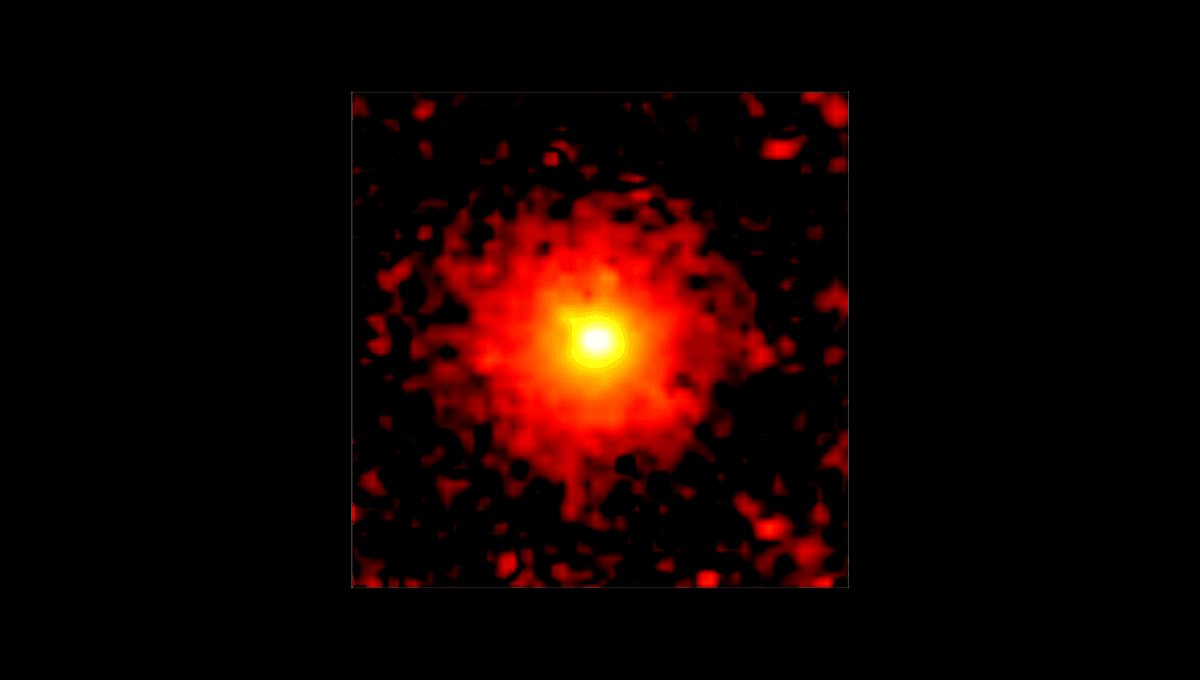
The Unveiling of an Ancient Wanderer: Comet 3I/ATLAS and the Galactic Secrets It Just Unleashed
In the vast, silent expanse between star systems, an ancient traveler has made an extraordinary appearance, prompting scientists to rethink fundamental aspects of cosmic chemistry. Interstellar Comet 3I/ATLAS, a celestial relic believed to be significantly older than our entire Solar System, recently underwent a dramatic and unexpected transformation after its closest approach to the Sun (perihelion), unleashing a colossal quantity of organic molecules into space. This event is not merely a spectacular light show; it is a profound revelation from the galaxy's primordial past.
An Epoch-Spanning Journey: The Galactic Nomad
Comet 3I/ATLAS is no ordinary visitor. Its designation, '3I', marks it as only the third interstellar object ever confirmed to traverse our Solar System. What sets it apart even further is its immense age and journey. For at least 10 million years, and likely much longer, this icy wanderer has navigated the treacherous cosmic seas, traversing the Milky Way without the gravitational embrace of any star. Such a pristine, undisturbed journey means that ATLAS carries within its frozen core a chemical signature directly from the interstellar medium — an unblemished snapshot of the raw materials that existed before our Sun, Earth, and everything we know came into being.
Astronomers hypothesize that its origins trace back to the cold, dense molecular clouds that predate star formation, or perhaps it was ejected from a distant stellar system eons ago. Its arrival in our cosmic neighborhood presents an unprecedented opportunity to sample material from beyond our stellar nursery, offering clues about the chemical composition of the wider galaxy.
The Perihelion Awakening: A Cosmic Detox
The true shock came not from its arrival, but from its behavior after perihelion. Typically, comets become more active as they near the Sun, their volatile ices sublimating into gas and dust, forming the characteristic coma and tail. However, 3I/ATLAS's activity was unprecedented. Observations revealed that nearly all its different types of ices began sublimating, even at distances where such compounds are usually stable. This isn't just water ice; the comet was shedding a complex cocktail of frozen materials.
The most significant aspect of this dramatic outgassing was the massive release of organic molecules. These aren't necessarily signs of life, but rather the complex carbon-based molecules that are the building blocks of life – the very same type of compounds that are theorized to have been delivered to early Earth by comets and asteroids, jumpstarting biochemistry. The sheer volume and diversity of these organics detected from ATLAS provide an extraordinary glimpse into the raw chemical toolkit available in the interstellar medium.
Implications for Astrobiology and Galactic Chemistry
The data from Comet 3I/ATLAS presents several profound implications:
- Universal Chemical Inventory: The presence of a rich array of organic molecules within an object originating from deep interstellar space suggests that the building blocks of life are not unique to our Solar System. This strengthens the hypothesis that the necessary ingredients for abiogenesis are widespread throughout the galaxy.
- Primordial Conditions: As a time capsule, ATLAS offers direct evidence of the chemical conditions present in the earliest stages of star and planet formation, potentially even before our Sun ignited. This allows scientists to refine models of protoplanetary disks and the genesis of planetary systems.
- Cometary Evolution: Its dramatic sublimation challenges existing models of how comets evolve and lose their volatile components. The unexpected activity suggests either an incredibly diverse composition of ices, or perhaps unique structural properties developed over its millions of years of galactic wandering.
Looking Ahead: Unlocking Further Secrets
While Comet 3I/ATLAS continues its journey back into the vastness of interstellar space, its brief visit has provided an invaluable dataset for astronomers and astrobiologists. Future analyses of the spectral data from its outburst will undoubtedly yield more detailed information about the specific types of organic molecules released, helping to construct a clearer picture of the comet's pristine composition and, by extension, the fundamental chemistry of the galaxy. Every piece of information gleaned from this ancient wanderer brings us closer to understanding not just where we come from, but the cosmic potential that lies dormant in the dark reaches between the stars.
The dramatic awakening of Comet 3I/ATLAS serves as a potent reminder of the dynamic, complex, and still largely mysterious universe we inhabit, urging us to continue our gaze upwards, for the cosmos perpetually holds more wonders than we can imagine.