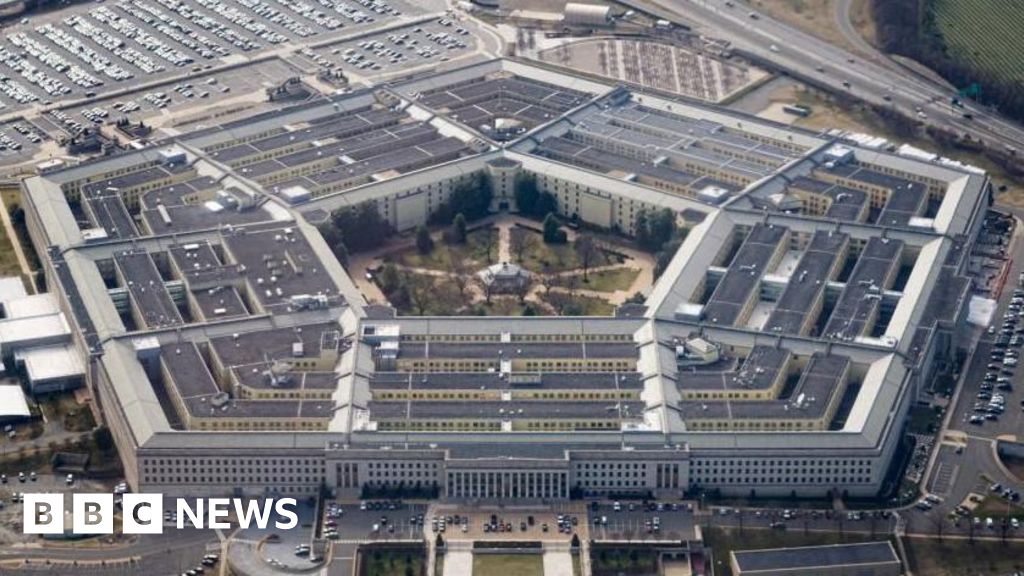
The Pentagon's Grand Reassessment: Beyond China, A New Era for U.S. National Security Strategy
The release of the Pentagon's quadrennial National Defense Strategy (NDS) has sent ripples across global strategic circles, signaling a profound shift in America's security calculus. For the first time in recent memory, China has been dethroned as the United States' top security priority, marking a significant departure from the concentrated focus that has characterized U.S. defense planning for years. This strategic pivot promises to reshape not just America's military posture, but also its relationships with allies and adversaries alike, ushering in a potentially new era of global geopolitics.
A Strategic Pivot: Understanding the Shift
For years, U.S. defense policy has been largely anchored around the concept of 'great power competition,' with Beijing often cited as the singular, overarching challenge to American primacy and global stability. The previous NDS iterations emphasized countering China's growing military influence, particularly in the Indo-Pacific, and investing heavily in capabilities designed to deter or, if necessary, confront Chinese aggression. This new document, however, indicates a broadened perspective, suggesting that the threats facing the U.S. are more diversified and complex than a single state actor.
While the full scope of the 'new' top priority is not entirely detailed in initial reports, the move away from exclusively naming China suggests a recognition of a more multifaceted threat landscape. This could encompass a broader array of systemic challenges, including the resurgence of other revisionist powers, the proliferation of advanced weaponry, the persistent threat of terrorism, climate change's destabilizing effects, and the ever-evolving domain of cyber and space warfare. The shift implies a strategy that prioritizes national resilience and a more agile response to diverse and emergent threats, rather than solely focusing on a singular rival.
The Nuance of "More Limited Support" for Allies
Perhaps one of the most immediate and consequential implications of this new NDS is the explicit mention of offering “more limited” support to U.S. allies. This phrase, though brief, carries immense weight for nations that have historically relied on American security guarantees. For NATO members, Indo-Pacific partners like Japan, South Korea, Australia, and other bilateral allies, this could signal a strategic re-evaluation of their own defense expenditures and self-reliance capabilities.
The U.S. has long called for burden-sharing among its allies, but this NDS statement could mark a more forceful push in that direction. Allies might interpret this as a need to rapidly modernize their own forces, increase defense budgets, and potentially forge stronger regional security arrangements independent of direct U.S. leadership. While some might view this as a necessary step towards a more balanced global security architecture, others might perceive it as a reduction in American commitment, potentially leading to anxiety and uncertainty in already volatile regions.
Implications for U.S.-China Dynamics
The change in priority does not necessarily signify a de-escalation of U.S.-China competition, but rather a re-framing of it. It suggests that while China remains a significant concern, the U.S. recognizes that an exclusive focus might detract from other pressing national security imperatives. This could lead to a more nuanced approach, where competition in economic, technological, and ideological spheres takes precedence, rather than an overwhelming emphasis on military confrontation.
For Beijing, this pivot might be interpreted in various ways – as a sign of U.S. overstretch, a strategic miscalculation, or perhaps an opportunity to assert influence in areas where U.S. attention may be less concentrated. Regardless, the shift will undoubtedly compel China to reassess its own long-term strategic planning and how it views its competition with the United States.
Broader Global Repercussions
Beyond U.S.-China relations and allied commitments, this NDS will reverberate globally. Other powers, from Russia and Iran to emerging regional players, will closely analyze this strategic document for cues on U.S. foreign policy and military engagement. The potential for perceived power vacuums or shifts in strategic alliances could redefine regional dynamics and potentially spark new security dilemmas.
Furthermore, the NDS’s focus on a broader threat spectrum implies increased investment in areas like cyber defense, artificial intelligence, biotechnology, and resilient supply chains. The very definition of 'national security' is expanding, moving beyond traditional military might to encompass technological dominance and societal resilience.
In conclusion, the Pentagon's new National Defense Strategy is far more than a bureaucratic update; it is a fundamental re-evaluation of America's place and priorities in a rapidly evolving global landscape. By moving beyond a singular focus on China and signaling a more limited direct engagement with allies, the U.S. is charting a new course that will undoubtedly shape the future of international security, demanding adaptation from friends and rivals alike.