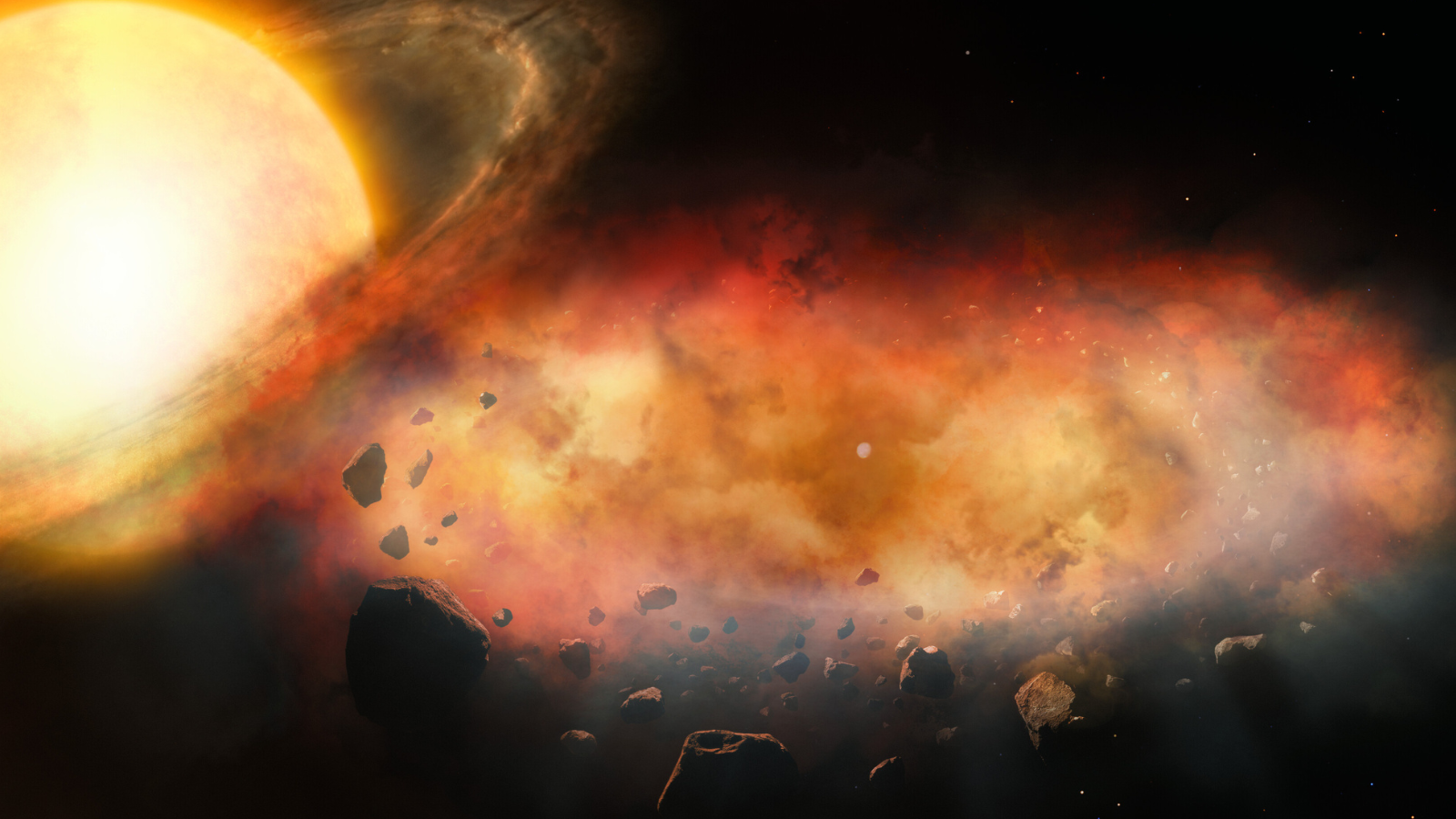
In the vast, inky canvas of space, where light journeys for millennia, astronomers have stumbled upon a discovery that challenges our fundamental understanding of cosmic phenomena. A colossal cloud, spanning an unimaginable 120 million miles – larger than the orbit of Venus – has been found to be composed of swirling winds of vaporized metal. This isn't just an ordinary nebula; this is an extraordinary event, as this gargantuan metallic tempest is inexplicably bound by an unseen, 'mystery object'. The implications are profound, hinting at either revolutionary physics or perhaps, something far more unconventional.
An Unprecedented Phenomenon: Vaporized Metal on a Cosmic Scale
The sheer scale of this metallic cloud defies easy comprehension. To put it into perspective, 120 million miles is approximately 1.3 times the distance from the Earth to the Sun. Yet, within this vast expanse, astronomers detect not gas and dust as in typical nebulae, but a volatile concoction of vaporized metals. This alone signals extreme conditions, requiring immense energy to keep such heavy elements in a gaseous, swirling state. The light from a distant star, once bright and clear, is now dimmed and distorted, filtered through this opaque, metallic shroud. What could generate and sustain such a unique and energetic environment?
The Invisible Architect: What Binds the Unbound?
The most perplexing aspect of this discovery is the 'mystery object' that appears to be holding this immense cloud together. Gravitational forces, while potent, typically act to condense matter, not to suspend a diffuse, vaporized cloud over such an enormous distance. If it were a supermassive black hole or a neutron star, we would expect to see distinct gravitational lensing effects, accretion disks, or immediate collapse of the cloud towards its center – none of which have been definitively observed in a manner that fully explains the cloud's stability and diffuse nature.
Could it be an entirely new class of astronomical body? Perhaps an elusive form of dark matter with unexpected properties, or a previously theorized but unconfirmed exotic star type? The stability of the cloud, resisting the powerful dispersive forces of its own swirling winds and the vacuum of space, suggests an incredibly strong, yet enigmatic, binding mechanism. This phenomenon pushes the boundaries of our current astrophysical models, forcing us to consider possibilities ranging from overlooked gravitational nuances to entirely new physical interactions.
Future Implications: Redefining Cosmic Understanding
The existence of such an object and its peculiar influence could have far-reaching implications for our understanding of galactic dynamics, stellar evolution, and even fundamental physics. If this 'mystery object' is a natural phenomenon, it could represent a critical missing piece in our cosmic puzzle, potentially hinting at new types of stellar remnants, or even a novel gravitational interaction yet to be described by theory. What if it’s a form of matter that interacts with vaporized metal in a way we don’t understand, or a magnetic field of unimaginable strength?
The scientific community is buzzing with speculation. Teams are undoubtedly scrambling to direct the most powerful telescopes, like the James Webb Space Telescope and forthcoming observatories, towards this cosmic anomaly. Spectroscopic analysis will be crucial to understand the exact composition of the metallic vapor, while gravitational lensing studies could provide clues about the mass and nature of the unseen binder. This discovery serves as a powerful reminder that our universe holds countless secrets, constantly challenging our assumptions and pushing the frontiers of knowledge.
A Glimpse Beyond the Known
In an era of incredible astronomical advancements, the 120-million-mile vaporized metal cloud, bound by an invisible hand, stands as one of the most compelling cosmic mysteries of our time. It’s a profound testament to the universe’s capacity for wonder and the endless pursuit of understanding that defines human curiosity. As 'NovaPress' continues to follow this developing story, one thing is certain: the cosmos has just presented us with a riddle that could redefine our place within its grand design.