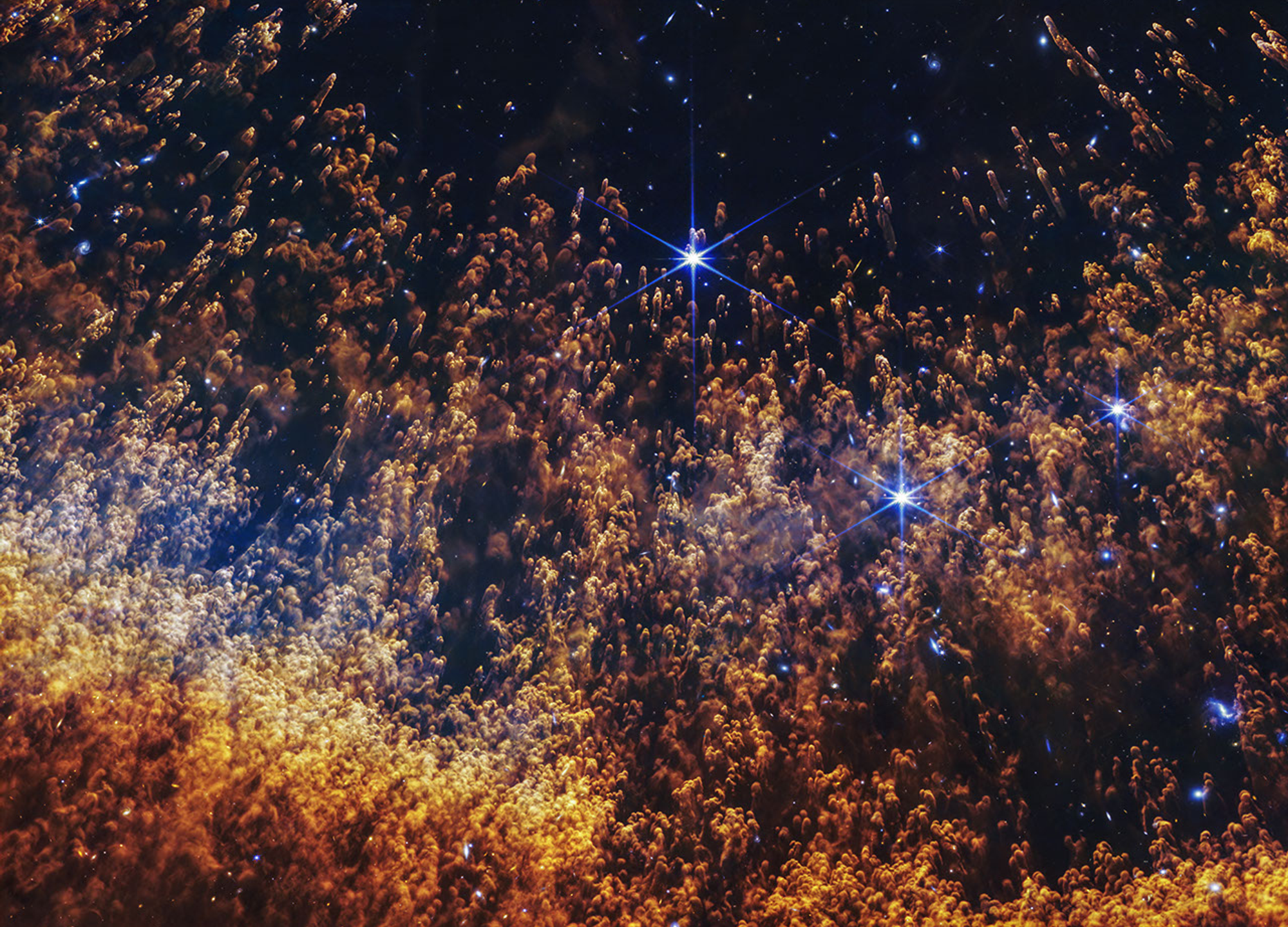
Cosmic Alchemy: Webb Telescope Unveils Stellar Demise as the Genesis of New Worlds
The cosmos, a grand theater of creation and destruction, consistently offers spectacles that challenge our understanding and expand our imagination. The latest marvel unveiled by the James Webb Space Telescope (JWST) is not just another breathtaking image; it's a profound narrative etched in starlight and dust – the final, spectacular breath of a star transforming into the raw ingredients for new worlds. This unparalleled clarity provided by Webb is not merely aesthetically pleasing; it is a critical window into the fundamental processes that govern the universe's material cycle.
The Swan Song of a Star: Understanding Planetary Nebulae
What Webb has captured with phenomenal clarity is a planetary nebula, a misnomer coined in the 18th century due to their spherical, planet-like appearance through early telescopes. In reality, these are the radiant shrouds cast off by dying stars, typically those with masses similar to our Sun, as they exhaust their nuclear fuel. After billions of years burning hydrogen, these stars swell into red giants, shed their outer layers, and leave behind a super-dense, hot core called a white dwarf. The expelled gas and dust, illuminated by the intense ultraviolet radiation from the nascent white dwarf, glow in a kaleidoscope of colors – each hue a chemical signature of the elements being flung into space.
Webb's Unprecedented Gaze: A Deeper Spectrum of Creation
The JWST, with its advanced infrared capabilities, cuts through the obscuring dust that often veils the intricate structures of these nebulae from ground-based telescopes and even its predecessor, Hubble. This deep penetration allows scientists to observe not just the aesthetic beauty, but the precise chemical composition and intricate dynamics of these expanding shells. The 'colors' Webb reveals are more than just visual delights; they are spectroscopic maps. They show the distribution of heavy elements – carbon, oxygen, nitrogen, neon – forged within the star's fiery heart over its lifetime and now dispersed into the vast emptiness of interstellar space.
This level of detail is transformative. We can now trace the filaments of gas, the shockwaves, and the complex geometries with a precision never before possible. It’s akin to moving from a blurry watercolor to a high-definition photograph, allowing astrophysicists to model the physics of stellar mass loss with unprecedented accuracy.
From Death to Life: The Cosmic Foundry of New Worlds
Perhaps the most profound implication of these observations is the direct visualization of how dying stars literally sow the seeds for future cosmic structures. The heavy elements expelled during a star's final breath are not merely waste products; they are the fundamental building blocks. Carbon forms organic molecules, oxygen makes water, silicon forms rocks – all essential components for planets, and ultimately, for life as we know it.
These newly enriched clouds of gas and dust will, over millions of years, cool and coalesce. Under the influence of gravity, they will eventually collapse to form new generations of stars, often encircled by protoplanetary disks – the nurseries where planets are born. Every atom of carbon in our bodies, every speck of iron in our planet's core, was once forged in the heart of a star and scattered across the galaxy by events like the one Webb has so vividly captured.
Future Implications and the Cycle of Existence
The Webb's detailed images of planetary nebulae provide critical data points for refining our models of stellar evolution and galactic chemical enrichment. By understanding the precise mechanisms and rates at which stars recycle their material, we gain deeper insights into the timeline of element availability in different regions of the galaxy. This directly impacts our understanding of when and where rocky planets capable of supporting life might have formed throughout cosmic history.
Ultimately, Webb's vision of these cosmic cocoons reminds us of the universe's elegant, relentless cycle. Death is not an end, but a spectacular, vibrant transformation into the raw materials for new beginnings. The universe is a grand, continuous act of recycling, where the breathtaking demise of one star lays the foundation for the eventual birth of others – and perhaps, entire new planetary systems teeming with life. Webb's revelations confirm that beauty, destruction, and creation are inextricably linked in the grand tapestry of space.