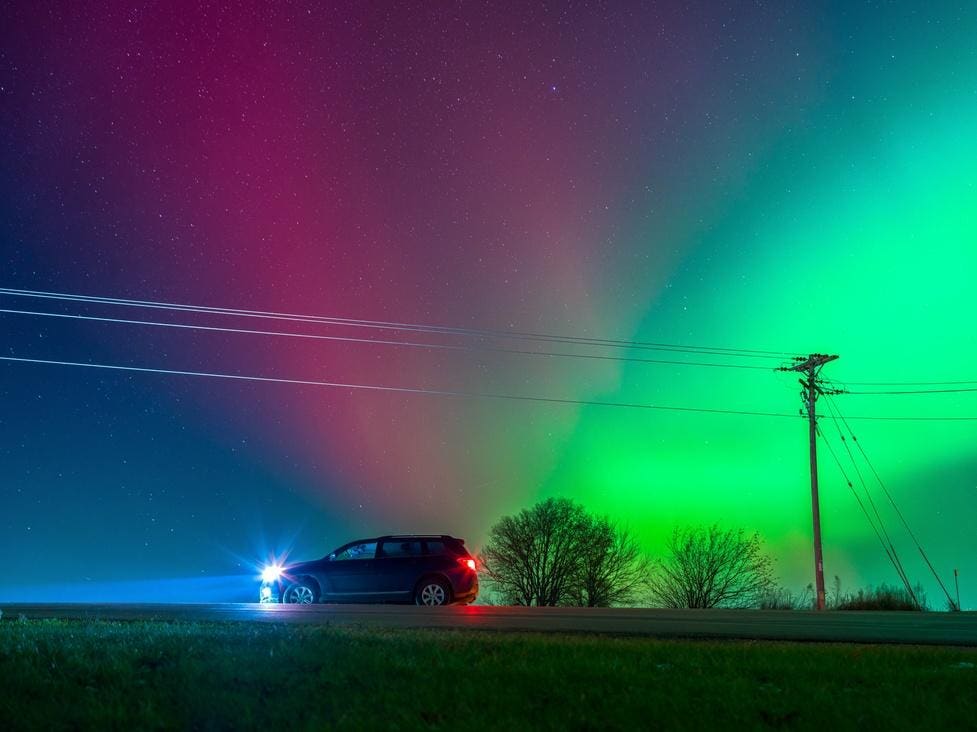
Aurora Alert: Why the Northern Lights Are Dancing Closer to the US Border – And What It Means for Future Skygazers
For many, the ethereal glow of the aurora borealis remains a bucket-list spectacle, often associated with the far reaches of Scandinavia, Canada, or Alaska. Yet, an increasingly frequent and thrilling phenomenon is bringing this celestial ballet much closer to home for millions in the United States. Thanks to heightened solar activity, the Northern Lights are once again forecast to be visible from states hugging the U.S.-Canadian border, presenting a rare and captivating opportunity for stargazers in the lower 48.
The National Oceanic and Atmospheric Administration (NOAA) has been at the forefront of these forecasts, tracking the solar winds and geomagnetic storms that are the architects of the aurora. While specific viewing windows can be fleeting, these alerts underscore a broader trend: a dynamic period in our sun's cycle that promises more such dramatic displays.
The Science Behind the Spectacle: Solar Flares and Earth's Magnetic Field
The aurora borealis is not just a pretty light show; it's a direct consequence of the intricate, violent dance between our sun and Earth's protective magnetic field. At its core, the phenomenon begins with the sun. Our star constantly emits a stream of charged particles known as solar wind. Occasionally, more powerful eruptions, such as solar flares or coronal mass ejections (CMEs), unleash vast quantities of plasma and magnetic fields into space at incredible speeds.
When these charged particles from the sun collide with Earth's magnetosphere – the magnetic field that envelops our planet – they are largely deflected. However, some particles are trapped and guided towards the magnetic poles. As these high-energy electrons and protons plunge into Earth's upper atmosphere, they collide with atoms of oxygen and nitrogen. These collisions excite the atmospheric gases, causing them to emit photons of light – the vibrant reds, greens, blues, and purples we associate with the aurora.
The color variations themselves are a testament to the specific gases involved and the altitude at which the collisions occur. Oxygen typically produces green and red light, while nitrogen contributes to blue and purple hues.
A Rare Glimpse: Why These Southern Sightings Are Significant
While auroras are a regular occurrence in the polar regions, their visibility in the lower 48 states is a rarer event. This southward expansion of the auroral oval is typically indicative of a strong geomagnetic storm, measured by indices such as the Kp-index. A Kp-index of 5 or higher usually signifies a geomagnetic storm, with higher numbers correlating to more intense storms and broader visibility.
For states like Michigan, Minnesota, Wisconsin, Montana, North Dakota, Idaho, and Maine, which share a border with Canada, these strong storms offer a legitimate, albeit often challenging, opportunity to witness the aurora without traveling to sub-arctic latitudes. These events are not just visual treats; they are also important for scientific study, helping researchers better understand space weather and its potential impacts on satellites, power grids, and communication systems.
Preparing for the Show: Tips for Catching the Aurora
Catching the Northern Lights requires a blend of preparation, patience, and a bit of luck. Here are NovaPress's top tips for maximizing your chances:
- Monitor Forecasts: Keep an eye on NOAA's Space Weather Prediction Center (SWPC) for real-time Kp-index forecasts and aurora alerts.
- Seek Dark Skies: Light pollution is the aurora's worst enemy. Drive away from city lights to a rural area with an unobstructed view of the northern horizon.
- Timing is Key: The best viewing window is typically between 10 PM and 2 AM local time, though strong storms can make them visible earlier or later.
- Look North: While intense auroras can fill the sky, their origin point will always be in the north.
- Patience: Auroras can be fickle. They ebb and flow in intensity, so be prepared to wait. What starts as a faint glow might erupt into a vibrant display.
- Photography: Even if your eyes struggle to see distinct colors, a modern smartphone or DSLR camera on a tripod with a long exposure (10-30 seconds, high ISO) can often capture the aurora's hidden beauty.
The Solar Cycle: A Glimmer of More to Come?
These recent southern aurora sightings are not isolated incidents but rather part of a larger cosmic rhythm. Our sun operates on an approximately 11-year solar cycle, characterized by periods of high and low activity. We are currently heading towards the peak of Solar Cycle 25, which is projected to reach its maximum sometime in 2024-2025. This means an increased likelihood of solar flares and CMEs, and consequently, more frequent and potentially stronger geomagnetic storms.
For skygazers across the globe, and particularly those in mid-latitudes, this period presents an unprecedented opportunity to witness the aurora borealis. The prospect of these celestial dances gracing our skies with greater regularity offers a powerful reminder of the dynamic forces at play in our solar system and the stunning beauty they can unleash.
As we continue to receive these exciting forecasts, it's a perfect time to step outside, look up, and connect with the profound wonders of our universe. The aurora is not just a light show; it's a living canvas, constantly repainted by the sun, inviting us all to gaze in awe.