Unearthing a Ghost Plate: How a Long-Lost Fragment is Complicating Cascadia's Seismic Future
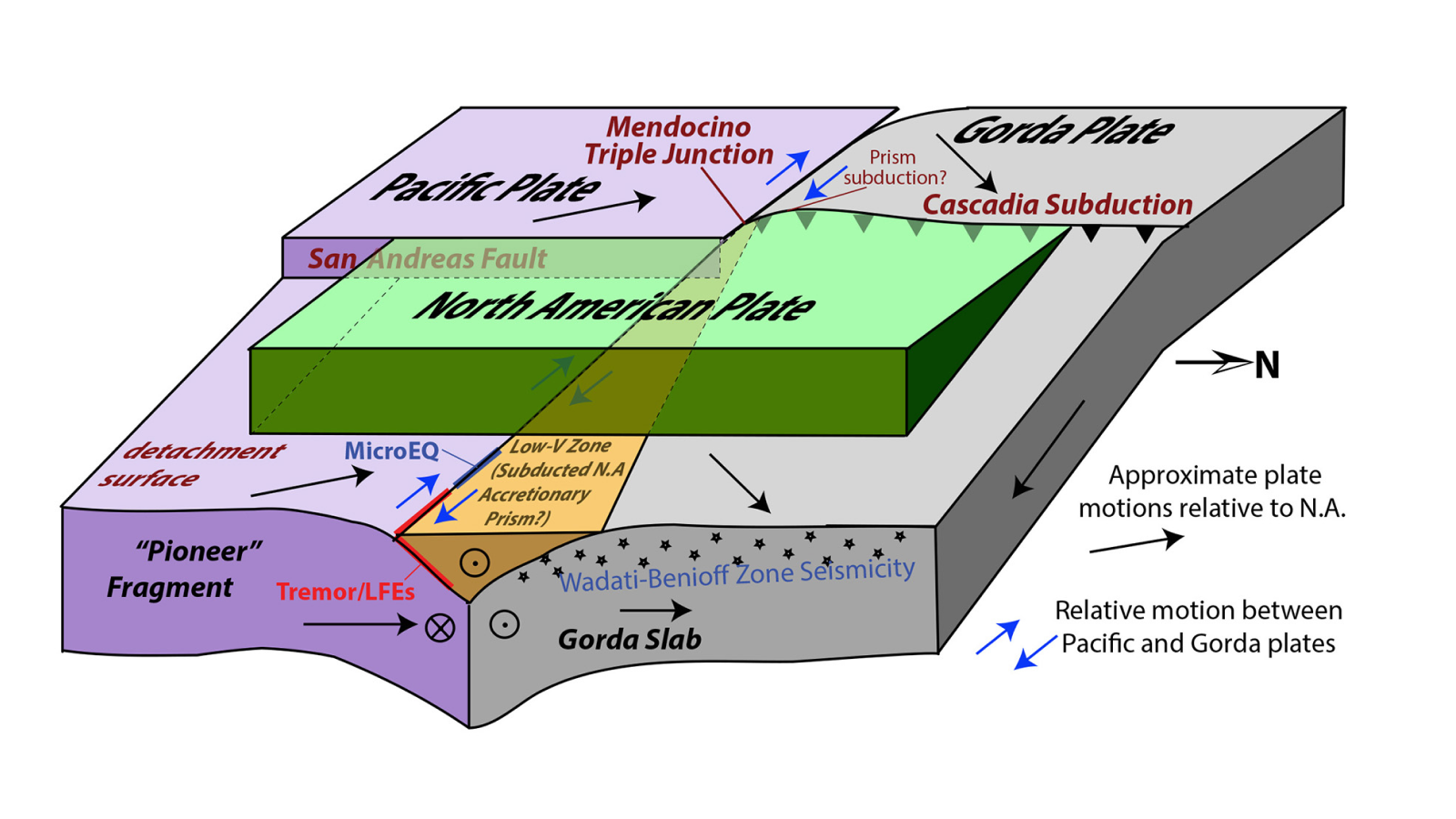
The Earth's crust is a dynamic canvas, constantly shifting and reshaping our world. Yet, even with advanced scientific tools, profound secrets remain hidden beneath the surface. Scientists have recently unveiled one such secret: a substantial fragment of a long-lost tectonic plate, silently sliding beneath the North American continent at the critical juncture where the notorious San Andreas Fault meets the volatile Cascadia Subduction Zone. This discovery is not merely an academic curiosity; it's a complex new variable in the already precarious equation of earthquake risk for millions in the Pacific Northwest.
A Tectonic Tapestry: Understanding the Regional Dynamics
To grasp the significance of this revelation, one must first understand the geological titans at play. The Cascadia Subduction Zone, a 700-mile stretch off the coast from Northern California to British Columbia, is where the Juan de Fuca, Gorda, and Explorer plates are diving beneath the North American Plate. This immense convergence has the potential to unleash 'megathrust' earthquakes of magnitude 8 or 9, capable of causing widespread devastation and tsunamis, as evidenced by the last known event in 1700. For decades, scientists have meticulously modeled the stress accumulation and potential rupture scenarios along this zone, bracing for 'The Big One'.
Further south, the San Andreas Fault is a right-lateral strike-slip fault forming the tectonic boundary between the Pacific Plate and the North American Plate. Responsible for countless tremors and infamous major quakes throughout California's history, its southern termination approaches the Cascadia system, creating a geometrically complex and seismically active region.
The Discovery: A Relic of Ancient Earth
The newly identified fragment is a remnant of the 'Farallon Plate', an ancient oceanic plate that largely subducted beneath North America millions of years ago, giving rise to mountain ranges like the Rockies. What scientists have now found is a significant piece of this ancestral plate that, against prior assumptions, did not fully disappear. Instead, it remains 'stuck' to the Pacific Ocean floor and is actively being dragged eastward, sliding underneath the North American continent in the southern reaches of the Cascadia subduction zone. This 'ghost' fragment, far from being inert, is a dynamic player in the ongoing geological drama.
Profound Implications for Earthquake Science
The presence of this unexpected tectonic fragment introduces a layer of complexity that could significantly alter our understanding of regional seismicity. Geologists have long characterized subduction zones based on the interaction of known plates. The introduction of an additional, deeply buried entity demands a re-evaluation of existing models:
- Stress Accumulation: How does this fragment influence the locking and slipping behavior of the Cascadia interface? Does it act as a major sticking point, increasing stress build-up in certain areas, or does it facilitate creep, releasing stress more gradually?
- Rupture Dynamics: The fragment's uneven geometry and different material properties could significantly affect how a megathrust earthquake rupture propagates. It might deflect, halt, or even amplify seismic waves in unpredictable ways.
- Revisiting Seismic Hazard Maps: Current hazard assessments, which inform building codes and emergency preparedness plans, are based on the best available geological models. This discovery necessitates a thorough reassessment of earthquake probabilities and potential intensities, especially in the southern Cascadia region.
- Tectonic Evolution: Beyond immediate risk, the finding offers unprecedented insights into the long-term tectonic evolution of western North America. It prompts new questions about the fate of subducted plates and the intricate mechanics of their remnants.
The Path Forward: Enhanced Monitoring and Research
This discovery underscores the critical importance of ongoing geological research and advanced seismic monitoring. Scientists will now focus on more detailed imaging of this fragment, using techniques like seismic tomography to map its exact dimensions, depth, and material properties. Sophisticated computational models will be required to simulate its interaction with the surrounding plates and predict its influence on future earthquake scenarios.
For the communities living along the Cascadia margin, this information, while complex, is vital. It reinforces the need for robust infrastructure, stringent building codes, and comprehensive emergency preparedness plans. A deeper, more nuanced understanding of the Earth beneath our feet is our best defense against its raw power.
Conclusion: A Planet Full of Surprises
The unearthing of this ancient tectonic fragment is a powerful reminder that our planet, even in its most well-studied regions, still holds profound secrets. It reshapes our geological map, adds a new chapter to Earth's history, and crucially, compels us to refine our understanding of earthquake risk in one of the world's most seismically active regions. As NovaPress continues to follow this developing story, one thing is clear: the ground beneath us is far more complex, and potentially more surprising, than we ever imagined.