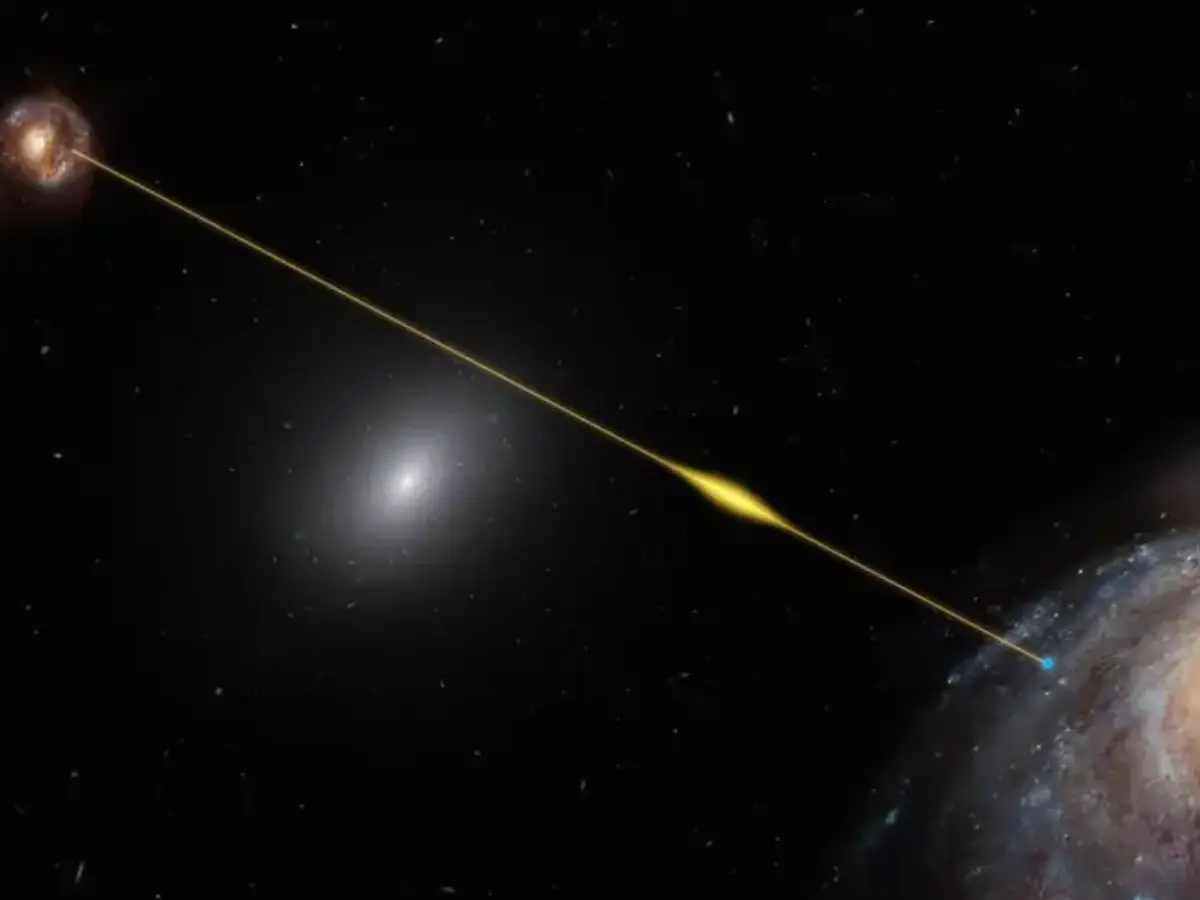
Imagine receiving a message sent almost at the very beginning of time, a fleeting signal that journeyed through the cosmos for 13 billion years before finally reaching its destination. On March 14, 2025, humanity did just that. The Space-based multi-band astronomical Variable Objects Monitor (MRO) satellite, a testament to Franco-Chinese collaboration, detected a gamma-ray burst (GRB) lasting a mere ten seconds. This isn't just an astronomical curiosity; it's a profound echo from the universe's infancy, offering unprecedented insights into its earliest moments, the nature of time in space, and the grand cosmic drama that continues to unfold.
The Cosmic Whisperer: Decoding a Gamma-Ray Burst
Gamma-ray bursts are the most powerful explosions in the universe, typically originating from the collapse of massive stars into black holes or the merger of neutron stars. This particular GRB, though brief, carries a gravitational weight of immense significance due to its extreme distance. Traveling 13 billion light-years means the light we just observed left its source when the universe was less than a billion years old. To put that in perspective, our sun wouldn't even exist for another 8-9 billion years. What we've witnessed is essentially the 'death cry' of one of the universe's very first stars, a primordial giant whose demise helped forge the building blocks for future generations of stars and galaxies, including our own.
A Glimpse into the Primordial Universe
The early universe was a vastly different place. Denser, hotter, and populated by stars far more massive and short-lived than those we see today. These first stars, known as Population III stars, were critical for 'reionization' – a period when the neutral hydrogen fog that permeated the early cosmos was burned away by their intense ultraviolet radiation, making the universe transparent to light. By analyzing the faint imprint of this GRB, scientists can glean invaluable data about the composition, density, and dynamics of the universe at that epoch. It provides a direct observation, a timestamped snapshot, of conditions shortly after the Big Bang, helping to refine our cosmological models and understand how the first structures began to coalesce.
The Warping of Time and Space
The description's mention of 'how time warps in space' is particularly apt when considering events across such vast cosmic distances. While the GRB lasted only ten seconds at its source, its journey of 13 billion years through an expanding universe means that the light itself has stretched. This phenomenon, known as cosmological redshift, means the gamma-rays have been stretched into longer wavelengths, observed by MRO as radio signals. The very expansion of space-time stretches light waves, acting as a cosmic speedometer and clock. Understanding this distortion is crucial for accurately determining the burst's true energy, its original duration, and its precise location within the fabric of early space-time. It's a testament to Einstein's theories on relativity playing out on the grandest stage imaginable.
Pioneering Observatories and International Collaboration
The detection by the Space-based multi-band astronomical Variable Objects Monitor (MRO) satellite underscores the incredible advancements in astronomical technology and the power of international scientific collaboration. A joint French-Chinese mission, MRO is designed to monitor transient astronomical events across multiple wavelengths, making it uniquely suited to capture such fleeting yet profound signals. This success highlights the global effort required to push the boundaries of human knowledge and our collective ability to listen to the whispers of the ancient cosmos, even if they are faint and brief.
Future Implications and Unanswered Questions
This 10-second 'death cry' is far more than an interesting anecdote; it's a potent catalyst for future research. What were these early stars truly like? How did they die? What kind of environments did they create? Such observations provide empirical data for theoretical astrophysics, helping us to understand the formation of the first black holes, the seeding of galaxies, and perhaps even offering clues about the elusive nature of dark matter and dark energy that continue to shape the universe. Each ancient signal is a piece of a cosmic puzzle, bringing us closer to a complete picture of our origins and destiny.
Conclusion
The detection of this 13-billion-year-old, 10-second gamma-ray burst is a monumental achievement in astronomy, a direct communication from the universe's earliest epochs. It reminds us that even the briefest events can carry the most profound information, bridging unimaginable spans of time and space. As NovaPress continues to report on these breakthroughs, we invite our readers to ponder the incredible story written in the stars – a narrative we are only just beginning to decipher, one ancient 'death cry' at a time.