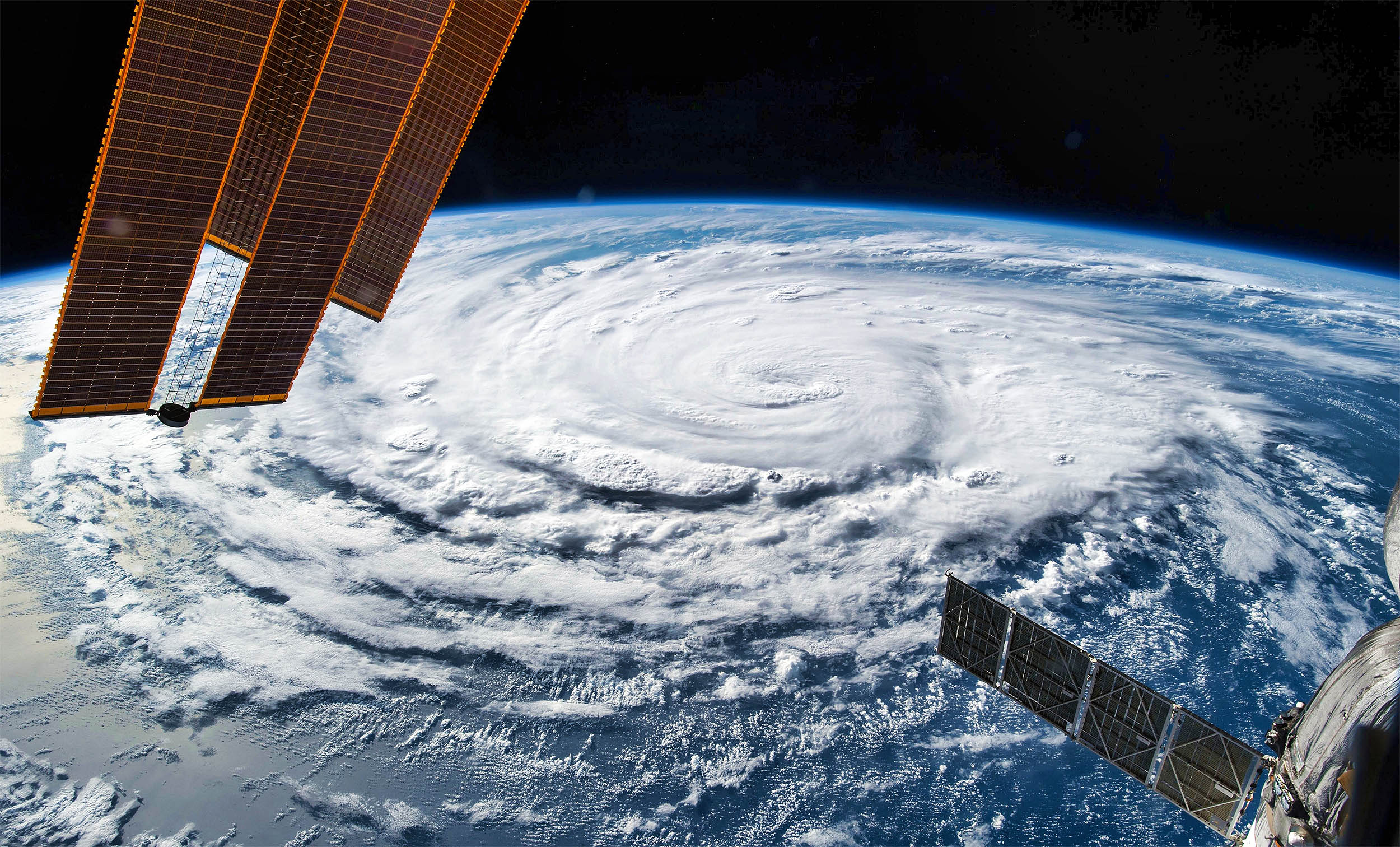
Beyond the Storm: How Hurricane Helene Unveiled a Shocking Connection 55 Miles Above Earth
A groundbreaking discovery by NASA's AWE mission reveals that extreme terrestrial storms wield influence far into our upper atmosphere, challenging long-held scientific assumptions.
The fury of Hurricane Helene as it lashed the Florida coast was a spectacle of raw power, a devastating reminder of nature's might. Fierce winds tore through communities, and torrential rains brought widespread flooding, leaving a path of destruction in its wake. Yet, according to a recent revelation from NASA, the impact of Helene didn't stop at the troposphere, the lowest layer of our atmosphere where all weather occurs. Its energetic signature rippled upwards, an astounding 55 miles into space, initiating a never-before-seen atmospheric event detected by the International Space Station's (ISS) Atmospheric Waves Experiment (AWE).
The Unseen Reach of Terrestrial Storms
For decades, scientists have studied hurricanes and other severe weather phenomena primarily within the context of the lower atmosphere. Models predicted localized effects, with energy dissipating long before reaching the ionosphere or even the mesosphere – the region around 55 miles (88 kilometers) above Earth's surface. The AWE mission, specifically designed to observe atmospheric gravity waves and their impact on Earth's upper atmosphere, has now provided direct evidence that these assumptions were incomplete. The instruments on the ISS picked up distinct atmospheric waves directly correlating with Hurricane Helene’s passage.
What are Atmospheric Waves and Why Do They Matter?
Atmospheric waves are disturbances that propagate through the atmosphere, much like ripples in a pond. They are crucial for transporting energy and momentum vertically through different atmospheric layers. Gravity waves, a specific type of atmospheric wave, are generated by various phenomena, including weather systems, terrain, and even seismic activity. When a powerful storm like Helene churns, it creates massive updrafts and downdrafts, essentially "pushing" and "pulling" on the air above it. This vigorous motion can launch gravity waves that travel upwards, sometimes reaching extremely high altitudes.
The detection of these waves at 55 miles up is extraordinary because it signifies a direct and powerful coupling between a major weather event in the troposphere and the highly sensitive environment of the mesosphere and lower thermosphere. This region, often referred to as the "gateway to space," plays a vital role in Earth's energy balance and influences phenomena like the aurora and satellite drag.
Rewriting the Atmospheric Rulebook
This discovery has profound implications for our understanding of Earth's interconnected systems. It suggests that extreme weather events are not merely confined to their immediate vicinity but can exert a far-reaching influence, impacting regions previously thought to be isolated. This new insight challenges existing atmospheric models that largely treat upper and lower atmospheric layers as separate entities with minimal direct interaction. Integrating this newfound coupling will be crucial for developing more accurate and holistic models of Earth's atmosphere.
For space weather forecasters, this could mean considering terrestrial weather patterns when predicting conditions for satellites, GPS communications, and even astronaut safety. Changes in the upper atmosphere's density and composition, driven by these storm-induced waves, can affect satellite orbits and signal propagation.
Future Implications and Research Pathways
The AWE mission continues to collect invaluable data, and scientists are now tasked with unraveling the full extent of this storm-to-space connection. Key research areas will include:
- Quantifying Energy Transfer: Precisely how much energy is transferred from a hurricane to the upper atmosphere, and what are the mechanisms?
- Global Impact Assessment: Do other extreme weather events (e.g., severe thunderstorms, volcanic eruptions) also generate similar upper-atmospheric responses? What is the cumulative effect on a global scale?
- Refining Climate Models: How will incorporating this vertical coupling affect our predictions for long-term climate change and its impact on atmospheric circulation?
- Predictive Capabilities: Can we develop new forecasting tools that anticipate these upper-atmospheric disturbances based on lower-atmospheric weather patterns?
This discovery serves as a powerful reminder of the delicate and dynamic nature of our planet. Just when we think we understand its complexities, Earth reveals another layer of interconnectedness, pushing the boundaries of scientific inquiry. The legacy of Hurricane Helene, therefore, extends beyond the devastation it caused on the ground; it has opened a new window into the mysterious interplay between our weather and the very edge of space.
Stay tuned to NovaPress for more updates on this groundbreaking research and its implications for our understanding of Earth and beyond.