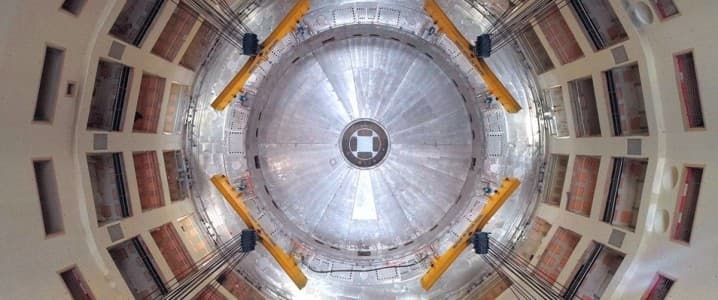
In a monumental stride that could redefine the global energy landscape, Chinese researchers have announced a breakthrough in nuclear fusion, successfully overcoming a long-standing barrier known as the Greenwald density limit. This achievement, reported from China's heavily invested fusion programs, signals a significant acceleration in the race towards commercially viable clean energy and positions China at the forefront of this high-stakes scientific frontier.
Understanding the Greenwald Limit: The Plasma Confinement Conundrum
Nuclear fusion, the process that powers the sun, promises an almost limitless supply of clean energy by fusing light atomic nuclei. The primary challenge lies in confining extremely hot, dense plasma – a state of matter where electrons are stripped from atoms – long enough and under precise conditions for fusion reactions to occur. Tokamak reactors, donut-shaped devices, use powerful magnetic fields to achieve this confinement. However, a critical hurdle has been the Greenwald density limit, an empirical boundary dictating the maximum plasma density that can be sustained in a tokamak without causing catastrophic disruptions and loss of confinement.
Exceeding this limit has historically led to plasma instabilities, making it impossible to achieve the higher densities required for efficient fusion power generation. For decades, it has stood as a formidable barrier, hindering the path to reactors capable of generating more energy than they consume.
China's Breakthrough: A New Era for Tokamak Performance
While specific details of the experimental setup and methodology remain under wraps, the core of the Chinese researchers' report is the successful operation of a tokamak plasma beyond the Greenwald limit, achieving unprecedented densities without succumbing to disruptions. This implies they have developed new methods or refined existing ones to maintain plasma stability under conditions previously deemed impossible. This success is not merely incremental; it suggests a fundamental advancement in plasma physics and engineering, potentially unlocking higher performance regimes for current and future fusion devices.
China's investment in nuclear fusion has been immense, with projects like the Experimental Advanced Superconducting Tokamak (EAST), often dubbed the "artificial sun," consistently pushing the boundaries of plasma confinement and duration. This latest announcement underscores the strategic foresight and sustained funding that has propelled Chinese scientists to this pivotal moment.
Implications for the Global Energy Race and Future Power
The ability to operate tokamaks at higher plasma densities directly translates to increased fusion power output and improved efficiency. For a technology still striving for net energy gain (breakeven and beyond), this breakthrough brings the reality of practical fusion energy significantly closer. It could accelerate the design and construction of next-generation reactors, potentially shaving years off current development timelines.
Geopolitically, this places China in a powerful position in the global energy future. While international collaborations like ITER are vital, individual nation-state advancements can provide a competitive edge in developing proprietary technologies and achieving energy independence. This move by China is a clear signal of its intent to lead in cutting-edge energy solutions, potentially reshaping economic and strategic power balances in the coming decades.
The Road Ahead: Hurdles Remain, but Hope Ignites
Despite this monumental achievement, the journey to commercial fusion power is far from over. Significant challenges persist, including the development of materials capable of withstanding extreme neutron fluxes, the efficient extraction of energy, and achieving sustained, continuous operation. However, overcoming the Greenwald limit addresses one of the most fundamental scientific and engineering obstacles. It validates decades of theoretical work and experimental efforts, injecting renewed optimism and urgency into the global fusion community.
NovaPress will continue to track these developments closely, providing deep analysis as humanity inches closer to harnessing the power of the stars. This breakthrough is not just a scientific curiosity; it is a potential harbinger of a world powered by limitless, clean energy.