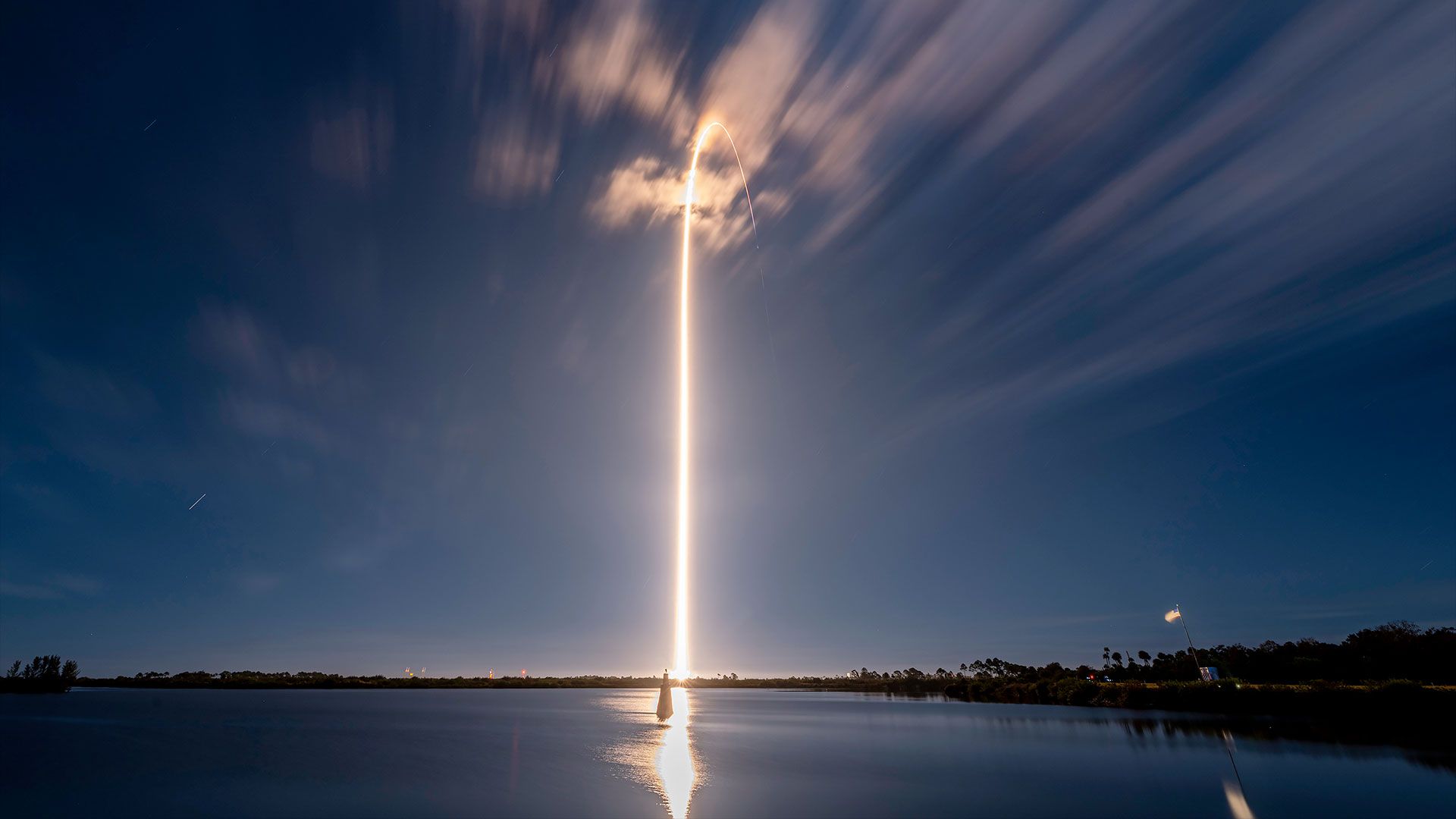
In the quiet pre-dawn hours of Sunday, January 4, 2026, at precisely 1:48 a.m. EST, SpaceX commenced its ambitious year with a familiar yet profound spectacle: the launch of the first Starlink satellites of the new year. Lifting off from Florida, a brand new Falcon 9 rocket propelled 29 internet broadband relay satellites into low Earth orbit, marking not just another mission but a significant stride in the relentless expansion of a network poised to redefine global communication.
The Relentless March of the Megaconstellation
This latest deployment is more than just a routine launch; it underscores SpaceX's unwavering commitment to building out its Starlink megaconstellation, an audacious project designed to deliver high-speed, low-latency internet access to every corner of the globe. From remote villages to maritime vessels and aerial transport, Starlink aims to bridge the digital divide, offering connectivity where traditional terrestrial infrastructure is impractical or nonexistent. The inclusion of a "brand new" Falcon 9 rocket for this mission highlights SpaceX's manufacturing prowess and its operational tempo, demonstrating a robust supply chain capable of producing both the launch vehicles and the satellite payloads at an unprecedented scale.
Falcon 9: The Workhorse of Orbital Expansion
While Starlink's vision is grand, its execution relies heavily on the proven reliability and reusability of the Falcon 9. Each new booster, even if destined for multiple future flights, represents a fresh investment in a system that has fundamentally altered the economics of space access. This continuous influx of new rockets, alongside the rapid refurbishment of flight-proven stages, ensures that SpaceX can maintain an astonishing launch cadence—a critical factor for a constellation that requires thousands of satellites to achieve its full potential and global coverage. The rapid deployment of these 29 satellites further cements Starlink's position as the dominant player in the nascent field of satellite internet services.
Beyond Connectivity: Strategic Implications
The implications of Starlink's rapid expansion extend far beyond simply providing internet access. On a strategic level, the ability to control and provide global internet infrastructure grants SpaceX—and by extension, the United States—significant geopolitical leverage. This network can serve as a vital communication lifeline during natural disasters, in conflict zones, or for regions with oppressive internet censorship. The dual-use nature of such technology, capable of both civilian and military applications, means its development is watched closely by nations worldwide.
Economically, Starlink represents a burgeoning market. As more satellites become operational, the network's capacity and reliability improve, attracting a wider subscriber base. This creates a powerful feedback loop: more subscribers fund more launches, which in turn leads to a more robust network. The ripple effect extends to ancillary industries, from ground station development to terminal manufacturing, fostering innovation and job creation.
The Horizon: Starlink V2 and Beyond
Looking ahead, this launch is merely a stepping stone. SpaceX is already developing next-generation Starlink satellites, often referred to as Starlink V2, which are significantly larger and possess enhanced capabilities, including direct-to-cell phone connectivity. These larger satellites are designed to be launched by Starship, SpaceX's fully reusable super heavy-lift launch system, which promises to dramatically reduce the cost per kilogram to orbit and accelerate constellation deployment even further. The ongoing launches with Falcon 9 serve to continuously bolster the existing network and gain valuable operational experience, paving the way for the eventual transition to Starship-based deployments.
Challenges and the Path Forward
Despite its successes, Starlink faces significant challenges. Concerns about space debris, light pollution affecting astronomical observations, and spectrum interference remain central to ongoing international discussions. SpaceX is actively working on mitigation strategies, including implementing satellite deorbiting systems and developing darker surfaces to reduce reflectivity. Regulatory hurdles and competition from other satellite internet providers, such as Amazon's Project Kuiper and OneWeb, also shape Starlink's trajectory.
However, with each new launch, SpaceX reinforces its lead in the race for global connectivity. The early morning liftoff on January 4, 2026, was not just another tick on a launch manifest; it was a potent symbol of human ingenuity pushing the boundaries of technology, transforming the future of communication one satellite, and one new rocket, at a time. The sky is no longer the limit; it's the beginning of a new digital frontier.