Cosmic Runaways: How Hypervelocity Stars Are Unlocking the Milky Way's Dark Matter Secrets
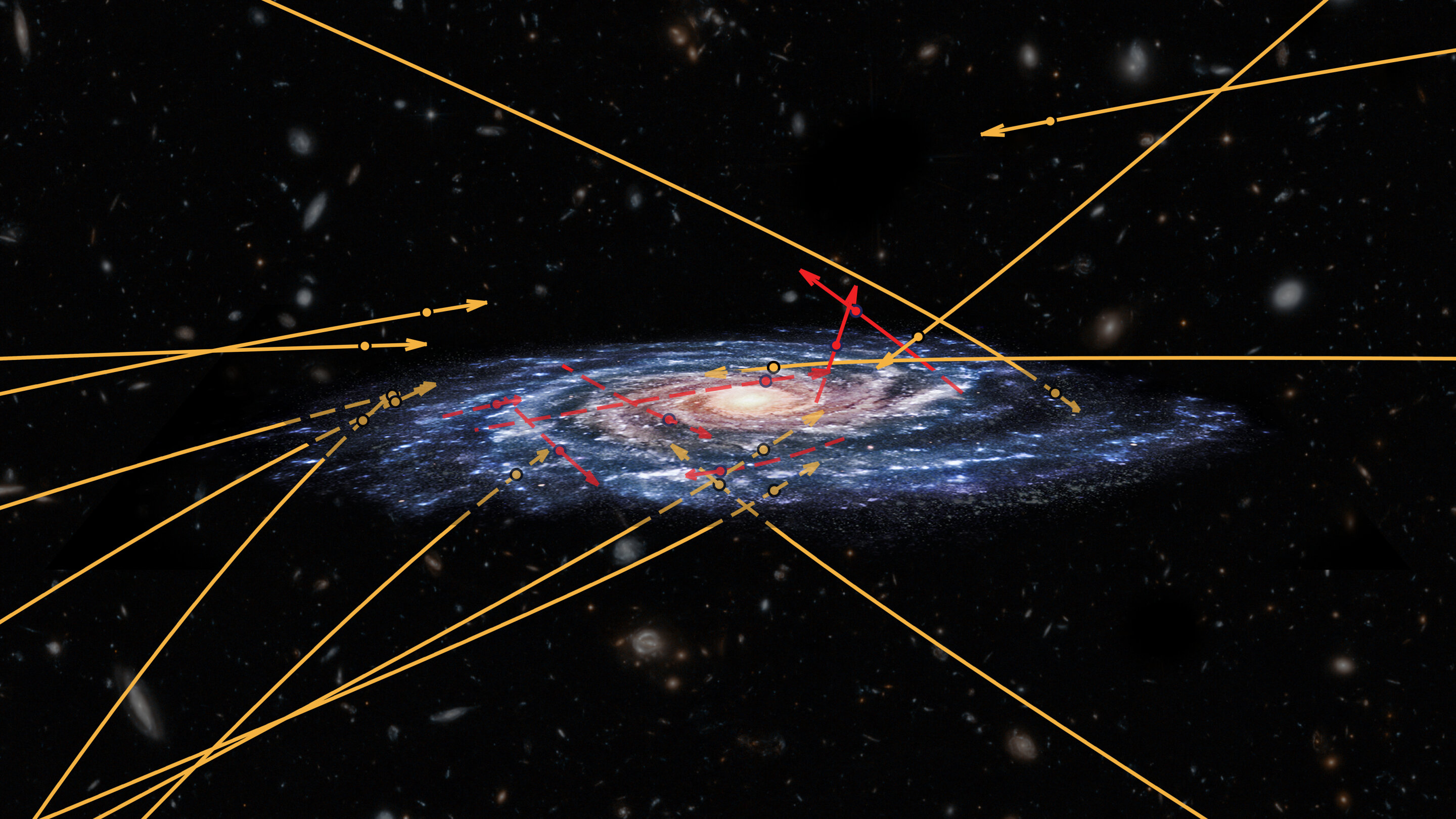
For nearly a century, astronomers have looked to the most extreme phenomena in the cosmos as their most potent tools. Among these, hypervelocity stars (HVS) – cosmic bullets ejected from the galactic core – have stood out as invaluable probes for understanding the unseen forces shaping our Milky Way. Now, a groundbreaking effort by Chinese astronomers promises to revolutionize our mapping of the galaxy’s mysterious dark matter distribution, pushing the boundaries of astronomical detection and analysis.
The Unseen Architects: Dark Matter and Galactic Gravity
Our universe is a grand tapestry woven with both visible and invisible threads. While stars, planets, and gas clouds illuminate roughly 5% of the cosmos, the vast majority – an astonishing 27% – is composed of dark matter. This enigmatic substance doesn't emit, absorb, or reflect light, making it incredibly difficult to detect directly. Yet, its gravitational influence is undeniable, acting as the primary scaffolding upon which galaxies like our Milky Way are built and structured.
The distribution of dark matter dictates the Milky Way’s gravitational potential, affecting everything from the orbital paths of stars to the rotation curves of gas disks. Accurately mapping this invisible halo is crucial for understanding galactic formation and evolution, as well as testing fundamental theories of physics.
Hypervelocity Stars: Our Cosmic Messengers
So, where do hypervelocity stars fit into this cosmic puzzle? These are stars traveling at speeds so immense – often exceeding 700 kilometers per second – that they can escape the Milky Way’s gravitational pull entirely. Most HVS are thought to originate from violent gravitational slingshot interactions with Sagittarius A*, the supermassive black hole at our galaxy’s center. As a binary star system passes too close, one star can be captured by the black hole, while its companion is flung outwards at incredible velocity.
What makes them so useful is their unique trajectory. Unlike ordinary stars bound within the galactic disk, HVS pierce through the entire galactic halo, traveling for millions of years. Their paths are meticulously sculpted by the gravitational field they traverse, which is overwhelmingly dominated by the invisible hand of dark matter. By meticulously tracking their positions, velocities, and origins, astronomers can effectively 'feel' the distribution of dark matter along their flight paths, much like throwing a ball and observing its curve to infer the wind’s strength and direction.
A New Era of Dark Matter Mapping: The Chinese Contribution
Since their theoretical prediction in the late 1980s and first detection in the early 2000s, HVS studies have been a specialized field. The recent work by astronomers from China marks a significant leap forward, undertaking a "large-volume" survey that dramatically increases the dataset of known hypervelocity stars. This expansive approach is critical because the more HVS we identify and track, the more robust and detailed our maps of the dark matter halo become.
This new survey likely leverages powerful spectroscopic instruments and advanced data analysis techniques to distinguish true HVS from other high-velocity stars, while precisely measuring their radial velocities and proper motions. A larger sample size allows for statistical averaging, reducing noise and revealing subtle patterns in the gravitational potential that single HVS observations might miss. This enhanced precision is vital for refining theoretical models of dark matter distribution – whether it forms a smooth halo, is clumpy, or exhibits other complex structures.
Challenges and the Road Ahead
While promising, mapping dark matter with HVS is not without its challenges. Identifying these rare cosmic anomalies requires vast observational campaigns and sophisticated analysis to filter out background noise and other stellar populations. Accurately determining their origins and ensuring they are indeed escapees rather than simply fast-moving disk stars also poses a significant hurdle. Furthermore, theoretical models used to interpret their trajectories need to be robust and account for all known gravitational forces within the galaxy.
Nevertheless, the path forged by these new studies is clear. The increased volume and precision of HVS data will allow astronomers to:
- Refine Dark Matter Profiles: Gain a clearer picture of the density and shape of the Milky Way’s dark matter halo, especially in its outer regions.
- Understand Galactic Core Dynamics: Shed more light on the violent interactions around Sagittarius A*.
- Test Modified Gravity Theories: Potentially distinguish between dark matter theories and alternative explanations for gravitational anomalies.
- Inform Future Missions: Guide the design of next-generation telescopes and observatories focused on cosmic dynamics.
Conclusion: A Universe Illuminated by Its Runaways
The work by Chinese astronomers leveraging hypervelocity stars is a testament to human ingenuity in confronting the universe's greatest mysteries. By turning these spectacular stellar escapees into precision instruments, we are not just adding to our catalog of cosmic oddities; we are actively piecing together the invisible architecture of our galaxy. As more HVS are discovered and their paths charted with increasing accuracy, the elusive dark matter will gradually yield its secrets, bringing us closer to a complete understanding of the Milky Way and the universe beyond.