Hubble Unveils the Enigma of 3I/ATLAS: Symmetric Jets Hint at Interstellar Secrets
The cosmos continues to surprise us, sending enigmatic visitors from beyond our solar system. The latest such guest, 3I/ATLAS, has become a focal point for astronomers worldwide, and recent observations by the venerable Hubble Space Telescope have peeled back another layer of its mystery, revealing a fascinating and variable jet structure that challenges our understanding of interstellar objects.
An Alien Visitor Under Scrutiny
Discovered in December 2019, 3I/ATLAS is the third confirmed interstellar object to traverse our solar system, following the elusive 'Oumuamua and the more cometary 2I/Borisov. Unlike its predecessors, 3I/ATLAS offered a unique opportunity for extended observation, thanks to its trajectory and proximity. Its presence in our cosmic neighborhood allows scientists to study material originating from distant stellar systems, providing invaluable clues about the diverse environments of star formation and planet evolution beyond our Sun.
Hubble's Piercing Gaze: Unveiling the Jets
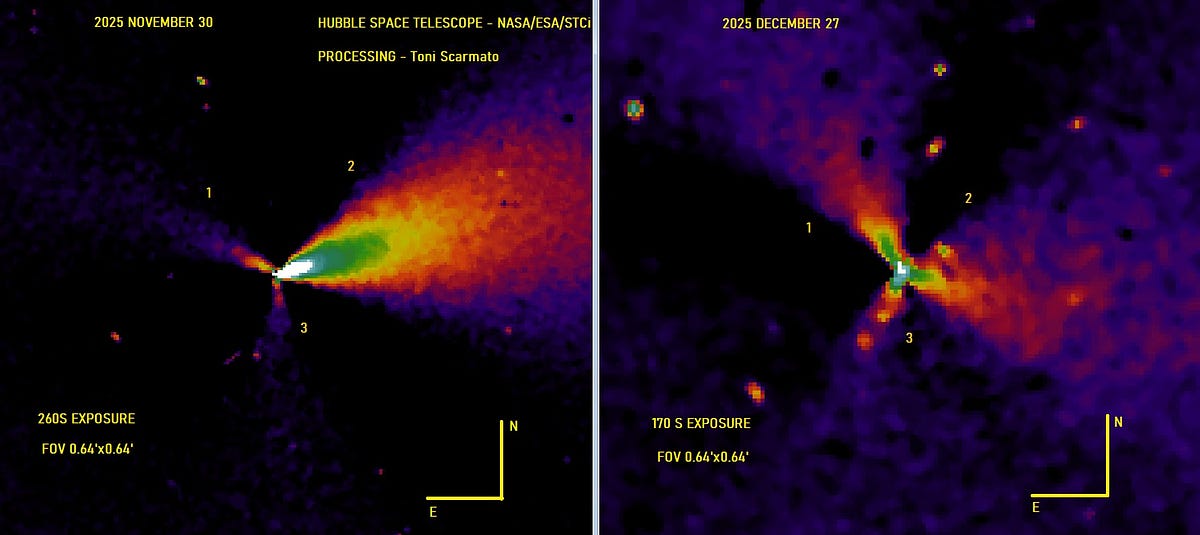
A series of seventeen detailed images captured by the Hubble Space Telescope on November 30, December 12, and December 27 have proven to be a game-changer. These observations, meticulously processed through advanced techniques like the Larson-Sekanina rotation gradient filter, have brought into sharp focus the "symmetric jet structure" emanating from 3I/ATLAS. What makes these jets particularly intriguing is their variability – a dynamic display that astronomers are now working to decipher.
The Larson-Sekanina filter is a powerful tool used in cometary studies to enhance and delineate subtle features in the coma, particularly jets, by highlighting rotational gradients. Its application here has allowed researchers to distinguish the delicate, outflowing material from the main body of 3I/ATLAS, offering an unprecedented look at its activity.
The Puzzle of Symmetry and Variability
The detection of a symmetric jet structure suggests a controlled and possibly stable expulsion of material from the object's nucleus. In solar system comets, such jets are typically formed by the sublimation of volatile ices (like water, carbon dioxide, or carbon monoxide) as the comet approaches the Sun. The Sun's heat causes these ices to turn directly into gas, carrying dust particles with them, creating the characteristic coma and tail.
However, the variability observed in 3I/ATLAS's jets adds a layer of complexity. Is this variability due to the rotation of the object, exposing different active regions to solar radiation? Or does it indicate changes in the composition or subsurface structure, leading to fluctuating outgassing rates? Understanding these dynamics is crucial for inferring the internal characteristics of this interstellar visitor.
Beyond Our Solar System: What 3I/ATLAS Tells Us
The study of 3I/ATLAS offers a direct window into the material makeup and evolutionary processes of other stellar systems. Interstellar objects are essentially cosmic samples, ejected from their home stars and traveling through the vast emptiness of space for potentially billions of years. By analyzing their composition and activity, we can gain insights into the conditions in protoplanetary disks around other stars – the very nurseries where exoplanets are born.
The strong cometary activity, as evidenced by these jets, implies that 3I/ATLAS likely contains a significant amount of volatile ice, much like our own comets. This could mean that the planetary system it originated from had a similar icy outer region, or that the object itself formed in a colder, distant part of its home system before being flung into interstellar space.
The Future of Interstellar Archaeology
The observations of 3I/ATLAS represent a triumph of modern astronomy and foreshadow an exciting future for "interstellar archaeology." As telescopes like the James Webb Space Telescope (JWST) come online and surveys like the Vera C. Rubin Observatory begin full operations, the detection rate of interstellar objects is expected to increase dramatically. Each new visitor will offer fresh opportunities to refine our models of stellar system formation and galactic dynamics.
Further analysis of 3I/ATLAS's spectroscopic data, combined with ongoing theoretical modeling, will undoubtedly shed more light on the nature of these enigmatic jets. The ultimate goal is to reconstruct the origin story of objects like 3I/ATLAS, piecing together the journey it undertook across the galaxy and the secrets it holds about its birthplace.
The universe is an endless source of wonder, and 3I/ATLAS, with its mysterious, symmetric, and variable jets, stands as a testament to the incredible diversity and dynamic nature of cosmic phenomena. As humanity continues to gaze upwards, each interstellar visitor brings us closer to understanding our place in the grand tapestry of the cosmos.