Cosmic Enigma: Hubble Reveals Wobbling Jets of Interstellar Visitor 3I/ATLAS, Deepening the Mystery of Our Galactic Neighbors
By NovaPress Staff - December 28, 2025
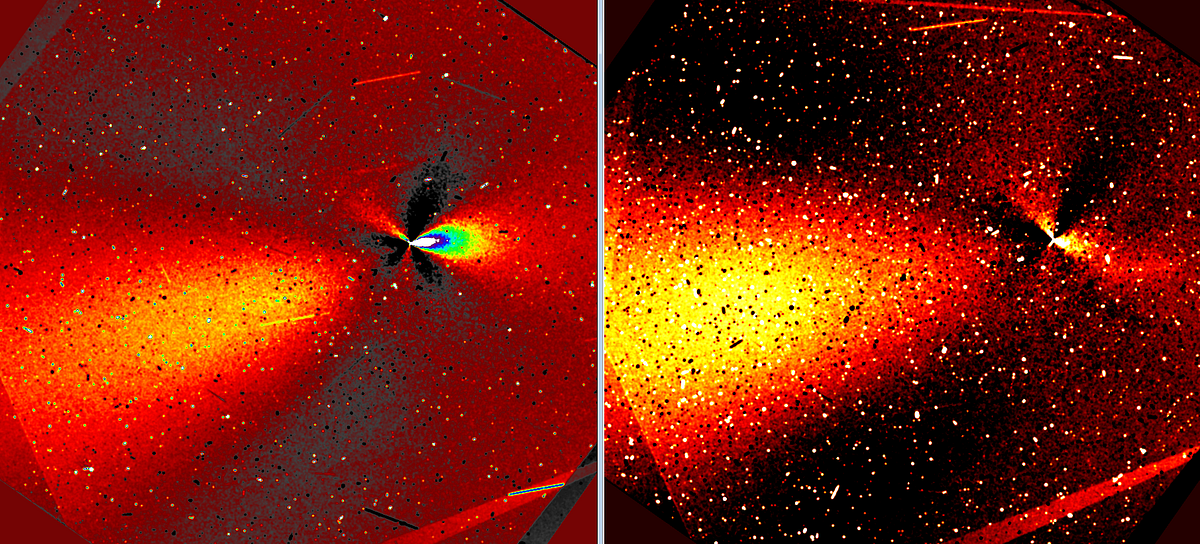
The cosmos continues to surprise us. Just when scientists thought they were getting a handle on interstellar visitors, new observations from the venerable Hubble Space Telescope have thrown a fascinating curveball: the enigmatic object 3I/ATLAS appears to be emitting "wobbling jets." This unprecedented discovery, based on meticulous imaging from December 12 and 27, 2025, promises to redefine our understanding of these mysterious wanderers from beyond our solar system.
A Glimpse of the Interstellar Frontier
Interstellar objects – cosmic travelers originating from other star systems – have captivated astronomers since the detection of 'Oumuamua in 2017. These rare visitors offer a direct window into the composition and processes of distant planetary systems, delivering pristine samples of alien worlds to our cosmic doorstep. 3I/ATLAS, first identified as an interstellar interloper, has been a subject of intense scrutiny, and now, Hubble has provided its most intriguing portrait yet.
Hubble's Unprecedented Detail: The Wobbling Jets
The new data, captured by Hubble's Wide Field Camera 3 (WFC3 UVIS) using its F350LP filter and 170-second exposures, offers a resolution previously unattainable. What stands out most vividly after processing through the specialized Larson-Sekanina rotation gradient filter is a distinct double-jet structure emanating from 3I/ATLAS. But these aren't static plumes; they exhibit a noticeable "wobble," suggesting a dynamic and complex interaction within the object itself.
"The precision of these images is astounding," notes Dr. Anya Sharma, lead analyst on the Hubble observation team. "The wobbling motion is highly unusual for a simple cometary outgassing and points to either a very peculiar spin dynamics, an asymmetrical sublimation process, or something entirely new."
What Could Cause the Wobble? Leading Hypotheses
The scientific community is buzzing with potential explanations for 3I/ATLAS's peculiar behavior. Several hypotheses are currently being explored:
- Asymmetrical Outgassing: If 3I/ATLAS is composed of volatile materials that are unevenly distributed or have different sublimation temperatures, the jets could be non-uniform, causing a perceived wobble as the object rotates.
- Complex Rotation: The object itself might be tumbling or rotating along multiple axes, causing the jets, if fixed relative to the object's surface, to appear to wobble from our perspective. This could be indicative of a past collision or a highly irregular shape.
- Internal Dynamics: Less conventional theories suggest internal seismic activity or shifting mass within the object could be influencing its surface jets.
- Exotic Composition: Could 3I/ATLAS be made of materials unknown in our solar system, reacting to solar radiation in unprecedented ways?
The mention of Avi Loeb in the original source data hints at another, more speculative, avenue of thought. Loeb, a controversial figure in astrophysics, famously proposed that 'Oumuamua's non-gravitational acceleration could be evidence of artificial origin. While no direct evidence for such a claim exists for 3I/ATLAS, the unusual "wobbling jets" are sure to fuel discussions about the potential for advanced technology or entirely novel natural phenomena at play.
Implications for Interstellar Exploration
Understanding the nature of 3I/ATLAS's jets is crucial for several reasons. It could provide vital clues about:
- The formation environments of exoplanets and the diversity of materials present in other star systems.
- The mechanisms by which objects are ejected from their home systems and travel across vast interstellar distances.
- The fundamental physics governing matter and energy in extreme cosmic conditions.
The presence of jets typically implies volatile materials sublimating under stellar heating, similar to comets. However, the "wobbling" aspect distinguishes 3I/ATLAS, challenging simplistic interpretations. If these jets are indeed an expression of internal activity or an unusually complex rotational state, it means our models for interstellar objects might need significant refinement.
The Road Ahead: Unraveling the Mystery
With these new images, 3I/ATLAS solidifies its place as one of the most enigmatic objects ever observed. Astronomers will undoubtedly leverage every available resource, from ground-based telescopes to future space missions, to gather more data. Spectroscopic analysis could reveal the chemical composition of the jets, while continued imaging might capture variations in the wobble over time, offering insights into its rotation and internal structure.
The scientific journey to fully comprehend 3I/ATLAS has just taken an exciting, and perhaps bewildering, turn. As humanity looks to the stars, objects like 3I/ATLAS serve as tantalizing messengers, reminding us that the universe is far stranger, and more wondrous, than we often imagine. Its wobbling jets beckon us to look closer, to question harder, and to prepare for discoveries that could rewrite our cosmic textbooks.