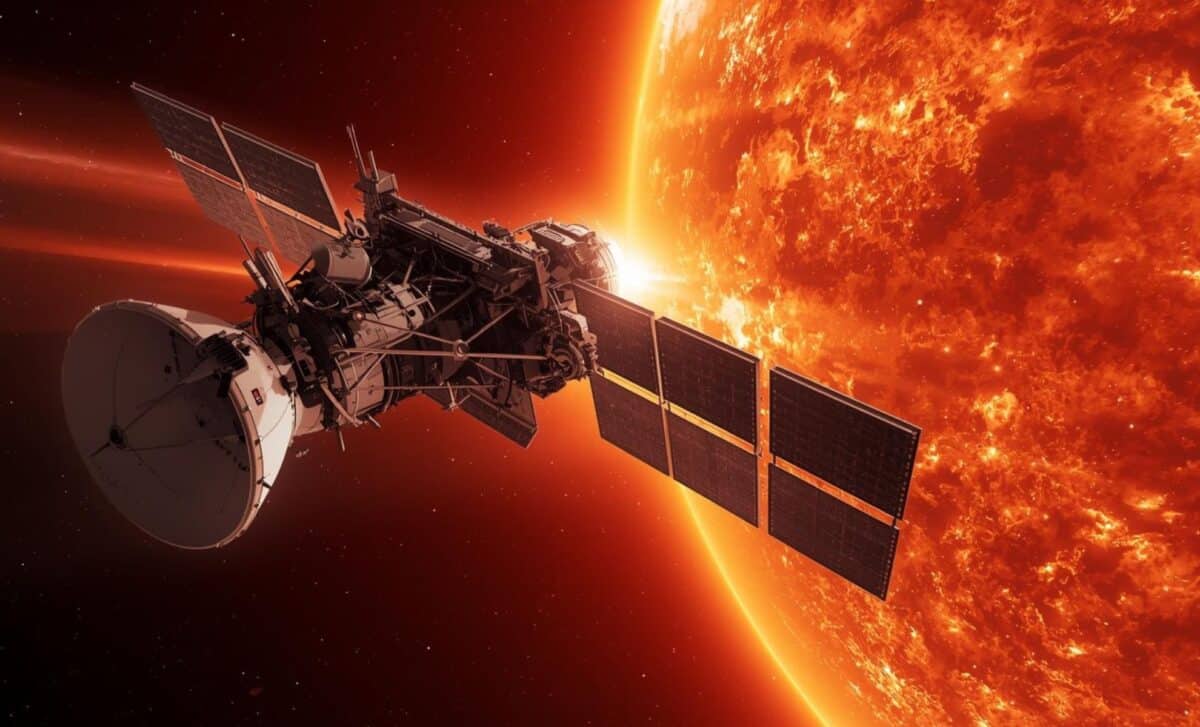
Beyond the Heliosphere: Voyager's Unexplained 50,000 Kelvin 'Firewall' Reshapes Our Cosmic Map
For over four decades, NASA's legendary Voyager 1 and Voyager 2 probes have journeyed silently through the vast emptiness of space, pushing the boundaries of human exploration. Launched in the late 1970s, these twin pioneers have already gifted humanity with unprecedented close-ups of gas giants and revealed the true scale of our solar system. Now, as they venture into the interstellar medium, they've sent back data that's not just groundbreaking—it's utterly baffling.
The latest revelation from the Voyager missions points to a discovery that challenges fundamental assumptions about the edge of our solar system: a searing-hot, invisible barrier, dubbed a "wall," registering an astonishing 50,000 Kelvin. To put that in perspective, this region is hotter than the surface of most stars, including our own Sun, which burns at approximately 5,778 Kelvin at its surface. And, according to prevailing scientific models, it simply shouldn't exist.
The Edge of the Known: Defining the Heliosphere
For generations, scientists have conceptualized our solar system as being enveloped within a protective bubble called the heliosphere. This immense magnetic and plasma structure, generated by the Sun's constant outflow of charged particles (the solar wind), shields us from much of the harsh galactic cosmic radiation present in interstellar space. The boundary where the solar wind dramatically slows down is known as the termination shock, followed by the heliosheath, and finally, the heliopause—the ultimate frontier where the Sun's influence truly ends and the interstellar medium begins.
The conventional understanding held that as one traversed the heliopause into the interstellar medium, conditions would gradually cool, with a gentle transition into the sparse, relatively cooler plasma of galactic space. Voyager's initial data, as they passed the heliopause in 2012 (Voyager 1) and 2018 (Voyager 2), largely confirmed a shift in particle density and magnetic field direction consistent with entering interstellar space. However, recent, more detailed analysis has painted a far more perplexing picture.
An Unforeseen Inferno: The 50,000 Kelvin Anomaly
The probes' instruments, designed to detect subtle changes in plasma density, magnetic fields, and cosmic rays, have now registered an extreme and localized heating event. This isn't a gradual warming; it's a distinct, blistering "wall" of plasma at a staggering 50,000 Kelvin. This temperature is far beyond what theoretical models predicted for the immediate vicinity beyond the heliopause. It suggests intense energetic processes are at play, utterly rewriting our textbooks on interstellar boundaries.
"It's like finding a scorching hot desert at the edge of the Arctic," one scientist reportedly remarked, highlighting the profound contradiction this discovery presents.
The exact nature and origin of this superheated region remain a profound mystery. Early hypotheses range from unexpected shockwaves generated by the interaction of the heliosphere with the local interstellar medium, to complex magnetic reconnection events releasing vast amounts of energy, or even novel particle acceleration mechanisms triggered by the collision of different plasma flows. The sheer temperature, however, points to incredibly violent and efficient energy conversion processes previously unobserved or theorized at this scale.
Implications for Our Cosmic Neighborhood and Beyond
This discovery has far-reaching implications, not only for understanding our own solar system but for astrophysics as a whole:
- Redefining Planetary Boundaries: If our heliosphere exhibits such extreme phenomena at its edge, what does this mean for other star systems? Do all stellar bubbles have similar, unforeseen fiery frontiers?
- Interstellar Travel: For future missions contemplating interstellar travel, navigating such intense thermal barriers would pose significant engineering challenges, requiring robust shielding and propulsion systems.
- Cosmic Ray Shielding: The interaction of this hot plasma wall with incoming galactic cosmic rays could profoundly affect how they penetrate our solar system, influencing planetary atmospheres and even the potential for life.
- Fundamental Physics: The existence of this wall may necessitate a re-evaluation of fundamental plasma physics, magnetic field interactions, and energy dissipation models in extreme cosmic environments.
The Enduring Legacy of the Voyagers
As the Voyager probes continue their solitary journey into the darkness, slowly losing power but still transmitting whispers across billions of miles, their mission continues to yield astonishing insights. This 50,000 Kelvin 'firewall' is not merely an interesting anomaly; it's a testament to the fact that even at the very edge of our cosmic backyard, the universe holds profound secrets waiting to be uncovered.
The data they beam back, painstakingly collected and analyzed, forces us to question, to hypothesize anew, and to acknowledge the vast complexity and unexpected wonders that lie just beyond the reach of our current understanding. The Voyagers, truly, are humanity's eyes and ears on the frontier of the unknown, proving that the most incredible discoveries often hide in plain sight, waiting for us to venture just a little bit further.