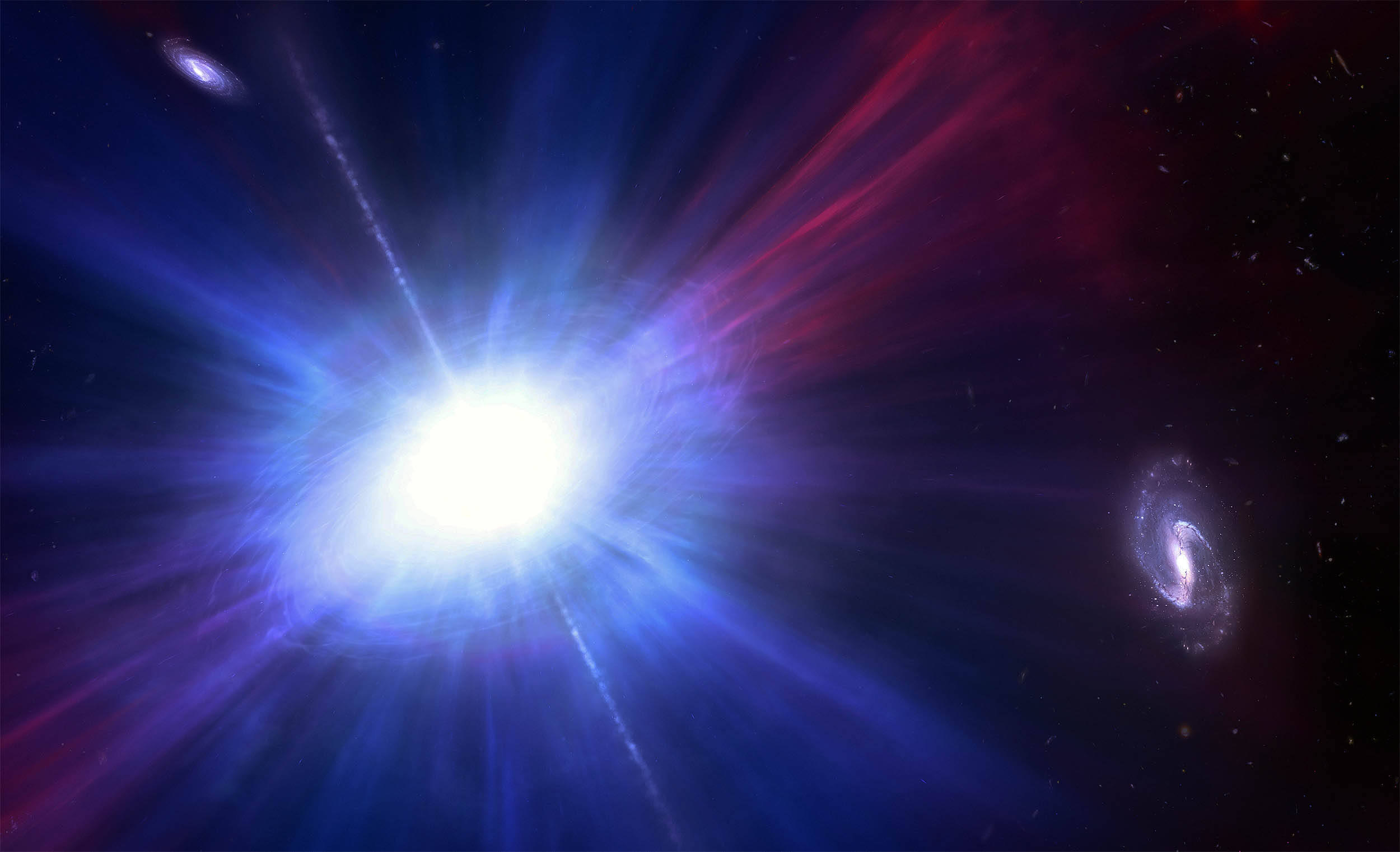
The Universe's Violent Blue Blazes: Unmasking the Cosmic Monsters Known as LFBOTs
By NovaPress Editorial Board
Imagine gazing into the profound darkness of space, only to witness an eruption of electric blue light – an event so startlingly bright it outshines entire galaxies for days, then vanishes as quickly as it appeared. These are Luminous Fast Blue Optical Transients (LFBOTs), a class of cosmic phenomena that continue to baffle and excite astronomers. Far from mere stellar flares, LFBOTs are believed to be the universe's most violent spectacles, revealing the brutal encounters between black holes and stars.
What Are These 'Cosmic Monster Flashes'?
LFBOTs are exactly what their name suggests: luminous, fast-evolving, blue, and optical transients. They are characterized by their extreme luminosity, which can be tens to hundreds of times brighter than typical supernovae, and their rapid evolution, peaking in brightness in a matter of days and fading over weeks. Their distinctive blue color suggests incredibly high temperatures and energetic processes. Discovered only in the last decade, these events are exceedingly rare, making each new sighting a golden opportunity for scientific discovery.
A Record-Bright Revelation: Unveiling Extreme Black Hole Systems
A recent, record-bright LFBOT has particularly captured the attention of the astronomical community. Its unprecedented luminosity and the detailed observations gathered during its brief existence have provided invaluable data, allowing scientists to peer deeper into the physics of these extreme events. Such events are not just dazzling light shows; they are crucial clues to understanding the most energetic processes in the cosmos, particularly those involving supermassive black holes.
The Violent Culprit: Black Holes Shredding Stars
The prevailing theory for the origin of LFBOTs points to one of the most destructive processes in the universe: a tidal disruption event (TDE) involving a black hole and a star. When a star ventures too close to a black hole, the immense gravitational forces (tidal forces) stretch and rip it apart. This 'spaghettification' of the star results in a spectacular burst of energy. As stellar material spirals into the black hole, it forms an accretion disk, generating intense radiation, and in some cases, launching powerful relativistic jets of plasma into space. It is this catastrophic interaction that is thought to fuel the incredible luminosity of LFBOTs.
Why LFBOTs Are Critical to Astrophysics
Beyond their sheer dramatic appeal, LFBOTs offer a unique window into fundamental astrophysical questions:
- Extreme Physics Laboratories: They provide a natural laboratory to study matter under conditions that cannot be replicated on Earth – immense gravitational fields, ultra-high temperatures, and relativistic speeds.
- Black Hole Accretion: Observing LFBOTs helps us understand the mechanisms by which black holes consume matter and grow, shedding light on the physics of accretion disks and the formation of jets.
- Stellar Evolution and Death: These events contribute to our understanding of the ultimate fate of stars caught in the gravitational pull of black holes, offering insights into stellar dynamics in galactic centers.
- Discovery of New Transients: Their distinct characteristics could point towards entirely new classes of cosmic explosions or phenomena yet to be fully understood.
The Future of Cosmic Flash Hunting
As observational capabilities advance, with new instruments like the Vera C. Rubin Observatory coming online, astronomers anticipate detecting many more LFBOTs. This increased sample size will be crucial for refining theoretical models, understanding the diversity within this class of transients, and possibly uncovering additional mechanisms that could power these extraordinary flashes. The continued monitoring of the night sky promises to unravel more of the universe's most extreme and enigmatic secrets.
The electric blue flashes of LFBOTs are more than just fleeting lights in the dark; they are cosmic sirens, beckoning us to understand the universe's most violent interactions. Each sighting deepens our appreciation for the raw power of black holes and the incredible, often destructive, beauty of our cosmos.