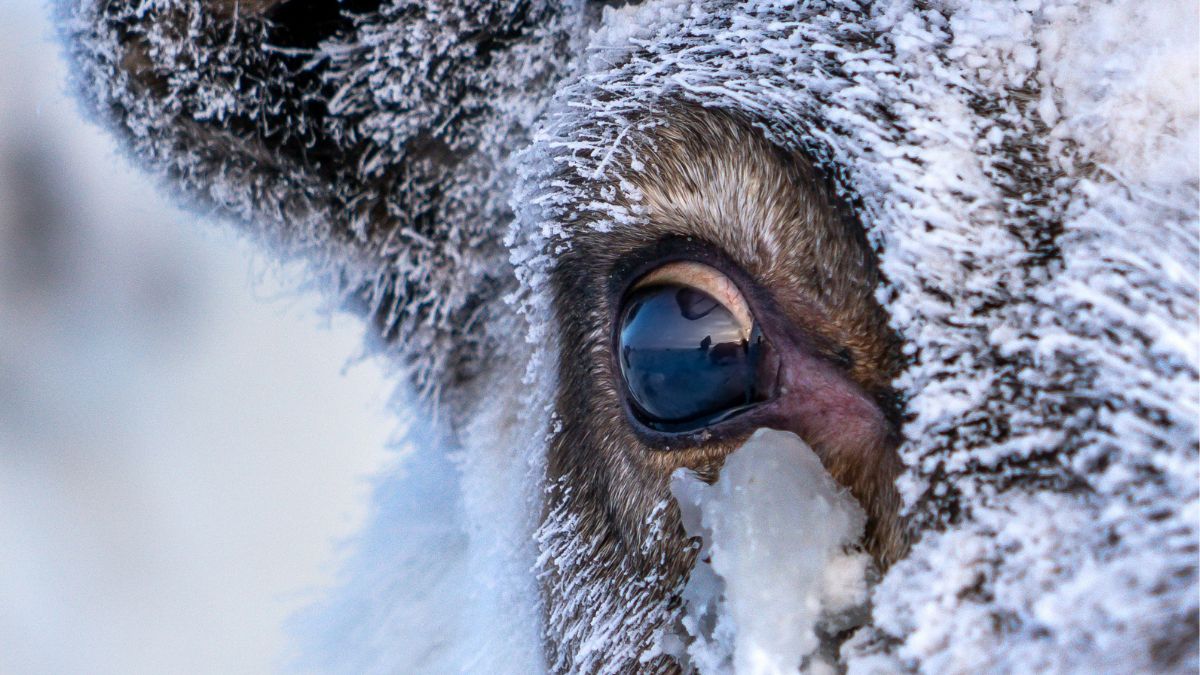
For centuries, the reindeer has captured our imagination, often symbolized by its festive association. Yet, beneath the veneer of popular folklore lies a creature of profound biological marvel, particularly concerning its extraordinary visual system. Far from the whimsical glow of a fictional red nose, real reindeer possess an adaptation that allows them to navigate the extreme contrasts of light and darkness in their Arctic habitat: their eyes literally change color with the seasons.
The Winter Transformation: A Biological Lens Shift
The groundbreaking discovery in 2013 revealed that reindeer eyes undergo a remarkable physiological transformation. Unlike many mammals whose eye color remains constant, a reindeer's eyes shift from a golden-yellow hue in summer to a deep blue in winter. This isn't merely a superficial change; it's a sophisticated recalibration of their ocular structure, specifically the tapetum lucidum – a reflective layer behind the retina common in nocturnal animals.
Adapting to the Extremes: The Science Behind the Shift
During the perpetual daylight of Arctic summers, the tapetum lucidum in reindeer eyes is yellowish, reflecting light directly back through the retina. This configuration is optimized for high light conditions, enhancing visual acuity and helping the reindeer distinguish predators and forage in a brightly lit, albeit short, summer season. However, as winter descends, bringing months of near-total darkness and low-angle sunlight, their eyes transform.
The shift to a blue tapetum lucidum in winter is an incredible adaptation to the scarce light. Scientists believe this change is driven by the compression of collagen fibers within the tapetum, caused by increased intraocular pressure. This compression alters the way light is reflected. Instead of reflecting most light back, the blue tapetum scatters more blue light, allowing more photons to reach the retina. This increased light scattering boosts the eye's sensitivity, enabling the reindeer to detect movement and shapes even in the profound twilight and darkness of the Arctic winter.
This adaptation also likely makes them more sensitive to ultraviolet light, which penetrates deeper into icy, snowy environments and could be crucial for spotting lichen, their primary winter food source, or detecting the subtle outlines of predators against a snow-covered landscape. It's an evolutionary masterpiece, ensuring survival where other creatures might struggle.
Ecological Significance and Future Insights
The seasonal eye color change in reindeer underscores the incredible power of natural selection to engineer precise biological solutions to environmental challenges. This adaptation is not just a fascinating tidbit; it's central to their survival, influencing foraging strategies, predator avoidance, and social interactions within their herds during the harshest months. Without this biological marvel, reindeer populations would undoubtedly face significantly higher mortality rates in the extreme Arctic winter.
From a broader scientific perspective, the reindeer eye offers a compelling model for understanding vision adaptation in extreme environments. It prompts questions about other animals inhabiting similar biomes and whether they possess comparable, albeit perhaps less dramatic, adaptations. The insights gained from studying the reindeer's visual system could even have biomimetic implications, informing the development of advanced optical technologies for low-light conditions, or even specialized camera sensors designed for specific light spectrums.
As we continue to unravel the complexities of the natural world, the reindeer stands as a vibrant testament to evolution's ingenuity. Its seasonally shifting eyes are a profound reminder that even in the most familiar creatures, there remain incredible secrets waiting to be discovered, challenging our perceptions and deepening our appreciation for the intricate dance between life and environment.