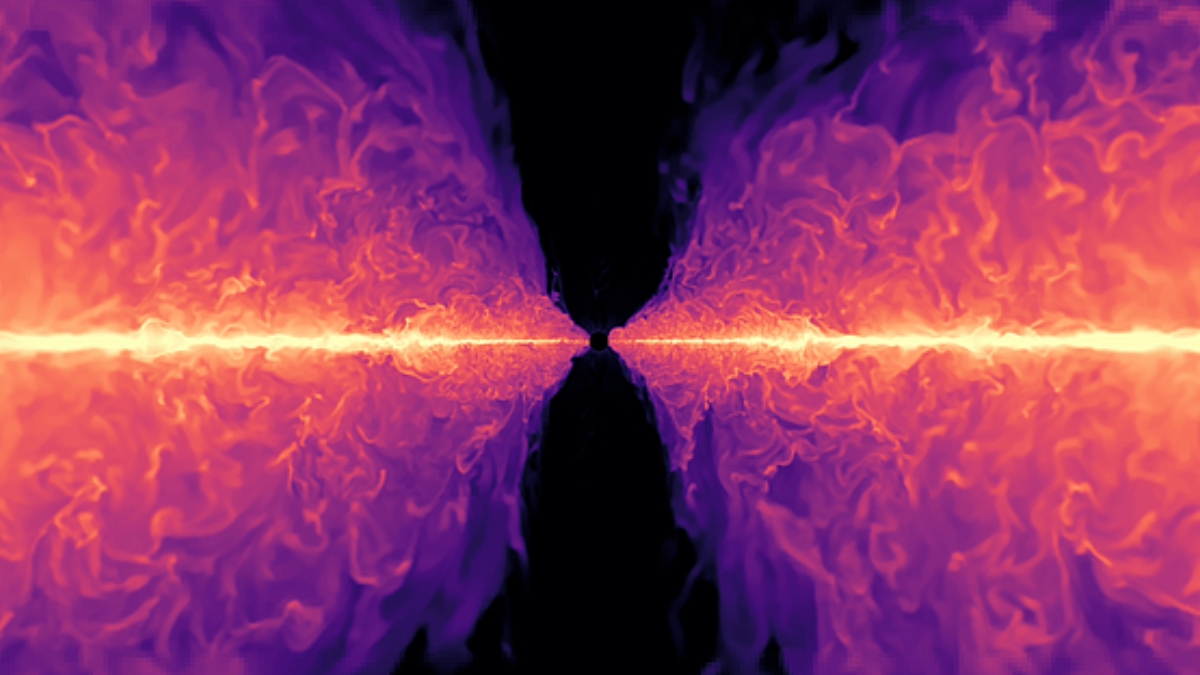
Beyond the Event Horizon: Supercomputers Unveil the Chaotic Dance at a Black Hole's Edge
By The NovaPress Science Desk
For decades, black holes have captivated scientists and the public alike, representing the universe's most extreme gravitational titans. Their event horizons mark a point of no return, beyond which even light cannot escape. Yet, the regions immediately surrounding these cosmic behemoths – often referred to as the 'borderlands' – have remained a maelstrom of theoretical complexity. Now, thanks to the immense power of supercomputing, we are beginning to peel back the curtain on these chaotic spaces, revealing a universe far more dynamic and intricate than previously imagined.
The Conventional View: A Cosmic Drain?
Traditionally, the mental image of a black hole's vicinity has often been that of an insatiable cosmic vacuum cleaner, relentlessly drawing in all matter that strays too close. Matter forms scorching-hot accretion disks, spiraling inwards, destined for oblivion. While fundamentally true, this simplified view overlooks the furious battle of forces at play just outside the event horizon. It's here, in this intense crucible of gravity, radiation, and magnetic fields, that the universe's most dramatic energy transformations occur.
A New Revelation: The Fury of Radiation
The latest breakthroughs, powered by cutting-edge supercomputer simulations, challenge and refine this understanding. Researchers have meticulously modeled the 'borderlands' of black holes, environments where the infalling matter isn't merely sucked in. Instead, its descent is powerfully resisted – or at least regulated – by an opposing force: the blinding fury of radiation. This radiation, generated by the superheated plasma in the accretion disk itself, exerts immense pressure, pushing outwards against the relentless inward pull of gravity.
These sophisticated simulations demonstrate that the rate at which matter is pulled into a black hole is not solely dictated by gravity. The outward pressure of photons, acting like a cosmic brake, plays a crucial role in moderating the infall. This complex interplay creates a dynamic equilibrium, where gravity's inexorable grip is constantly tested by the energy it helps to generate. It's a cosmic tug-of-war, with radiation pushing matter away even as gravity tries to drag it over the edge.
The Power of Supercomputing
Such detailed insights were previously unattainable. The extreme conditions near a black hole – relativistic speeds, immense gravitational fields, plasma physics, and radiative transfer – combine to form a computational nightmare. Supercomputers, with their ability to perform quadrillions of calculations per second, can now model these multi-faceted phenomena with unprecedented resolution. They allow scientists to simulate the complex magnetohydrodynamics (MHD) that govern the behavior of superheated, ionized gas in strong gravitational fields, accounting for how radiation is produced, absorbed, and re-emitted.
These simulations are not just pretty pictures; they are laboratories where the fundamental laws of physics are tested against cosmic reality. By running these models and comparing their outputs to observational data from telescopes, scientists can refine their theories and deepen our understanding of these enigmatic objects.
Implications for the Cosmos
The implications of this research are profound. Understanding the precise mechanisms that regulate matter infall has direct consequences for several key areas of astrophysics:
- Galaxy Evolution: Supermassive black holes at the centers of galaxies are thought to play a crucial role in galaxy formation and evolution. The energy output from their accretion disks, modulated by radiation pressure, can significantly impact star formation in the host galaxy.
- Quasars and Active Galactic Nuclei (AGN): These are some of the brightest objects in the universe, powered by actively feeding black holes. Better models of the borderlands will help explain the immense luminosity and powerful jets observed emanating from these objects.
- Fundamental Physics: These extreme environments are natural laboratories for testing Einstein's theory of General Relativity under conditions impossible to replicate on Earth. New insights into plasma dynamics and radiative processes could also inform other areas of physics.
A Glimpse into the Future
As supercomputing power continues to grow, and as observational tools like the Event Horizon Telescope provide ever-sharper glimpses of black hole surroundings, our understanding will only deepen. We are moving beyond theoretical abstractions to a new era of predictive and detailed modeling, where the universe's most mysterious objects reveal their secrets. The chaotic dance at a black hole's edge is no longer an impenetrable enigma, but a complex ballet of cosmic forces, orchestrated by gravity and illuminated by the 'blinding fury of radiation'. NovaPress will continue to bring you the latest on these groundbreaking discoveries.