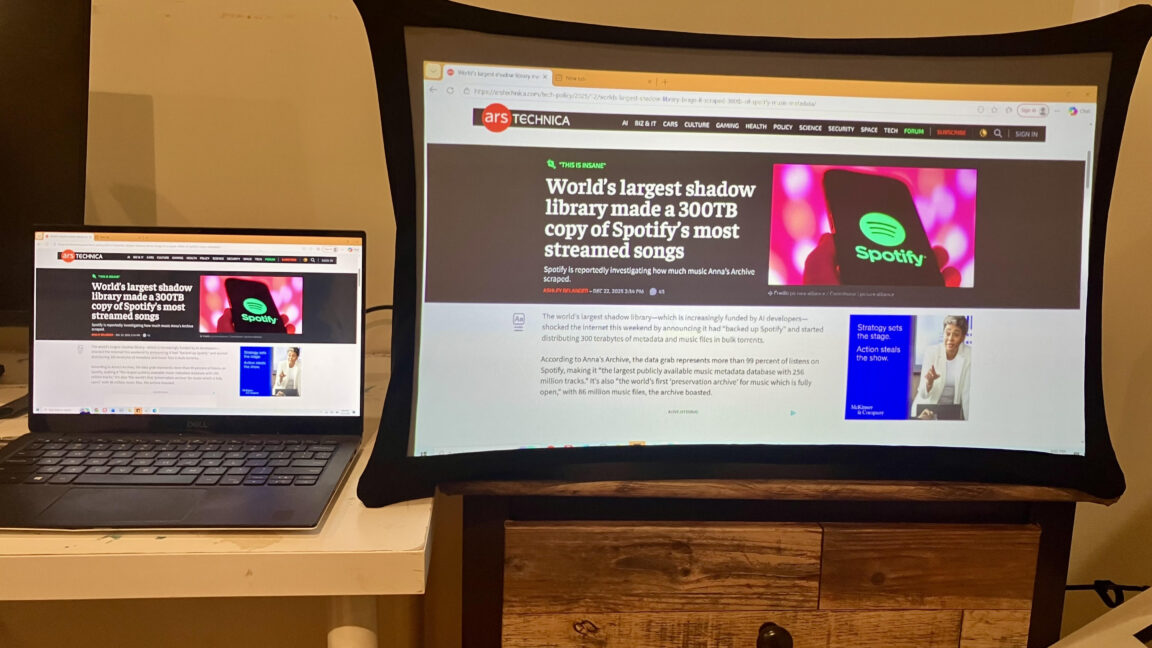
The Splay Paradox: Why a 'Subpar Monitor' is Redefining Portable Projection
In the ever-evolving landscape of personal technology, innovation often arrives in unexpected packages, sometimes embodying a fascinating paradox. The Splay device, as highlighted by Ars Technica, presents exactly such a enigma: simultaneously a 'subpar monitor' and an 'exciting portable projector.' This duality isn't a design flaw but rather a testament to a strategic compromise, prioritizing a niche yet revolutionary capability over universal excellence.
At NovaPress, we delve beyond the surface-level assessment to understand the deeper implications of such devices. The Splay challenges our preconceived notions of what a display can be, demonstrating that true utility sometimes lies not in being the best at everything, but in excelling uniquely where it truly matters.
The Monitor Compromise: A Glimpse into 'Subpar'
Let's address the elephant in the room first: the Splay as a monitor. When held to the rigorous standards of dedicated desktop or even portable monitors, its limitations become apparent. Resolution, often a critical metric for a satisfying monitor experience, is likely compromised to accommodate the projector's requirements. Brightness, refresh rates, and color accuracy, while potentially adequate for casual viewing, fall short of what professionals or avid consumers expect from a primary display.
This 'subpar' designation isn't an indictment of its engineering but rather an acknowledgement of the inherent trade-offs in an ambitious hybrid device. The Splay isn't engineered to replace your high-fidelity IPS panel; it's designed for utility in scenarios where any screen is better than no screen, or where ultimate portability dictates significant concessions.
The Projector Revolution: Unpacking the Excitement
Where the Splay truly shines, and indeed sparks excitement, is in its identity as a portable projector. The Ars Technica piece hints at its ability to "take a lot of the stress out of projectors." This isn't a trivial claim. Traditional projectors are often bulky, require fiddly setup with multiple cables, specific power sources, and a dark environment to be effective. The 'stress' they induce deters spontaneous use.
The Splay's innovation likely lies in its exceptional portability – perhaps folding, ultra-compact, or extremely lightweight – coupled with ease of use. Imagine a device that integrates a powerful, bright projector into a form factor so convenient that you can deploy a large screen virtually anywhere: for an impromptu meeting in a café, a movie night while camping, or sharing photos on a wall in a friend's living room. Features like an integrated battery, instant-on functionality, auto-keystone correction, and perhaps even built-in speakers would collectively remove the traditional barriers to spontaneous projection, making large-format viewing truly mobile and accessible.
Broader Context: Innovation, Niche, and the Future of Hybrids
The Splay stands as a compelling case study in product innovation. It doesn't aim to be a market leader in either monitors or projectors individually, but rather to carve out a unique space at their intersection. Its significance isn't just about its current capabilities, but what it represents for the future of display technology and mobile computing. As devices become smaller and more powerful, the line between categories will continue to blur, necessitating bold experiments like the Splay.
Could future iterations improve the monitor aspect while retaining the projector's magic? Absolutely. But for now, its value proposition is clear: to offer unparalleled convenience for large-screen projection, liberating users from the confines of fixed displays and cumbersome equipment. It caters to a growing demand for flexibility, spontaneous collaboration, and on-the-go entertainment.
Conclusion: A Flawed Gem with a Clear Vision
The Splay may not win awards for its monitor performance, but its potential as a groundbreaking portable projector cannot be overstated. It embodies the spirit of innovation by embracing trade-offs to deliver a truly novel user experience. By "taking a lot of the stress out of projectors," it transforms a niche technology into an accessible, everyday tool. The Splay reminds us that sometimes, the most exciting advancements aren't about perfection across the board, but about pushing boundaries and redefining convenience in specific, impactful ways. It's a testament to the idea that utility, in its most liberated form, can indeed be exciting.