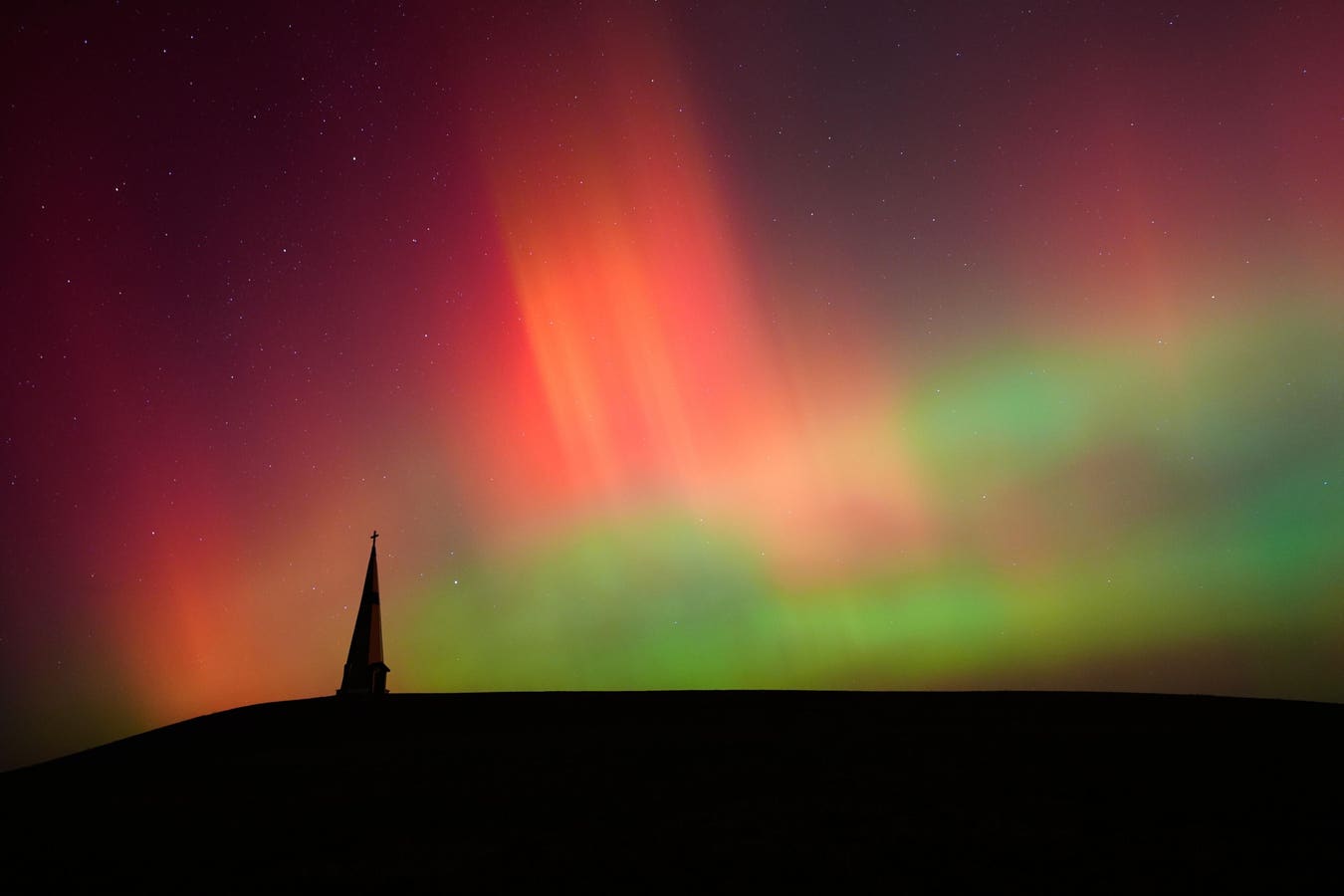
The Southern Specter: Why Aurora Borealis May Light Up Skies Down to Iowa Tonight
NovaPress delves into the rare celestial event bringing the Arctic's magic to the American Midwest.
Tonight, a celestial ballet usually reserved for the polar regions is poised to grace the night skies over a significant swath of the United States. Reports from the National Oceanic and Atmospheric Administration (NOAA) indicate a heightened chance of seeing the Aurora Borealis, or Northern Lights, extending surprisingly far south, with the viewing line potentially reaching as far as the Minnesota-Iowa border. This rare occurrence is more than just a beautiful display; it's a profound reminder of the dynamic interplay between our sun and Earth.
Understanding the Aurora: A Dance of Light and Magnetism
The Aurora Borealis is a breathtaking natural light display in Earth's sky, predominantly observed in high-latitude regions. It occurs when charged particles, primarily electrons and protons, emitted from the Sun in a phenomenon known as the solar wind, collide with gases in Earth's upper atmosphere. Our planet's magnetic field acts as a funnel, directing these particles towards the magnetic poles. As these particles interact with atmospheric gases – oxygen and nitrogen – they excite the atoms, causing them to emit light. The color of the aurora depends on the type of gas and the altitude at which the collision occurs: vibrant greens are common from oxygen at lower altitudes, while reds come from higher-altitude oxygen, and blues/purples from nitrogen.
The Role of Geomagnetic Storms
Tonight's southern reach of the aurora is attributed to what NOAA has predicted as 'minor geomagnetic storms'. These storms are disturbances in Earth's magnetosphere caused by enhanced solar wind activity. When a coronal mass ejection (CME) – a significant expulsion of plasma and magnetic field from the Sun's corona – or a fast stream of solar wind hits Earth's magnetosphere, it can cause a compression and then a relaxation of the magnetic field lines. This dynamic motion accelerates particles further down into the atmosphere, leading to more intense and widespread auroral displays, pushing the 'auroral oval' equatorward.
Unprecedented Reach: States on Alert
While typical aurora sightings are restricted to states like Alaska and parts of the Pacific Northwest, tonight's forecast includes a remarkable extension across the northern tier of the contiguous U.S. States along the northern border, from Washington to Maine, have a heightened chance of visibility. However, the truly astonishing detail is the projected curved viewing line that nearly stretches to the border of Minnesota and Iowa. This is a significant southward shift for minor geomagnetic activity, creating an exceptional opportunity for millions of Americans who wouldn't ordinarily expect to witness such a spectacle.
For prospective sky-watchers, several factors will influence visibility: a clear, dark sky away from city lights is paramount. Light pollution significantly diminishes the chances of seeing fainter auroral displays. Cloud cover is another crucial variable; a pristine night sky is essential.
Future Implications: A Warming Solar Cycle?
The frequency and intensity of auroral displays are directly linked to the Sun's 11-year solar cycle. We are currently heading towards the peak of Solar Cycle 25, which is anticipated to be more active than the previous cycle. This increased solar activity means we can expect more geomagnetic storms, and consequently, more frequent and potentially more spectacular auroral displays over the next few years, possibly reaching southern latitudes more often. Tonight's event serves as a harbinger of the exciting celestial phenomena awaiting us as the Sun awakens.
Beyond the immediate awe, these events offer scientists invaluable data. Studying the magnetosphere's response to solar winds helps us understand space weather, which can impact satellite communications, GPS systems, and even power grids on Earth. The beauty of the aurora is intertwined with vital scientific inquiry.
Don't Miss the Display: Look Up Tonight
For those in the fortunate viewing zones, tonight presents a unique opportunity to connect with the cosmos in a profound way. Step away from artificial lights, find an open northward view, and allow your eyes to adjust to the darkness. Even a subtle glow on the northern horizon can be the beginning of an unforgettable experience. The Northern Lights are a powerful reminder of the universe's grandeur and the intricate forces at play far beyond our terrestrial concerns.
This isn't just a weather forecast; it's a celestial invitation. Will you answer the call and witness the southern specter of the Aurora Borealis?