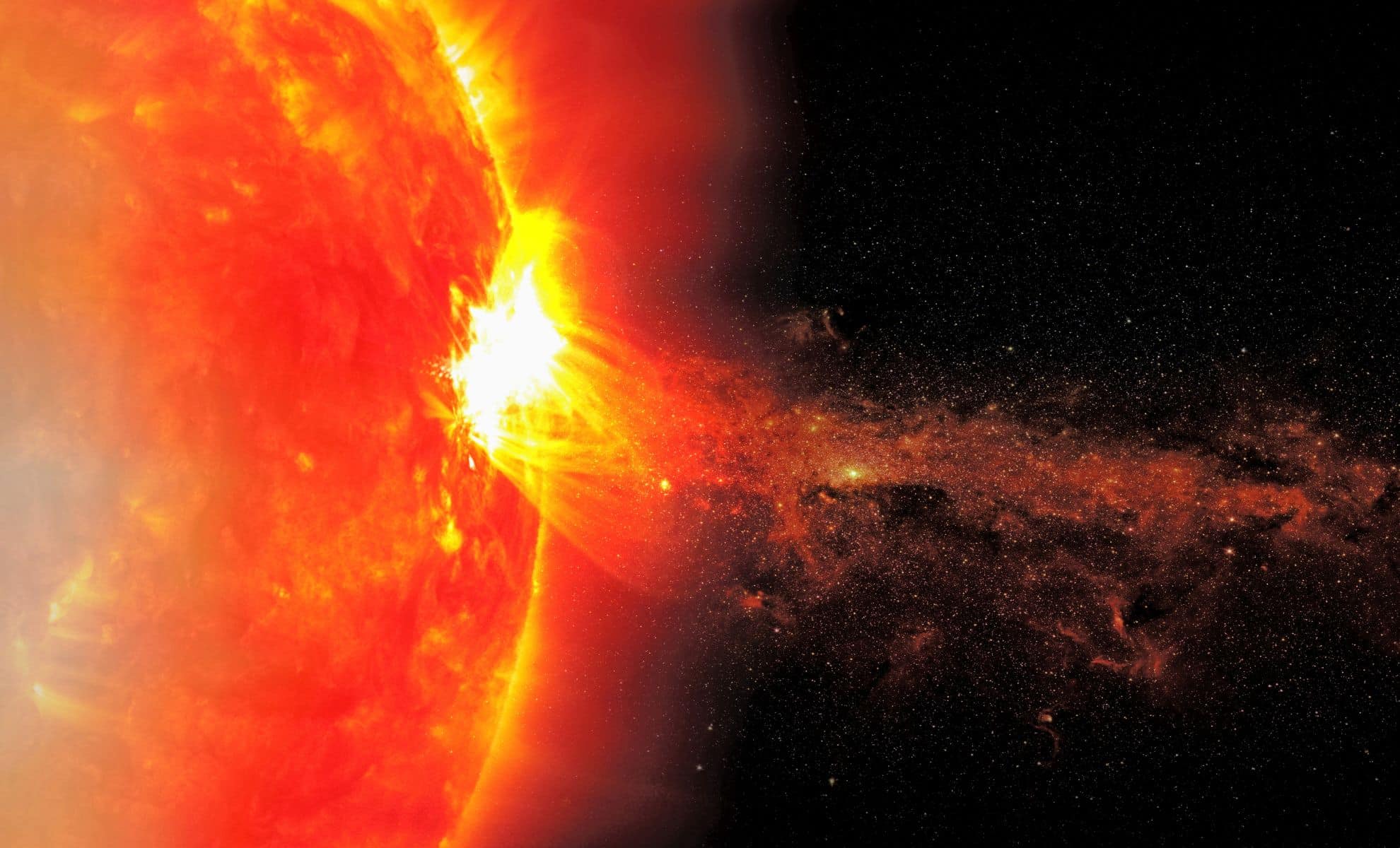
Solar Secrets Unveiled: Magnetic 'Tadpoles' Plunge into the Sun, Challenging Everything We Knew
In a groundbreaking feat of engineering and scientific daring, the Parker Solar Probe (PSP) made its closest approach to our star yet in December 2024. Skimming just under 4 million miles from the Sun's fiery surface, humanity's vanguard spacecraft offered an unprecedented glimpse into the heart of our solar system. What its Wide-Field Imager (WISPR) captured, however, was not just data, but a truly bizarre and potentially paradigm-shifting phenomenon: giant magnetic "tadpoles" seemingly falling directly into the Sun. This discovery isn't just a curiosity; it threatens to rewrite fundamental aspects of solar physics and our understanding of how stars work.
Touching the Fire: The Parker Solar Probe's Unparalleled Mission
For decades, the Sun has presented scientists with two enduring mysteries: why its outer atmosphere, the corona, is millions of degrees hotter than its surface, and how the solar wind, the stream of charged particles constantly emanating from the Sun, is accelerated to supersonic speeds. Traditional observations from Earth or distant orbits offered only partial answers. Enter the Parker Solar Probe, launched with the audacious goal of "touching the Sun" – flying directly into its corona to make direct measurements of the solar wind's origin and the mechanisms heating the solar atmosphere. Its December 2024 flyby, an orbital ballet of precision and endurance, brought it closer than any human-made object before, providing a unique vantage point to directly probe these cosmic puzzles.
The Bizarre Phenomenon: Magnetic 'Tadpoles'
The images returned by WISPR were nothing short of astonishing. Scientists observed distinct, luminous structures resembling tadpoles – compact, bright "heads" followed by elongated "tails" of plasma – appearing to plunge towards the Sun's surface. These aren't random puffs of gas; their coherent structure and directional movement suggest an underlying magnetic influence. While the exact nature of these "tadpoles" is still under intense investigation, preliminary analysis points towards complex magnetic reconnection events occurring at the Sun's outermost layers, potentially linked to the Sun's dynamic magnetic field lines. The fact that they appear to be falling in rather than being ejected is particularly intriguing, challenging conventional wisdom about plasma dynamics in the corona.
Rewriting the Manual: Implications for Solar Physics
The discovery of these magnetic tadpoles could fundamentally alter our understanding of the Sun's energy transfer mechanisms. If these structures are indeed a significant pathway for magnetic energy to dissipate or for plasma to be pulled back into the Sun, they could play a crucial role in the coronal heating problem. Furthermore, their presence might offer new insights into the generation of the "slow solar wind" – the slower, denser component of the solar wind that is less understood than its faster counterpart. Current models of the solar wind and coronal heating largely do not account for such coherent, falling plasma structures. The implications are profound, suggesting that our existing theoretical frameworks might be incomplete, missing a vital piece of the solar puzzle.
A Glimpse into the Future: Space Weather and Beyond
Beyond the purely academic, this discovery has practical implications. A deeper understanding of these processes could significantly improve our ability to predict space weather events, such as solar flares and coronal mass ejections (CMEs), which can disrupt satellites, power grids, and communications on Earth. If the magnetic tadpoles are precursors or byproducts of these larger events, their study could offer invaluable early warning signs.
The Parker Solar Probe has several more close approaches planned, each promising to gather even more detailed data. Scientists will be scrutinizing these subsequent flybys for further observations of the tadpoles, hoping to map their distribution, understand their lifecycle, and definitively determine their role in solar dynamics. This pioneering mission continues to push the boundaries of scientific exploration, promising a new era in astrophysics where the Sun, our nearest star, reveals its most guarded secrets. The magnetic tadpoles are just the beginning, signaling a vibrant future for solar research and potentially redefining our place in the cosmos.