Unveiling the Cosmic Inferno: Black Holes, Not Stars, Powering the Universe's Brightest Blue Blasts
For decades, astronomers have been captivated and confounded by mysterious, intensely bright blue cosmic explosions that momentarily outshone entire galaxies. These events, dubbed 'blue blasts,' defied conventional explanations, radiating energy far exceeding what even the most cataclysmic stellar explosions—supernovas—could produce. Now, a groundbreaking discovery, spearheaded by observations of the brightest object of its kind ever detected, appears to have cracked the cosmic code: the culprits are not dying stars, but hungry black holes tearing them apart.
The Puzzle of the Unexplained Energy
The universe is a stage for spectacular demolitions. Stellar explosions, such as supernovas, mark the dramatic end of massive stars, scattering their elements across the cosmos and briefly shining with the brilliance of billions of suns. Yet, the blue blasts presented an anomaly. Scientists calculated that the sheer amount of radiated energy from these phenomena was so immense that it simply could not be powered by any known type of stellar explosion, whether a core-collapse supernova or a thermonuclear detonation. This energy deficit left a gaping hole in our understanding of extreme astrophysical events, prompting a search for an entirely new mechanism.
Black Holes: The Ultimate Star Shredders
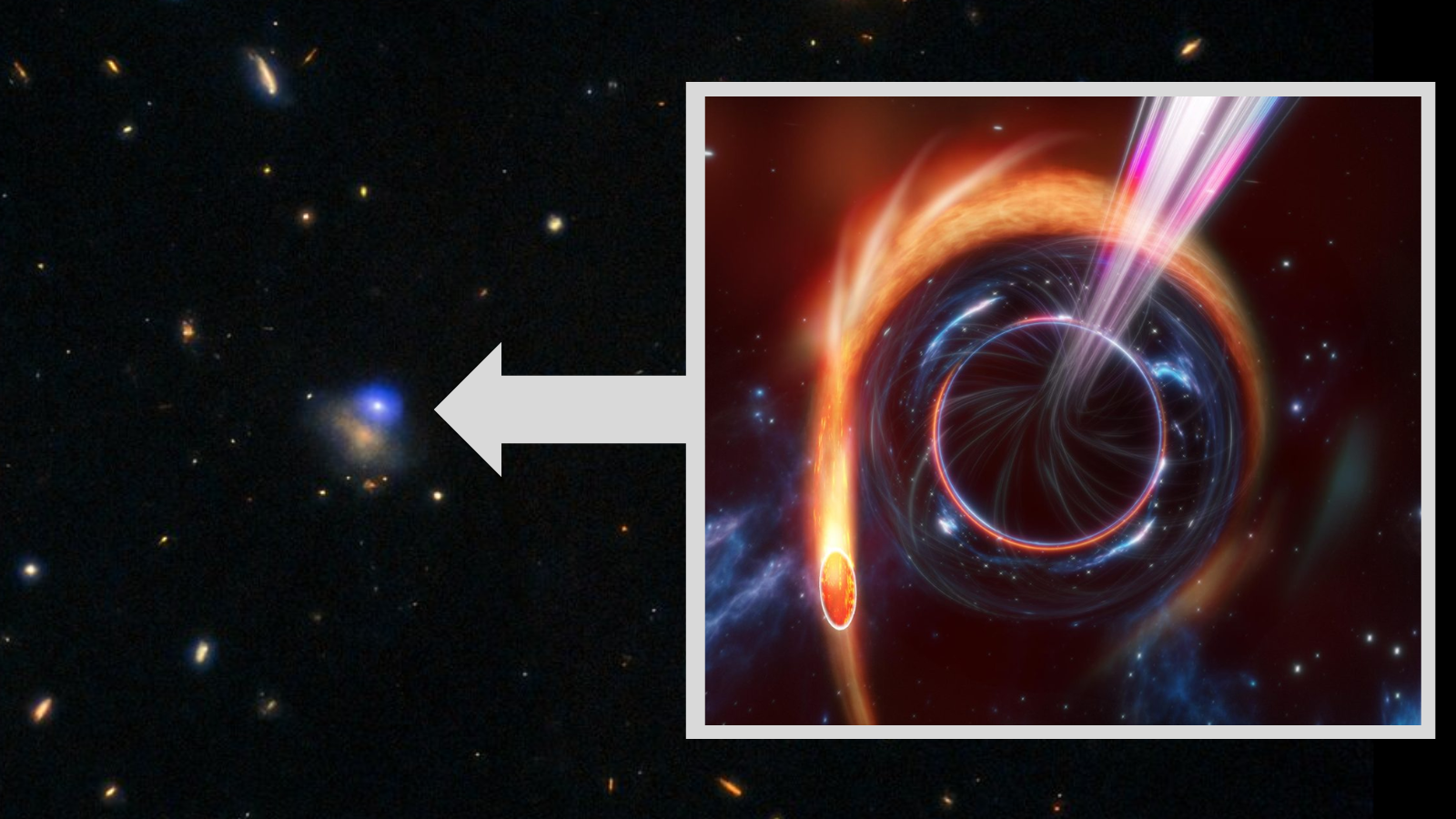
The solution, it turns out, lies in the most enigmatic objects in the universe: black holes. Specifically, the findings point to what are known as Tidal Disruption Events (TDEs). When a star wanders too close to a supermassive black hole—the behemoth lurking at the heart of most galaxies—the black hole's immense gravitational pull stretches and compresses the star, like cosmic spaghetti, in a process called 'spaghettification.' This brutal tidal force ultimately rips the star apart.
As the star's material is shredded, some of it is ejected into space, but a significant portion falls into a rapidly spinning accretion disk around the black hole. This disk becomes incredibly hot and luminous due to friction and gravitational energy conversion, emitting vast quantities of radiation across the electromagnetic spectrum, particularly in the X-ray and visible blue light ranges. Furthermore, some TDEs are observed to produce powerful relativistic jets of particles blasted out from the black hole's poles at near light speed, further contributing to the immense energy output and brightness.
The Brightest Clue: A Cosmic Rosetta Stone
The recent breakthrough was significantly aided by the detection of a specific object, heralded as the brightest cosmic object of its kind ever observed. Its unparalleled luminosity and detailed spectral analysis provided a crucial 'smoking gun,' allowing astronomers to differentiate its characteristics from traditional supernovas and align them perfectly with the theoretical predictions for TDEs. This particular event acted as a cosmic Rosetta Stone, unlocking the secrets of previously puzzling observations and solidifying the black hole-star shredding hypothesis.
Implications for Astrophysics and Beyond
This revelation has profound implications for our understanding of extreme astrophysics. Firstly, it provides a robust mechanism for explaining some of the most energetic transient events in the universe, distinguishing them definitively from stellar explosions. Secondly, it offers a new window into studying the behavior of black holes, particularly their accretion processes and the dynamics of matter in their immediate vicinity. Observing TDEs allows scientists to probe the environments around supermassive black holes, which are otherwise largely invisible.
Furthermore, TDEs contribute to our understanding of galaxy evolution. The energy released during these events can impact the surrounding interstellar medium, potentially influencing star formation and the feedback loops between supermassive black holes and their host galaxies. As more sophisticated telescopes and observational techniques come online, astronomers anticipate detecting an increasing number of these events, providing a richer dataset to refine our models and uncover even more nuances of black hole physics.
The Future of Cosmic Exploration
The universe continues to unveil its mysteries, and this latest discovery is a testament to humanity's relentless quest for knowledge. By confidently attributing the powerful blue cosmic blasts to black holes tearing apart stars, scientists have not only solved a long-standing puzzle but also opened new avenues for research. The next frontier involves refining our understanding of the different types of TDEs, studying their energy spectra in greater detail, and mapping their distribution across the universe. Each new blue flash observed will no longer be a mere mystery, but a direct observation of a black hole's violent meal, offering unparalleled insights into the engines that drive the most extreme phenomena in the cosmos.