The Unyielding Enigma: How Interstellar Object 3I/ATLAS Defied Expectation with a Sunward Jet
A recent observation of an interstellar visitor challenges our fundamental understanding of celestial mechanics and the nature of deep-space travelers.
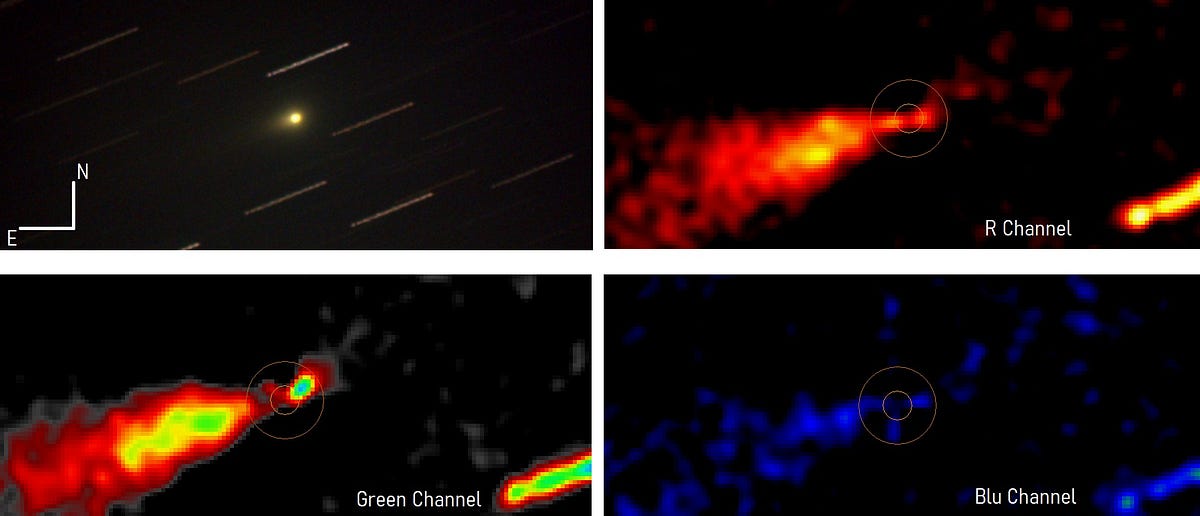
In the vast, silent arena of space, where gravity dictates the grand ballet of planets and stars, an interstellar anomaly known as 3I/ATLAS has delivered a profound astrophysical surprise. Detected traversing our solar system, this cosmic wanderer recently executed a dramatic gravitational slingshot around our Sun, undergoing a significant 16-degree deflection at perihelion. What has captivated the scientific community, however, is not just its journey, but its remarkable, seemingly defiant behavior immediately after this encounter: 3I/ATLAS maintained a stable, sunward-pointing jet, challenging conventional wisdom about cometary dynamics.
An Interstellar Visitor Like No Other
The detection of interstellar objects within our solar system remains a rare and invaluable opportunity for astrophysicists. Prior to 3I/ATLAS, 'Oumuamua and 2I/Borisov offered fleeting glimpses into the composition and characteristics of matter originating from distant star systems. These objects act as cosmic messengers, carrying clues about the birth and evolution of other planetary nebulae. 3I/ATLAS, however, has set itself apart not merely by its origin, but by its peculiar post-perihelion activity.
Observations from a 0.25-meter telescope in Calabria, Italy, on December 15, 2025, precisely captured the object's intricate dance. The data, with an impressive resolution of 1.38 arcseconds per pixel, provided an unprecedented look at 3I/ATLAS as it emerged from its closest approach to the Sun. While a gravitational perturbation of 16 degrees would typically induce a chaotic tumble or at least a significant alteration in the orientation of any outgassing jets for a typical comet, 3I/ATLAS demonstrated an astonishing stability.
The Mystery of the Unwavering Jet
Cometary jets are formed by the sublimation of volatile materials (like ice) from the comet's nucleus as it warms nearing the Sun. These jets exert a non-gravitational force, which can be observed as a slight deviation in the comet's trajectory. For a known comet, the orientation of these jets is influenced by the comet's rotation, its irregular shape, and the distribution of active regions on its surface. A significant gravitational tug, especially one causing a 16-degree deflection, would typically reorient the object, leading to a visible shift or disruption in its outgassing activity.
“The near alignment of the rotation axis of the interstellar object 3I/ATLAS with the sunward direction at large distances suggests an inherent property that allows it to self-correct or maintain orientation against external forces. This challenges our existing models for cometary and asteroidal bodies.”
Yet, 3I/ATLAS exhibited an unwavering sunward jet. This resilience suggests a highly unusual internal mechanism or an extraordinary structural integrity. The preliminary analysis, championed by figures like Avi Loeb, points towards an uncanny alignment of its rotation axis with the sunward direction, not just fleetingly, but enduringly even after a strong gravitational interaction.
Implications for Astrophysics and Beyond
This singular observation forces a re-evaluation of several astrophysical assumptions:
Rethinking Cometary Models:
Current models may not adequately account for the dynamics of certain types of interstellar objects. Is 3I/ATLAS composed of extraordinarily dense or uniquely cohesive material? Does it possess an internal mass distribution that inherently stabilizes its rotation, or are its jets capable of rapid, precise reorientation?
Origins and Evolution of Exoplanetary Systems:
If 3I/ATLAS represents a common type of object ejected from its home star, what does this tell us about the formation processes in other stellar neighborhoods? Could such stable, jet-emitting bodies be more prevalent than we thought?
The Search for Technosignatures:
While purely natural explanations are always the primary focus, the sustained, directional stability of 3I/ATLAS's jet inevitably prompts deeper questions. The discussion around 'Oumuamua's non-gravitational acceleration, for example, opened avenues for considering highly speculative, yet scientifically valid, possibilities of artificial origin. An object that actively stabilizes its orientation despite a strong gravitational disturbance, maintaining a directed output, presents a new fascinating challenge to categorize.
The Road Ahead for 3I/ATLAS
The ongoing monitoring of 3I/ATLAS is paramount. Astronomers worldwide are now focusing instruments on this unique visitor to gather more data on its rotational period, spectral composition, and any further outgassing behavior. Future missions or advanced telescopic arrays might be necessary to resolve the true nature of this object's stability.
3I/ATLAS stands as a testament to the universe's boundless capacity for wonder and surprise. It compels us to expand our conceptual frameworks, pushing the boundaries of what we consider possible for natural celestial bodies. As it continues its journey back into the interstellar void, it leaves behind a rich tapestry of data and an even richer set of questions, reminding us that the cosmos still holds countless secrets waiting to be unveiled.