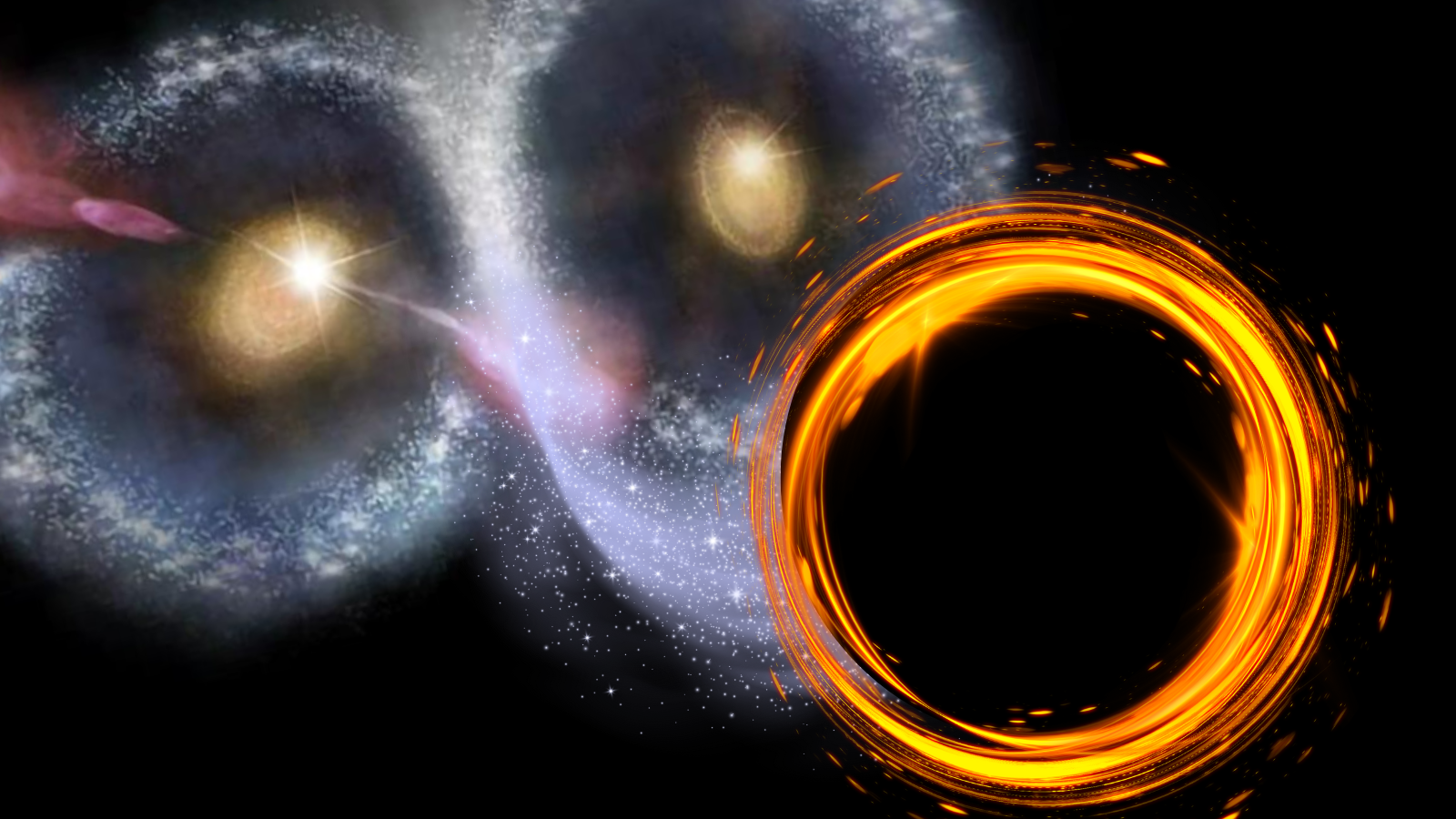
Unleashed Titan: JWST Confirms First 'Runaway' Supermassive Black Hole, Rewriting Cosmic Dynamics
The cosmos, in its infinite grandeur, continues to defy our expectations, revealing phenomena that challenge the very foundations of our understanding. In a truly groundbreaking discovery, the James Webb Space Telescope (JWST) has delivered photographic evidence of what scientists are calling the first confirmed "runaway" supermassive black hole. This colossal entity, a behemoth 10 million times the mass of our sun, is not merely drifting – it's rocketing through space at an astonishing 2.2 million miles per hour, leaving an extraordinary trail of newly formed stars in its wake.
A Cosmic Escape Artist: The Discovery in Detail
Located in the intricate tapestry of what astronomers affectionately term the "Cosmic Owl" galaxies, this rogue black hole presents a spectacle unlike any other observed. Its immense velocity is not merely impressive; it's a testament to the colossal forces required to dislodge such a massive object from its gravitational moorings. Imagine a celestial slingshot, but on an unimaginable scale, propelling a cosmic anchor across the universe.
The detection itself is a marvel of modern astrophysics. Unlike stationary supermassive black holes which lie at the heart of most galaxies, this runaway titan is identified not by its own emissions (as black holes are, by definition, invisible), but by the extraordinary consequences of its hypersonic journey. As it ploughs through the interstellar medium, it creates a turbulent wake, compressing gas and dust. This compression triggers intense star formation, illuminating its path like a cosmic filament – a glowing, ionized gas trail that stretches for hundreds of thousands of light-years, providing direct visual evidence of its trajectory.
Unraveling the Mystery: What Propelled This Behemoth?
The fundamental question reverberating through the astronomical community is: how did this happen? Scientists hypothesize that such an ejection event is likely the result of a catastrophic collision between galaxies. When two galaxies merge, their central supermassive black holes often engage in a cosmic dance, spiraling closer until they coalesce. However, in rare instances involving a triple galaxy merger, the gravitational interplay of three supermassive black holes can lead to one being violently ejected, or "slingshotted," from the newly formed galactic nucleus. The sheer energy involved in such an event is almost incomprehensible, far surpassing any known terrestrial or solar system phenomena.
This particular black hole's escape velocity suggests a past violent interaction, hinting at a dynamic and chaotic early universe where galactic collisions were more frequent and more intense. The absence of a host galaxy at its 'starting' point further supports the theory of a complete gravitational liberation.
Implications for Galactic Evolution and Future Discoveries
The discovery of this runaway black hole is more than just a spectacular astronomical curiosity; it offers invaluable insights into the fundamental processes governing galaxy evolution. Understanding how supermassive black holes interact during mergers is crucial to comprehending how galaxies form, grow, and are structured. This observation provides a direct, albeit extreme, example of these interactions, shedding light on the mechanics of gravitational recoil and the distribution of baryonic matter in the cosmic web.
Furthermore, the glowing trail of star formation offers a unique laboratory for studying star birth in extreme environments, driven not by internal galactic dynamics, but by the sheer force of a passing gravitational titan. It provides a rare glimpse into how external forces can trigger massive stellar nurseries.
The James Webb Space Telescope, with its unparalleled infrared capabilities, was uniquely positioned to make this discovery, piercing through dust and gas to reveal the faint, stretched-out light of the distant star-forming wake. This finding underscores JWST's transformative power, promising many more revelations as it continues to explore the universe's most enigmatic corners.
A Universe Full of Wonders
The concept of a "runaway" supermassive black hole boggles the mind, reminding us of the universe's capacity for the unexpected. It's a testament to the dynamic and often violent nature of cosmic evolution, where even the most fundamental gravitational anchors can be sent hurtling into the void. This discovery opens new avenues of research, pushing the boundaries of what we thought possible and reinforcing the notion that the universe, in all its complexity, still holds countless secrets waiting to be unveiled by the relentless curiosity of humanity.