Published: April 6, 2026
Artemis Crew's Record-Breaking Lunar Fly-by Reveals the Moon's Hidden Palette and Future Frontiers
Credit: NASA
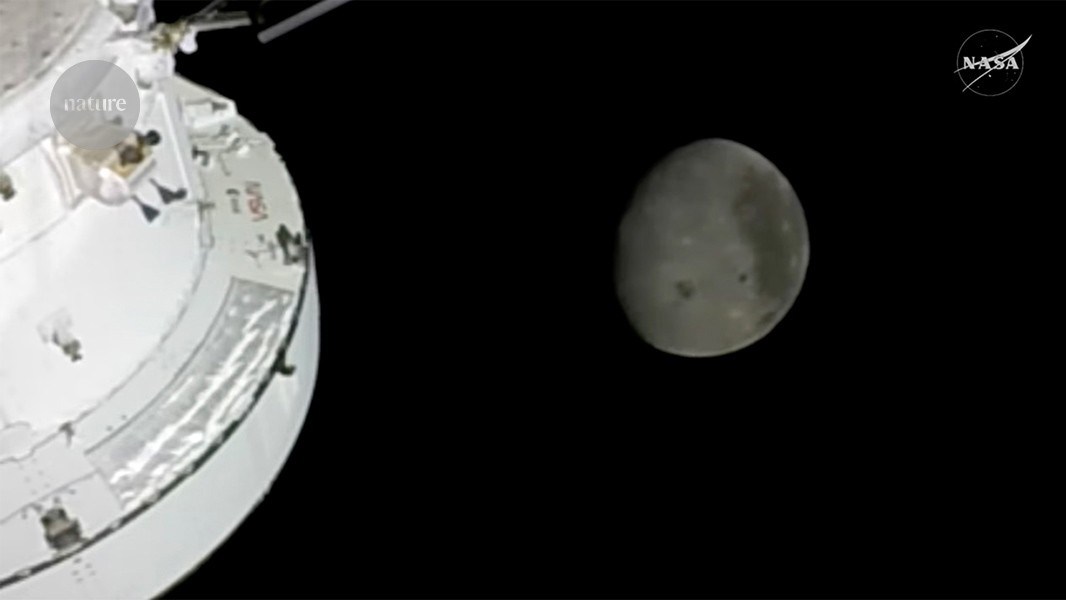
In a monumental leap for human space exploration, the Artemis crew, aboard the Orion capsule, has not only shattered records for the farthest human journey from Earth but has also delivered a tantalizing glimpse of the lunar far side, revealing a spectrum of "intriguing colours" that challenge our current understanding of the Moon's geology. This extraordinary fly-by, observed live from mission control in Houston, marks a pivotal moment in our quest to return to the Moon and beyond, heralding a new era of discovery.
Beyond Earth's Grasp: A New Distance Record
The successful Artemis mission continues to redefine the boundaries of human presence in space. As the Orion capsule arced around the Moon's far side, its crew achieved an unparalleled milestone, venturing hundreds of thousands of kilometers further than any human has ever traveled. This record-breaking distance is not merely a number; it represents the culmination of decades of engineering prowess, astronaut training, and a renewed commitment to deep-space exploration. The journey serves as a critical test of Orion's capabilities, its life support systems, and the resilience of the human spirit in an environment fraught with cosmic challenges. Successfully navigating the profound isolation and radiation belts at such distances provides invaluable data for future long-duration missions to Mars and beyond.
The Moon's Hidden Palette: A Scientific Enigma
Perhaps the most captivating revelation from this historic fly-by came in the form of visual observations from the crew. Transmitted back to Earth, high-resolution imagery and direct accounts from the astronauts detailed "intriguing colours" on the lunar surface, particularly on the enigmatic far side. For generations, our perception of the Moon has largely been a monochromatic one – a world of greys, whites, and blacks. Yet, these new observations hint at a far more complex and geologically diverse landscape than previously assumed. Scientists are now scrambling to interpret these findings, speculating on their potential origins.
The vibrant hues could signify the presence of previously undetected mineral deposits, perhaps indicative of different volcanic activities or hydrothermal processes in the Moon's ancient past. Anomalous colourations might point to concentrations of rare earth elements, vital for advanced technologies, or even water ice trapped within shadowed craters, reflecting light in unexpected ways. Dr. Elena Petrova, a leading lunar geologist observing from Houston, remarked, "These colour variations, if confirmed by subsequent spectral analysis, could completely rewrite our textbooks on lunar formation and evolution. It's like looking at a familiar painting and suddenly seeing new brushstrokes, new depths."
Contextualizing Artemis: Laying the Groundwork for a Lunar Future
This mission is a critical precursor to the broader Artemis program's ultimate goal: establishing a sustainable human presence on the Moon. The data gathered, from the performance of the Orion capsule in deep space to the geological observations made by the crew, directly informs the planning for future lunar landings, the construction of the Gateway lunar orbital outpost, and the eventual development of lunar habitats. Understanding the Moon's resource potential, particularly in areas exhibiting these new colours, could be instrumental in sustaining long-term missions, providing in-situ resources for fuel, water, and building materials.
Future Implications: A Stepping Stone to Mars and Beyond
The journey of the Artemis crew serves as more than just a return to the Moon; it is a foundational step towards Mars and ultimately, interstellar exploration. The experience gained in operating complex spacecraft at extreme distances, mitigating radiation exposure, and living in deep space environments are all vital lessons for the eventual human mission to the Red Planet. Furthermore, if the intriguing lunar colours indeed point to accessible resources, the Moon could become a critical supply depot and testing ground for technologies destined for even more distant worlds. The vision of humanity as a multi-planetary species feels tangibly closer with each successful Artemis milestone.
As the Orion capsule makes its triumphant return, bringing back not just astronauts but a trove of unprecedented data and breathtaking images, the scientific community and the public alike stand on the precipice of a new understanding of our celestial neighbor. The Moon, once thought to be a grey monolith, is now revealing its true, vibrant complexity, promising a future of lunar exploration far richer and more colorful than we ever dared to imagine.