Beyond Limits: NVIDIA's Neural Texture Compression Redefines GPU Memory
In a revelation that sent ripples across the tech world, NVIDIA, during one of its much-anticipated GTC 2026 sessions, unveiled more granular details about its groundbreaking Neural Texture Compression (NTC) technology. This isn't just an incremental upgrade; it's a paradigm shift poised to fundamentally alter how we perceive and utilize Graphics Processing Unit (GPU) VRAM. Initial demonstrations have showcased an astonishing reduction in VRAM usage, slashing requirements by up to seven times, heralding a new era for graphics rendering and AI applications.
The VRAM Bottleneck: A Persistent Challenge
For years, developers and enthusiasts alike have grappled with the ever-present challenge of VRAM limitations. As games and professional applications demand increasingly complex textures, higher resolutions, and more sophisticated rendering techniques like real-time ray tracing, the amount of dedicated memory on graphics cards has become a critical bottleneck. High-resolution textures, especially those encompassing entire environments or intricate character models, can quickly consume gigabytes of VRAM, leading to performance hitches, stuttering, and forcing compromises in visual fidelity. This escalating demand has driven up the cost and complexity of high-end GPUs, making cutting-edge experiences less accessible.
NTC: A Neural Revolution in Data Management
NVIDIA's Neural Texture Compression addresses this challenge head-on, leveraging the power of artificial intelligence to redefine data storage for graphics. Unlike traditional texture compression methods that rely on fixed algorithms and often result in noticeable quality degradation at extreme ratios, NTC employs sophisticated neural networks. These networks are trained to intelligently compress and decompress textures in real-time, preserving an unprecedented level of visual fidelity while drastically reducing the data footprint.
The core innovation lies in the neural network's ability to learn and reconstruct complex visual patterns. Instead of storing every single pixel, NTC can store a highly compressed representation and then use its trained model to infer and reconstruct the original texture data with remarkable accuracy when needed by the GPU. This "smart" compression allows for much higher compression ratios without the typical artifacts associated with aggressive lossy compression.
The Seven-Fold Leap: Real-World Impact
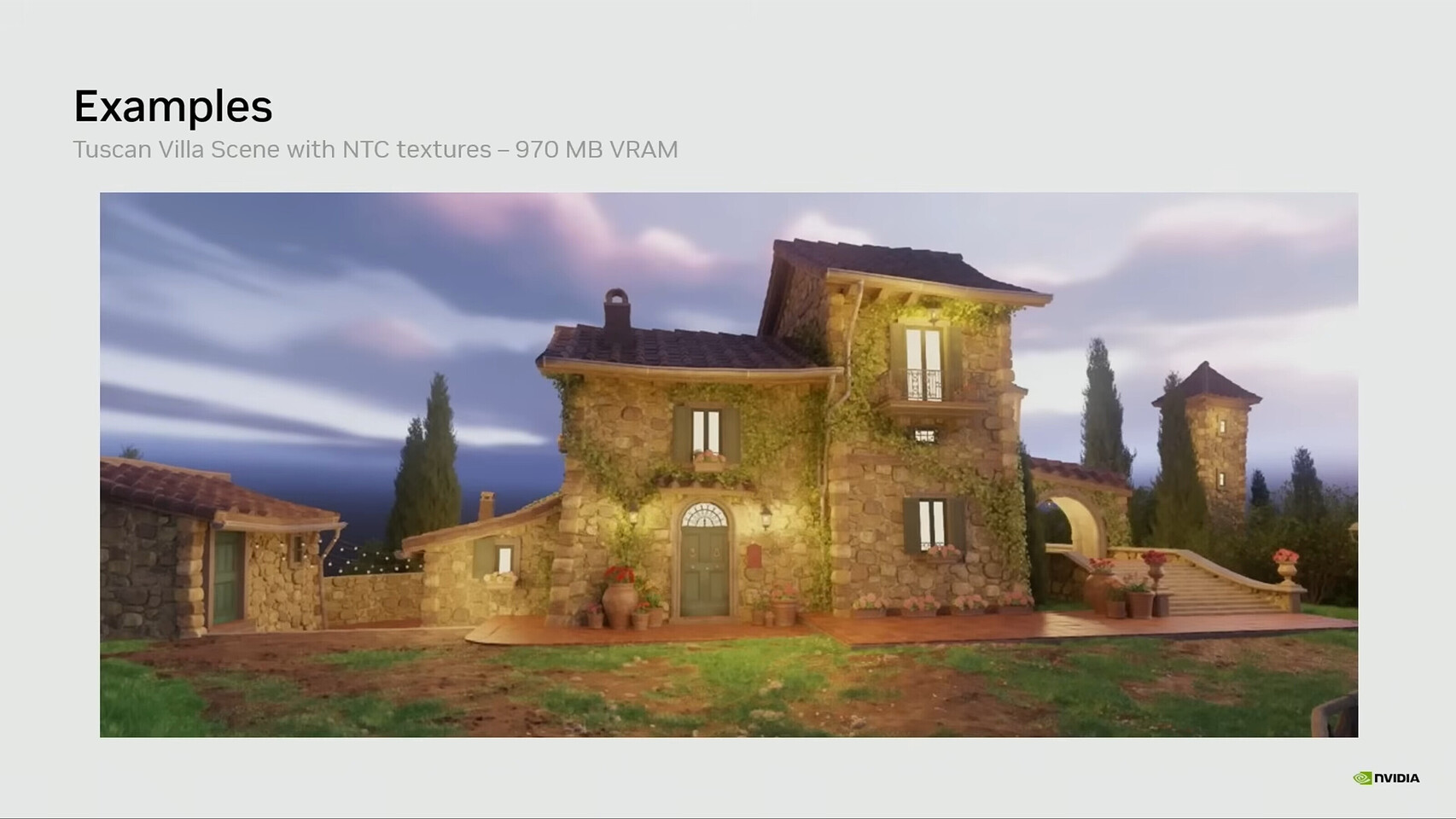
The most compelling aspect of NTC is its demonstrated efficiency. During the GTC 2026 presentation, NVIDIA showcased a technology demo where a scene that previously demanded approximately 6.5 GB of VRAM could be rendered with equivalent visual quality using a mere 970 MB. This astonishing seven-fold reduction is not just a statistical anomaly; it represents a profound leap in resource management.
What does this mean for the end-user and developers?
- Unprecedented Visual Fidelity: Developers can now integrate far more detailed textures, higher-resolution assets, and more complex environments without worrying about VRAM ceilings. This could unlock truly photorealistic graphics in gaming and professional visualizations.
- Enhanced Performance: Less VRAM usage means less data transfer over the memory bus, potentially leading to higher frame rates and smoother gameplay, especially in VRAM-heavy scenarios.
- Democratization of High-End Graphics: Mid-range GPUs with more modest VRAM configurations could suddenly become capable of handling workloads previously exclusive to top-tier cards, making advanced graphics more accessible.
- Future-Proofing: As resolutions like 8K become more common, and emerging technologies like volumetric rendering and advanced virtual reality demand even more resources, NTC provides a critical buffer.
- AI and Professional Applications: Beyond gaming, industries reliant on massive datasets and complex visual models—such as architectural visualization, medical imaging, scientific simulation, and AI model training on visual data—stand to benefit immensely from more efficient memory utilization.
The Road Ahead: Integration and Implications
While the initial demonstrations are incredibly promising, the full implications and integration roadmap for NTC are still unfolding. NVIDIA will likely integrate this technology deep into its future GPU architectures and software development kits (SDKs), providing tools for developers to leverage NTC seamlessly. It raises questions about potential overheads associated with the neural network processing, though NVIDIA's history suggests they will optimize this for negligible impact on performance.
NTC represents more than just a compression technique; it's a testament to the transformative power of AI in hardware design. By intelligently managing one of the most precious resources on a GPU, NVIDIA is not just optimizing; it's redefining the limits of what's possible in real-time graphics. The era of agonizing over VRAM capacity may well be drawing to a close, ushering in a future where visual complexity is limited only by imagination, not memory bandwidth.