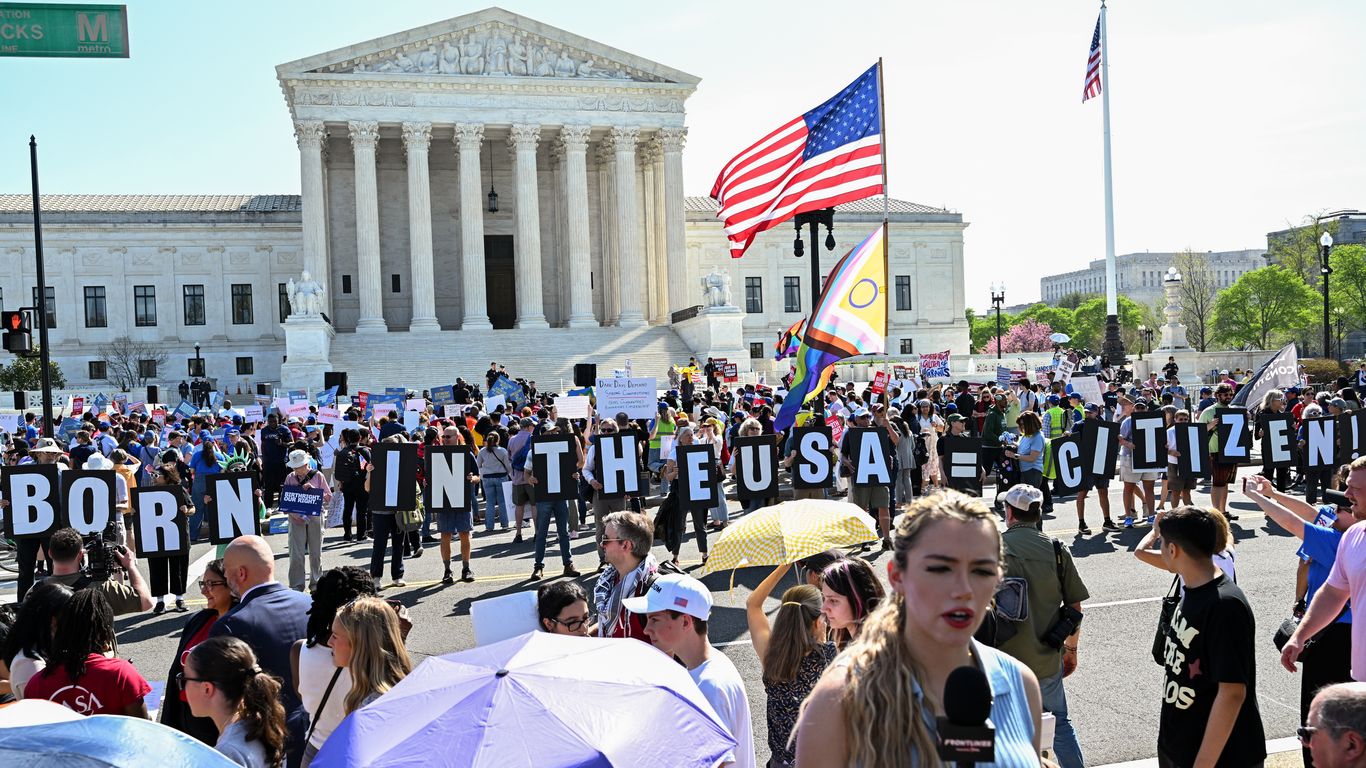
Supreme Skepticism: The High Court's Scrutiny of Trump's Birthright Citizenship Challenge
The hallowed halls of the Supreme Court recently bore witness to a high-stakes legal battle, as justices grappled with the Trump administration's controversial bid to redefine birthright citizenship. What unfolded during over two hours of oral arguments was a rare public display of judicial skepticism, with a majority of justices, including some typically aligned with conservative views, casting significant doubt on the executive order's legal footing. Even former President Trump's unprecedented courtroom appearance couldn't shield his decree from intense scrutiny, raising profound questions about constitutional interpretation, presidential authority, and the future of immigration law in America.
The Fourteenth Amendment at the Crossroads
At the heart of this legal contention lies the Citizenship Clause of the Fourteenth Amendment, ratified in 1868. It unequivocally states: "All persons born or naturalized in the United States, and subject to the jurisdiction thereof, are citizens of the United States and of the State wherein they reside." For over a century and a half, this clause has been widely interpreted to grant citizenship to virtually everyone born on U.S. soil, regardless of their parents' immigration status. This interpretation was solidified by the landmark 1898 Supreme Court case, United States v. Wong Kim Ark, which affirmed birthright citizenship for children born in the U.S. to non-citizens.
The Trump administration, however, sought to challenge this long-standing interpretation, arguing that the phrase "subject to the jurisdiction thereof" excludes children of undocumented immigrants or those on temporary visas, suggesting they are not fully subject to U.S. law. This move was framed as an effort to curb what the administration termed "anchor babies" and to reassert national sovereignty over immigration policy.
Skeptical Stances and Thorny Questions
During the intense oral arguments, justices probed deeply into the historical context and original intent of the Fourteenth Amendment, as well as the practical and legal implications of the administration's proposed reinterpretation. Justice Kavanaugh, often considered a conservative voice, reportedly expressed concerns about overturning established precedent, emphasizing the importance of stare decisis – the principle of adhering to prior rulings. Similarly, Chief Justice Roberts and Justice Barrett reportedly questioned the executive branch's power to unilaterally alter a fundamental aspect of citizenship without congressional action or a constitutional amendment.
The core of the justices' skepticism appeared to stem from several points:
- Constitutional Text: Many struggled with how the administration's interpretation could be reconciled with the plain language of the Citizenship Clause.
- Historical Precedent: The consistent application of birthright citizenship since Wong Kim Ark presented a significant hurdle to the administration's arguments.
- Separation of Powers: A key concern was whether the President possesses the authority to enact such a sweeping change via executive order, rather than through legislative means.
Lawyers for the administration faced rigorous questioning, struggling at times to articulate a compelling argument that didn't appear to contradict decades of legal consensus and historical understanding. The very act of asking the Court to revisit such a foundational principle underscores the administration's aggressive approach to immigration policy.
Implications and the Road Ahead
The Supreme Court's apparent skepticism does not guarantee a specific outcome, but it strongly suggests that the administration's challenge to birthright citizenship faces an uphill battle. A ruling upholding the traditional interpretation would be a significant affirmation of the Fourteenth Amendment's scope and a blow to executive attempts to unilaterally alter established constitutional principles.
Conversely, even a fragmented decision or a narrow ruling that avoids the core constitutional question could still send ripples through immigration law. However, the tone of the oral arguments indicates a reluctance from a broad spectrum of the Court to radically depart from existing precedent. Such a decision would likely reinforce the idea that fundamental changes to citizenship status require either a constitutional amendment or clear legislative action from Congress, rather than executive fiat.
For the millions of individuals who rely on birthright citizenship, and for the broader legal framework governing immigration, the Court's eventual decision will be monumental. It will not only determine the fate of a particular executive order but also send a powerful message about the limits of presidential power and the enduring strength of constitutional guarantees in a politically charged era. The nation now awaits the final word from the nine justices, a decision that will undoubtedly shape the fabric of American society for generations to come.